CTV Measurement 101: Tracking TV Ad Performance Like a Pro
slug: ctv-measurement-attribution-guide · status: draft · score: 76% · 1 versions
View published version → · Contentful entry: YGxc76sqjOiePZpJkO7kP
Validation
| Rule | Detail | |
|---|---|---|
| pass | No banned competitors | No banned competitors |
| pass | No emdashes | No emdashes |
| pass | Avoid AI telltale words | No AI telltale words |
| pass | Primary keyword in title | No primary keyword to check |
| pass | Use contractions | Contractions used |
| fail | Minimum internal links | Internal links not in sitemap: /resources/what-is-connected-tv-advertising, /resources/advertising-effectiveness-measurement, /resources/tv-advertising-for-small-business, /how-it-works, /features |
| fail | FAQ section required | Missing FAQ / 'Common questions answered' section |
| fail | Author assigned | No author assigned (never use 'Adwave Team' for new content) |
| pass | Title length 50-60 | Title length 58 |
| pass | Minimum 4 images | 5 images |
| pass | SEO description under 160 | seoDescription 144 chars |
| pass | Adwave mention cadence | 3 Adwave mentions |
| pass | Short description present | shortDescription 161 chars |
| warn | Word count by type | Word count 2259 below target (2500-5000) |
| warn | Year-dated title for evergreen types | Year-dated type should include (2026) in the title |
| pass | No manual table of contents | No manual TOC |
Images (5)
Content
CTV Measurement 101: Tracking TV Ad Performance Like a Pro
SEO Description: Learn CTV measurement fundamentals including attribution, key metrics, and how to track connected TV ad performance. Understand what CTV can and can't measure for your campaigns.
---
You've heard the pitch: CTV advertising combines the impact of TV with digital-like targeting. But then comes the question that makes marketers hesitate: "How do I actually measure this?"
If you're used to Meta or Google ads where you can track every click and conversion, CTV measurement can feel like stepping into a fog. The good news? CTV measurement has come a long way, and it's not the black box it used to be.
This guide breaks down exactly what you can measure with connected TV advertising, how attribution actually works, and what realistic expectations look like. Let's clear up the confusion.
Key CTV Metrics You Need to Know
Before diving into attribution, let's establish the vocabulary. These are the core metrics you'll see in any CTV campaign report.
Delivery metrics:
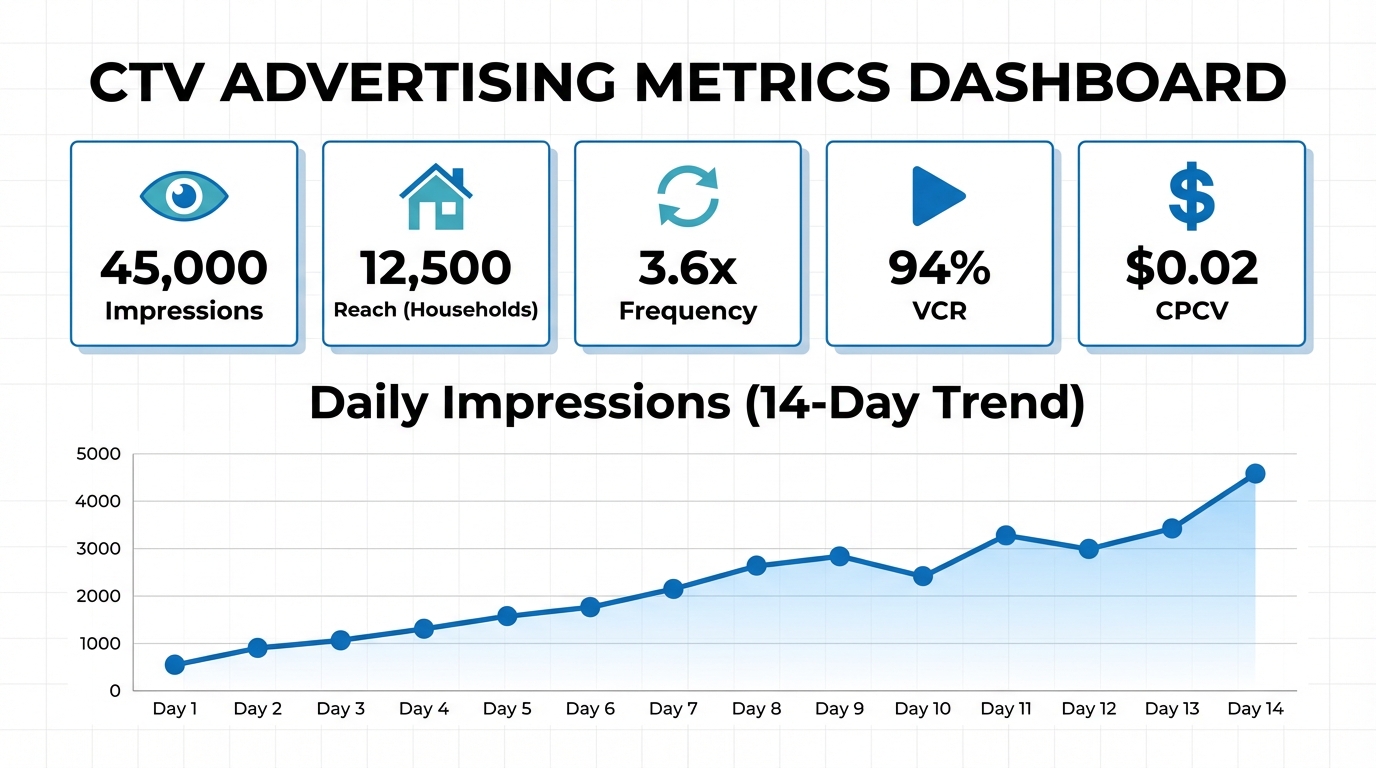
- Impressions: The number of times your ad was served. One impression equals one ad view on one device.
- Reach: The number of unique households or devices that saw your ad. This tells you how many different people you touched.
- Frequency: How many times, on average, each household saw your ad. A frequency of 3 means viewers saw your ad three times on average.
Engagement metrics:
- Video Completion Rate (VCR): The percentage of viewers who watched your entire ad. CTV typically sees 90%+ VCR because viewers can't skip ads like on YouTube.
- Cost Per Completed View (CPCV): Your spend divided by completed views. This tells you what you're actually paying for full attention.
Why these matter: Unlike display or social ads where scroll-past rates are high, CTV delivers full-screen, sound-on, non-skippable exposure. A 95% VCR on CTV is standard. Getting 95% of your Meta audience to watch a full 30-second video would be remarkable.
How CTV Attribution Actually Works
Here's where CTV differs from digital advertising. There's no click. Someone sees your ad on their TV, and then... what? How do you know if it worked?
CTV attribution uses several methods to connect ad exposure to outcomes:
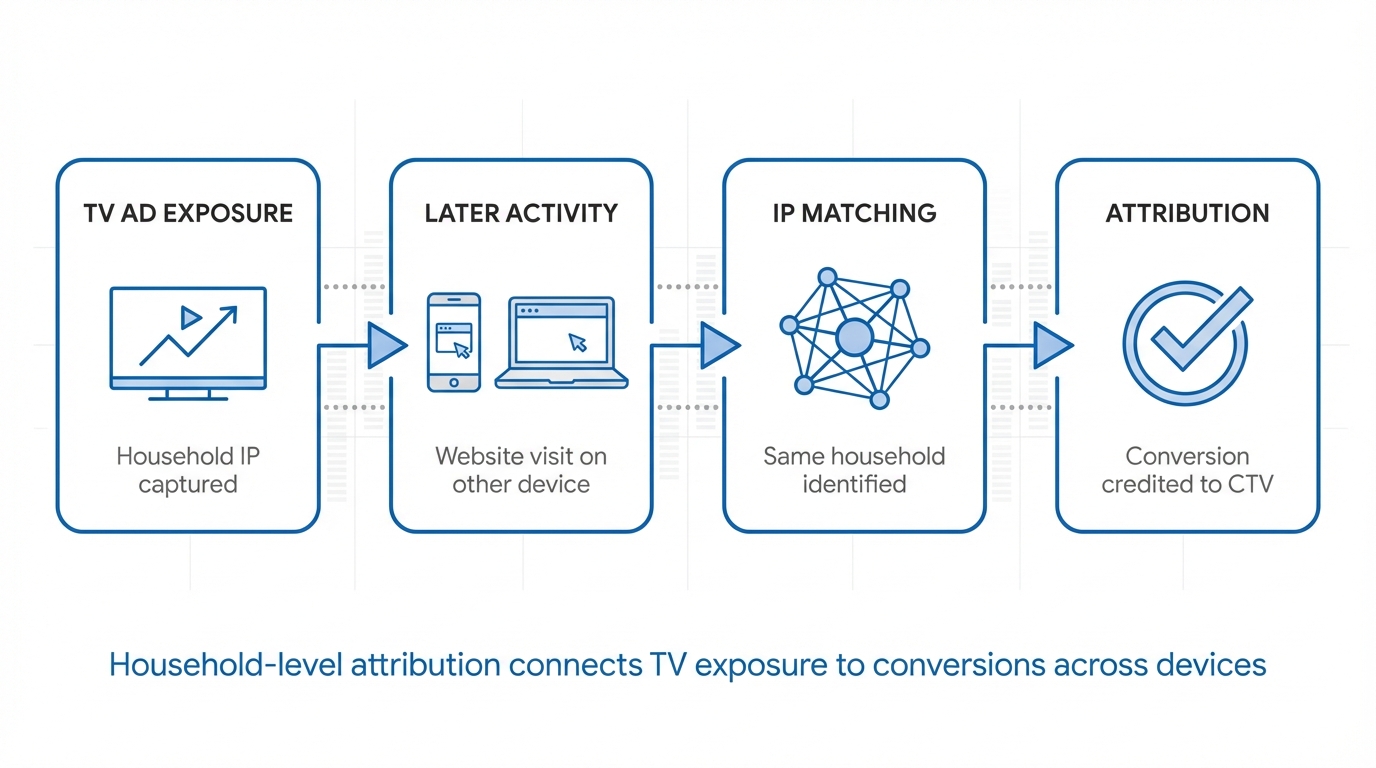
Household IP matching:
When your ad serves to a streaming device, it's associated with that household's IP address. Later, when someone from that household visits your website or takes action on another device (phone, laptop), the system can match that activity back to the ad exposure.
This isn't perfect, but it's surprisingly accurate. Most streaming happens on home networks, and household-level attribution captures the reality that TV influences purchasing decisions made later on other devices.
Device graphs:
Attribution partners maintain databases that link devices within households. Your Roku, your phone, your laptop, and your spouse's tablet can all be connected to the same household profile. When any of those devices converts, it can be attributed to the CTV exposure.
Exposure files:
After your campaign runs, you receive data about which households saw your ads. This can be matched against your customer data or conversion data to measure lift and attribution.
Important caveat: CTV attribution is probabilistic, not deterministic. Unlike a click that creates a direct link, CTV attribution infers connections based on household-level data. It's directionally accurate, but not pixel-perfect like search ads.
Upper-Funnel Metrics: Measuring Brand Impact
CTV advertising excels at brand building, but how do you measure something as fuzzy as "brand awareness"?
Brand lift studies:
These measure the difference in awareness, consideration, or favorability between people who saw your ad and people who didn't. A typical brand lift study might show:
- 15% increase in unaided brand awareness
- 22% increase in ad recall
- 18% increase in consideration
Brand lift studies require larger budgets (typically $10,000+) because you need statistical significance between exposed and control groups. For smaller campaigns, proxy metrics work better.
Proxy metrics for brand impact:
- Branded search volume: Are more people Googling your business name after the campaign started? Google Trends can show this for free.
- Direct traffic: Are you seeing increases in people typing your URL directly?
- Social mentions: Are more people talking about your brand organically?
For most small businesses, watching branded search volume is the most practical way to gauge awareness impact. It's free, easy to track, and directly reflects whether people are remembering your name.
Lower-Funnel Metrics: Tracking Business Results
While CTV is primarily an awareness channel, you can still track its impact on conversions with the right setup.
Website visit attribution:
With a tracking pixel on your site, you can see how many people visited after being exposed to your CTV ad. This isn't the same as a click-through, but it shows downstream behavior.
Typical CTV-to-website visit rates range from 0.5% to 2% of exposed households. That might sound low compared to click-through rates, but remember: these are people who saw a TV ad, then independently navigated to your site later. That's a strong intent signal.
Conversion tracking:
If you can place a pixel on your conversion page (purchase confirmation, lead form thank you, etc.), you can track how many converters were previously exposed to your CTV campaign.
The formula looks like this:
CTV-Attributed Conversions = Converters who were in exposed households
Conversion Rate = CTV-Attributed Conversions ÷ Exposed Households
ROAS calculation:
To calculate return on ad spend for CTV:
CTV ROAS = Revenue from CTV-attributed conversions ÷ CTV ad spend
A coffee shop spending $500 on CTV that sees $2,000 in attributed revenue has a 4:1 ROAS. Not bad for a brand awareness channel.
For detailed guidance on measuring advertising results, see our guide on advertising effectiveness measurement.
The Halo Effect: CTV's Impact on Other Channels
One of the most underappreciated aspects of CTV is how it amplifies your other marketing channels. This "halo effect" often delivers more value than direct CTV conversions.
What typically happens:
- Search performance improves: People who've seen your TV ad are more likely to click your search ads when they see them later. Click-through rates and conversion rates both tend to increase.
- Social ads work harder: Brand familiarity makes your social ads more effective. That Facebook ad isn't a cold introduction anymore.
- Direct response increases: Even channels like email and SMS see lift when recipients have seen your brand on TV.
How to measure the halo effect:
- Compare periods: Look at your other channels' performance before, during, and after CTV campaigns.
- Watch for branded search lift: This is the clearest signal of halo effect.
- Monitor cost-per-acquisition across channels: If your overall CPA drops during CTV flights, that's halo effect at work.
Real-world example:
A local business running TV ads might see their Google Ads click-through rate increase by 15-20% during a CTV campaign, even though the ads themselves didn't change. That's the halo effect: TV exposure primes people to engage with your other marketing.
Setting Up Proper Tracking
To measure CTV effectively, you need some infrastructure in place before your campaign launches.
Basic tracking setup:
- Website pixel: Install your CTV platform's tracking pixel on all pages of your site. This enables visit attribution.
- Conversion pixel: Place a separate pixel on confirmation pages to track completed actions.
- UTM parameters: Use unique UTMs for any QR codes or vanity URLs in your CTV creative.
What you need from your CTV platform:
- Exposure reports (which households saw your ads)
- Visit attribution data
- Conversion attribution (if pixel is installed)
- Geographic breakdowns
With Adwave, the dashboard provides real-time tracking of impressions, geographic reach, and which channels your ads ran on. For small businesses, this level of visibility was previously only available to brands spending six figures.
Attribution windows:
CTV attribution typically uses 7-day or 14-day windows. This means a conversion is attributed to CTV if the household was exposed within that timeframe. Longer windows capture more conversions but may include activity that wasn't influenced by your ad.
For most campaigns, a 7-day window strikes the right balance between capturing true impact and avoiding over-attribution.
What CTV Can't Tell You (Honest Limitations)
Let's be honest about what CTV measurement can't do. Setting realistic expectations prevents disappointment.
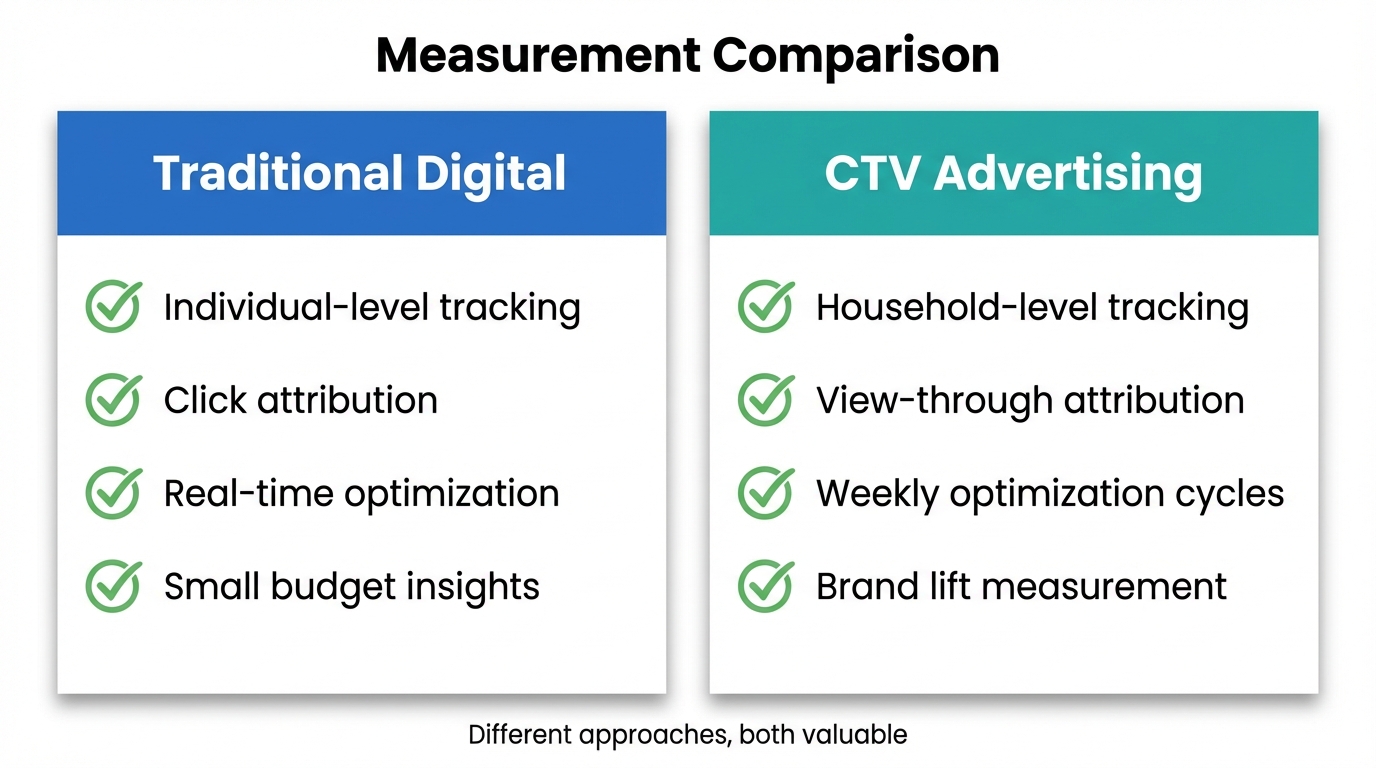
Individual-level tracking:
CTV works at the household level, not the individual level. You know a household saw your ad and later converted, but you don't know which person in that household took action. For most purposes, this doesn't matter, but it's different from digital advertising.
View-through vs. true influence:
Attribution shows correlation, not necessarily causation. If someone was already planning to buy from you and happened to see your ad first, the conversion gets attributed to CTV. Some attribution is coincidental rather than causal.
Real-time optimization:
Unlike search or social where you can adjust bids and targeting hourly based on results, CTV optimization happens more slowly. You typically need a week or more of data before making meaningful adjustments.
Small budget limitations:
With budgets under $500, you might not have enough data for statistically significant measurement. You can still track directionally, but be cautious about drawing conclusions from small sample sizes.
Cross-device gaps:
While device graphs have improved, they're not perfect. Some household members might not be linked. Some conversions will go unattributed even when CTV influenced them.
Understanding these limitations helps you interpret your data correctly. CTV measurement is good and getting better, but it's not click-level precise.
Reading Your CTV Reports
When you log into your CTV dashboard, here's how to interpret what you see.
What "good" looks like:
- VCR above 90%: This is standard for CTV. Below 85% might indicate creative issues.
- Frequency between 2-5: Lower means you're reaching new people; higher means you're reinforcing with existing viewers. Both can be strategic depending on goals.
- CPM in your target range: For small business campaigns through platforms like Adwave, expect CPMs of $15-35. Premium inventory or tight targeting may push higher.
Red flags to watch:
- VCR below 80%: Something's wrong with your creative or targeting.
- Frequency above 7: You're likely over-saturating your audience.
- Zero conversions with significant spend: Check your tracking setup before assuming the campaign failed.
Questions to ask your data:
- Which geographies are performing best?
- What time of day generates the most exposure?
- Is frequency building appropriately over time?
- Are attributed conversions increasing week over week?
The goal isn't perfect data. It's directional insight that helps you improve over time.
Ready to Measure Your TV Advertising?
CTV measurement isn't the mystery it once was. With household-level attribution, brand lift metrics, and cross-channel halo effects, you can understand what your TV investment is delivering.
The key is setting appropriate expectations. CTV primarily builds awareness and consideration. Direct conversions happen, but the bigger value is often in how TV makes all your other marketing more effective.
Adwave's dashboard makes CTV measurement accessible for businesses of any size. Track impressions, see where your ads ran, monitor geographic reach, and understand your campaign's performance without needing an analytics team.
Start with a test campaign, set up proper tracking, and let the data guide your optimization. TV advertising is now measurable enough for even the most data-driven marketer.
Version history
| Version | When | Summary |
|---|---|---|
| v1 | 6/20/2026, 3:11:54 AM | migration import |