TV Advertising for Medical Practices: The HIPAA-Compliant Marketing Guide
slug: tv-advertising-medical-practices-guide · status: draft · score: 69% · 1 versions
View published version → · Contentful entry: 35lDbxDCnbHpL2HUMCTTyI
Validation
| Rule | Detail | |
|---|---|---|
| pass | No banned competitors | No banned competitors |
| pass | No emdashes | No emdashes |
| warn | Avoid AI telltale words | AI telltale words found: landscape |
| pass | Primary keyword in title | No primary keyword to check |
| pass | Use contractions | Contractions used |
| fail | Minimum internal links | Internal links not in sitemap: /how-it-works, /resources/what-is-connected-tv-advertising, /industries/health-and-wellness, /success-stories, /how-it-works, /try-free, /industries/health-and-wellness, /resources/what-is-connected-tv-advertising, /resources/local-tv-advertising-costs, /how-it-works |
| fail | FAQ section required | Missing FAQ / 'Common questions answered' section |
| fail | Author assigned | No author assigned (never use 'Adwave Team' for new content) |
| warn | Title length 50-60 | Title length 73 (aim 50-60 chars) |
| pass | Minimum 4 images | 4 images |
| warn | SEO description under 160 | seoDescription 166 chars (keep under 160) |
| pass | Adwave mention cadence | 3 Adwave mentions |
| pass | Short description present | shortDescription 202 chars |
| warn | Word count by type | Word count 1916 below target (2500-5000) |
| warn | Year-dated title for evergreen types | Year-dated type should include (2026) in the title |
| pass | No manual table of contents | No manual TOC |
Images (4)

Content
TV Advertising for Medical Practices: The HIPAA-Compliant Marketing Guide
SEO Description: Learn how medical practices can use TV advertising to reach new patients while staying compliant. Covers HIPAA considerations, targeting strategies, and creative best practices for healthcare marketing.
---
TV advertising has helped medical practices reach new patients for decades. But in an era of HIPAA compliance, digital health data concerns, and evolving advertising regulations, many healthcare providers hesitate to explore this channel.
Here's the good news: TV advertising for medical practices can be done ethically, compliantly, and effectively. This guide covers everything you need to know about growing your practice through television while respecting patient privacy and professional standards.
Important Note: This guide provides general marketing guidance. Always consult with your compliance officer and legal counsel for advice specific to your practice, specialty, and state regulations.
Regulatory Considerations for Medical Advertising
Before launching any TV campaign, understand the regulatory landscape. Medical advertising isn't like advertising a restaurant or retail store.
HIPAA and Patient Privacy
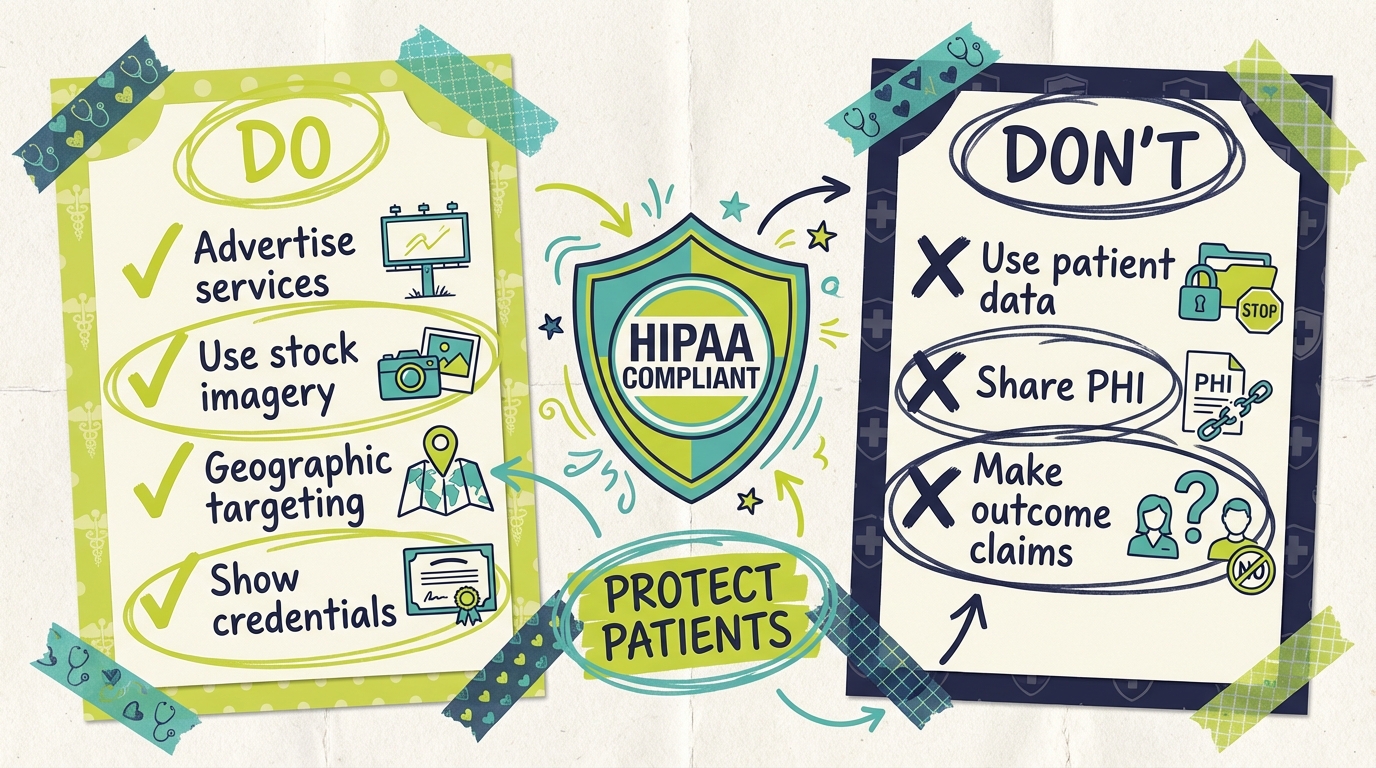
The Health Insurance Portability and Accountability Act (HIPAA) doesn't prohibit advertising, but it does restrict how you can use patient information:
What you CAN do:
- Advertise your services, specialties, and credentials
- Use stock imagery or hired actors in commercials
- Share general patient testimonials (with written authorization)
- Target audiences by geography, demographics, and interests
What you CANNOT do:
- Use patient information to target ads without explicit authorization
- Show identifiable patients without written HIPAA-compliant authorization
- Make claims about specific patient outcomes without proper documentation
- Access or use protected health information (PHI) for marketing purposes
State Medical Board Regulations
Beyond HIPAA, your state medical board likely has advertising rules:
- Truthfulness requirements: Claims must be accurate and verifiable
- Credential display: Requirements for showing board certifications
- Disclaimer requirements: Some states require specific disclosures
- Specialty restrictions: Rules about advertising specialties you're not board-certified in
Check your state medical board's advertising guidelines before creating any campaign.
FDA Considerations
If you're advertising specific treatments, devices, or pharmaceuticals, FDA regulations may apply. This is particularly relevant for practices offering:
- Cosmetic procedures
- Medical devices
- Off-label treatments
- Weight loss programs
When in doubt, have your compliance team review creative before launch.
Which Medical Practices Benefit Most from TV?
TV advertising works particularly well for certain types of medical practices:
High-Consideration Services
Patients research extensively before choosing providers for:
- Elective surgeries and cosmetic procedures
- Specialty care (oncology, cardiology, orthopedics)
- Long-term treatment relationships (primary care, pediatrics)
- Dental implants and cosmetic dentistry
TV builds the trust and familiarity patients need to choose your practice for these decisions.
Local-Focused Practices
Practices serving a defined geographic area benefit from local TV targeting:
- Community hospitals and urgent care centers
- Family medicine and pediatric practices
- Dental and orthodontic offices
- Physical therapy and rehabilitation centers
New Market Entrants
TV accelerates awareness for:
- New practice locations
- Physicians joining established groups
- Practices expanding into new specialties
- Healthcare systems entering new markets
Targeting Potential Patients (Without Health Data)
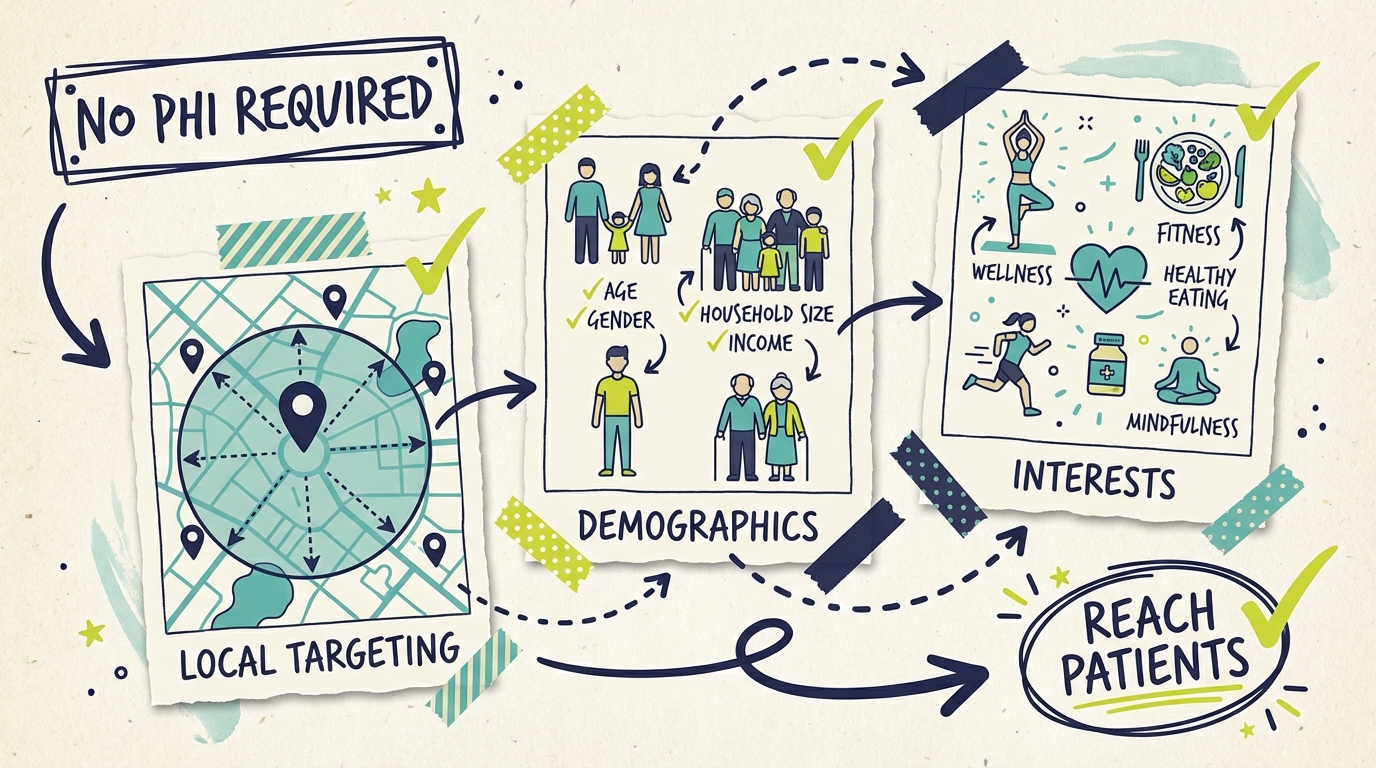
Here's where TV advertising actually has an advantage over digital: you don't need sensitive health data to reach potential patients effectively.
Geographic Targeting
The simplest and most effective approach:
- Radius targeting: Reach households within X miles of your practice
- ZIP code targeting: Focus on specific communities
- DMA targeting: Cover broader metro areas for specialty services
Most patients choose providers close to home or work. Geography naturally filters your audience to relevant prospects.
Demographic Targeting
Reach likely patients based on:
- Age: Pediatrics targets families with children; geriatrics targets older adults
- Household income: Relevant for elective and cosmetic procedures
- Homeownership: Often correlates with insurance stability and healthcare utilization
Interest-Based Targeting
CTV platforms can target viewers based on content preferences:
- Health and wellness content viewers
- Fitness enthusiasts (for sports medicine, physical therapy)
- Parents (for pediatric services)
- Home improvement viewers (often correlates with established households)
None of this requires protected health information. You're reaching people based on where they live and what they watch, not their medical history.
Creating Trust-Building Medical Commercials
Medical advertising has one primary job: building trust. Patients need to feel confident choosing your practice for their healthcare needs.
Lead with Credentials
Your qualifications matter. Include:
- Board certifications
- Years of experience
- Hospital affiliations
- Notable training or fellowships
- Awards and recognitions
Don't bury these at the end. Credentials establish authority immediately.
Show Your Team and Facility
Patients want to know what to expect. Show:
- Your physicians and staff (friendly, professional)
- Your facility (clean, modern, welcoming)
- Your equipment (when relevant to your specialty)
- Your waiting areas and patient spaces
Familiarity reduces anxiety about visiting a new practice.
Focus on Patient Experience
Beyond clinical excellence, emphasize:
- Appointment availability and convenience
- Insurance acceptance and payment options
- Communication style (patient-centered, accessible)
- Support services (scheduling, follow-up care)
Patients choose practices they believe will treat them well as people, not just as cases.
Use Testimonials Carefully
Patient testimonials can be powerful but require careful handling:
- Get written, HIPAA-compliant authorization
- Don't make outcome promises based on individual cases
- Include appropriate disclaimers
- Consider using general sentiment rather than specific medical details
Some practices avoid testimonials entirely to eliminate compliance risk. Others use them effectively with proper authorizations and disclaimers.
Geographic Targeting Strategies
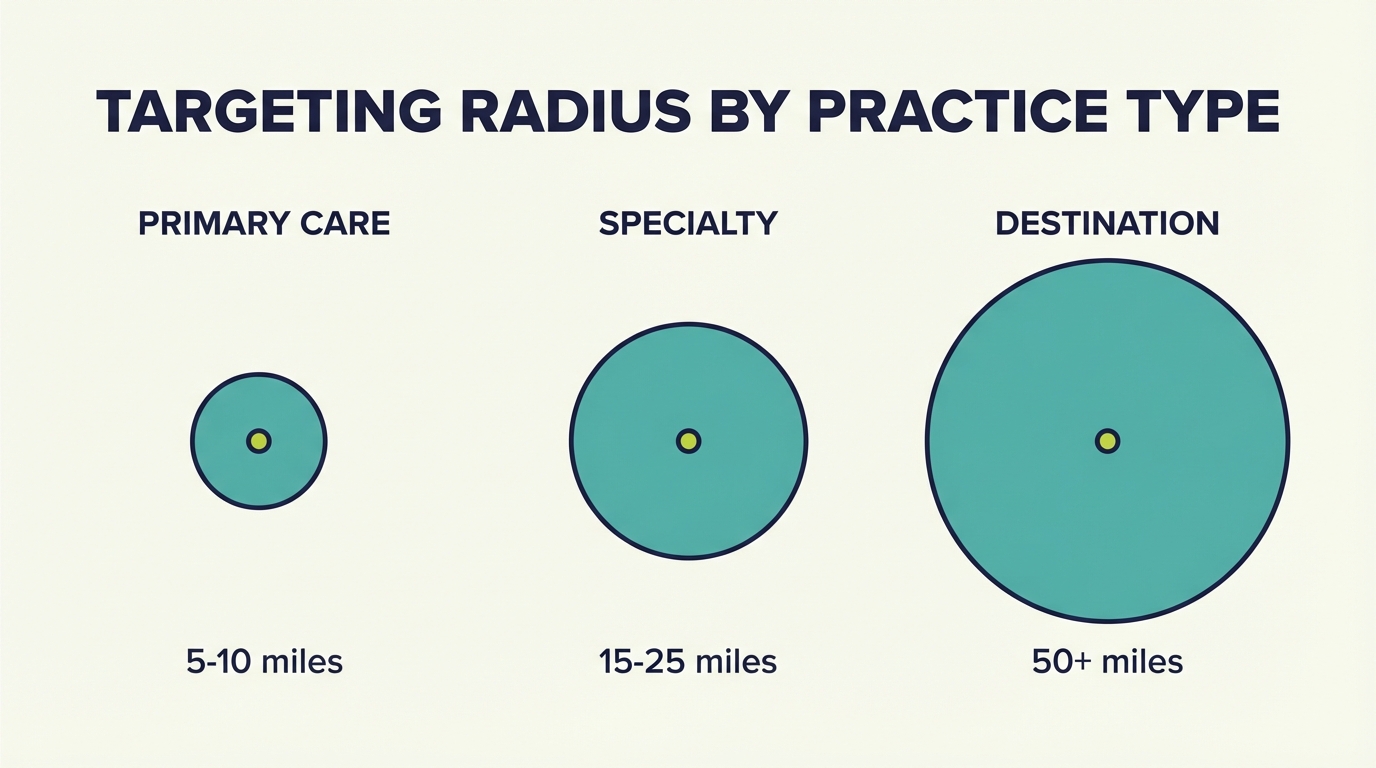
Different practice types need different geographic approaches:
Primary Care and General Practice
Target radius: 5-10 miles
Patients want primary care close to home. Focus tightly on your immediate community.
Specialty Services
Target radius: 15-25 miles
Patients travel farther for specialists. Expand your radius but stay within reasonable drive times.
Destination Services
Target radius: 50+ miles or regional
For rare specialties, complex procedures, or centers of excellence, patients travel significant distances. Target broader regions.
Multi-Location Practices
Run separate campaigns for each location with appropriate targeting radii, or create campaigns targeting multiple ZIP codes around all locations.
Specialty-Specific Strategies
Different medical specialties have unique advertising considerations:
Dental Practices
- Emphasize cosmetic results (smiles sell)
- Highlight family-friendly services
- Mention sedation options for anxious patients
- Promote new patient specials (cleanings, exams)
See our dental advertising guide for more details.
Dermatology
- Show before/after results for cosmetic services (with proper consent)
- Distinguish medical vs. cosmetic services
- Highlight same-day appointments for urgent concerns
- Emphasize board certification (many medical spas aren't dermatologist-owned)
Orthopedics and Sports Medicine
- Target active lifestyle demographics
- Show return-to-activity outcomes
- Emphasize minimally invasive options
- Partner with local sports teams or fitness facilities for credibility
Urgent Care
- Emphasize convenience (hours, wait times, walk-ins)
- Highlight services offered (X-ray, labs, etc.)
- Compare favorably to ER wait times and costs
- Target based on proximity (patients choose the closest option)
Cosmetic and Plastic Surgery
- Lead with credentials (board certification is critical)
- Show natural-looking results
- Emphasize consultation process
- Consider longer consideration cycles (retarget over time)
Measuring Patient Acquisition from TV
Healthcare marketing measurement has unique challenges, but tracking is still possible:
Ask Every Patient
The simplest approach: ask how they heard about you.
- Add "How did you hear about us?" to intake forms
- Train front desk staff to ask
- Track responses systematically
- Note when patients mention "seeing you on TV"
Monitor Appointment Requests
Look for increases in:
- New patient appointments
- Calls during and after campaign flights
- Website traffic and online appointment requests
- Specific service inquiries mentioned in ads
Track Brand Searches
Use Google Trends or your website analytics to monitor:
- Searches for your practice name
- Searches for "practice name + city"
- Direct website visits (people typing your URL)
Increases during campaigns indicate TV is driving awareness.
Calculate Acquisition Costs
Even with imperfect attribution:
TV spend ÷ New patients during campaign = Cost per acquisition estimate
Compare this to other patient acquisition channels. Many practices find TV competitive with or better than digital advertising for new patient acquisition.
Real Results from Medical Practice TV Advertising
Medical practices using TV advertising consistently report:
Awareness and recognition:
- Patients arriving already familiar with the practice
- Reduced new patient anxiety
- Increased referrals (people mention practices they've seen advertised)
Volume increases:
- More new patient appointments
- Higher consultation requests for elective services
- Improved schedule utilization
Competitive positioning:
- Differentiation from practices that don't advertise
- Premium perception from TV presence
- Community visibility and trust
The Kaimuki Dental case study shows how even small practices can use TV effectively to grow.
Getting Started with Medical Practice TV Advertising
Ready to explore TV for your practice? Here's your path forward:
1. Consult Your Compliance Team
Before creating any advertising:
- Review state medical board guidelines
- Confirm HIPAA-compliant processes for any patient content
- Get legal review of planned messaging
- Establish approval workflows
2. Define Your Goals
What does success look like?
- New patient volume targets
- Specific service line growth
- New location awareness
- Recruitment support
3. Create Compliant Creative
Adwave's AI can generate professional medical practice commercials from your website, but you'll want to:
- Review all content for compliance
- Ensure credentials are accurately displayed
- Add required disclaimers
- Get final approval before launch
4. Set Appropriate Targeting
Work with your platform to target:
- Your service area geography
- Relevant demographics for your specialty
- Appropriate interest categories
5. Launch and Monitor
Start with a test budget, monitor results, and scale what works.
Grow Your Practice the Right Way
TV advertising for medical practices requires more care than advertising for other industries, but the fundamentals are the same: reach the right people, build trust, and give them a reason to choose you.
With proper attention to compliance and a focus on patient-centered messaging, TV can be one of your most effective patient acquisition channels.
Create your medical practice TV ad and see what compliant, effective healthcare marketing looks like. Adwave's platform makes it easy to reach local patients on premium streaming channels, starting at just $50.
---
Related Resources:
Version history
| Version | When | Summary |
|---|---|---|
| v1 | 6/20/2026, 3:11:54 AM | migration import |