Best Advertising for Law Firms: What Actually Works
slug: best-advertising-law-firms · status: draft · score: 80% · 1 versions
View published version → · Contentful entry: 5nlce5X3RIIFbYY5SKwWz3
Validation
| Rule | Detail | |
|---|---|---|
| pass | No banned competitors | No banned competitors |
| pass | No emdashes | No emdashes |
| warn | Avoid AI telltale words | AI telltale words found: landscape |
| pass | Primary keyword in title | No primary keyword to check |
| pass | Use contractions | Contractions used |
| fail | Minimum internal links | Internal links not in sitemap: /resources/why-customers-trust-tv-brands, /resources/what-is-connected-tv-advertising, /how-it-works, /pricing, /try-free, /try-free |
| pass | FAQ section required | FAQ section present |
| fail | Author assigned | No author assigned (never use 'Adwave Team' for new content) |
| pass | Title length 50-60 | Title length 51 |
| pass | Minimum 4 images | 4 images |
| warn | SEO description under 160 | seoDescription 161 chars (keep under 160) |
| pass | Adwave mention cadence | 1 Adwave mentions |
| pass | Short description present | shortDescription 159 chars |
| pass | Word count by type | Word count 2618 within target |
| warn | Year-dated title for evergreen types | Year-dated type should include (2026) in the title |
| pass | No manual table of contents | No manual TOC |
Images (4)

Content
Best Advertising for Law Firms: What Actually Works
Law firms face a unique advertising challenge. Legal services are high-stakes purchases that people hope they never need. When someone does need a lawyer, they want the best, but they often have no idea how to evaluate quality. They search online, ask friends, and ultimately choose based on a combination of reputation, recognition, and gut feeling.
This reality shapes what works in legal advertising. The flashiest ad doesn't win. The firm that builds trust, demonstrates expertise, and stays visible during the long consideration period wins. Understanding this dynamic is essential before spending a dollar on marketing.
This guide compares the advertising channels available to law firms, examining what works, what doesn't, and how to build a marketing approach that generates quality clients for your practice.
Understanding Legal Client Acquisition
Before evaluating advertising options, understand how people actually choose lawyers.
The Legal Decision Process
High stakes create careful research. Legal matters involve significant money, freedom, or family. People don't hire lawyers impulsively. They research, compare, and deliberate before making contact.
Trust outweighs everything. When facing legal issues, people feel vulnerable. They want lawyers they can trust with sensitive information and important outcomes. Advertising must build trust, not just awareness.
Timing is unpredictable. People don't plan to need lawyers. Car accidents, divorces, criminal charges, and business disputes arise unexpectedly. Firms must be visible before the need arises to be remembered when it does.
Referrals carry weight. Despite all advertising, personal referrals remain powerful. People trust recommendations from friends, family, and other professionals. Advertising can amplify referral effectiveness by making firm names recognizable.
Practice Area Differences
Personal injury operates differently than estate planning. High-volume practice areas like personal injury see intense advertising competition. Specialized areas may have less competition but smaller addressable markets.
Consumer versus business clients. Individual consumers respond to different messaging than business decision-makers. B2B legal services often require relationship-building approaches beyond advertising.
Urgency varies by practice. Criminal defense clients need immediate help. Estate planning clients may consider options for months. Match advertising approaches to client decision timelines.
Television Advertising for Law Firms
Television has long been a dominant channel for legal advertising, and for good reason.
Why TV Works for Law Firms
Credibility through presence. Appearing on television signals success and stability. A firm that advertises on TV seems established and capable of handling important matters.
Emotional connection. Legal decisions are emotional. Television's combination of visuals, sound, and storytelling creates emotional resonance that text-based advertising cannot match.
Broad reach builds awareness. Television reaches people before they need lawyers. When legal issues arise, advertised firms come to mind first.
Competitive presence. In competitive practice areas, television presence is often table stakes. Firms that don't advertise on TV cede visibility to those that do.
Streaming TV Advantages
Streaming TV advertising offers capabilities that traditional broadcast cannot match.
Geographic targeting. Target specific counties or ZIP codes matching your service area. Avoid paying for impressions in areas you don't serve.
Demographic precision. Reach specific demographics more likely to need your services. Target homeowners for estate planning, business owners for commercial litigation, or specific age groups for relevant practice areas.
Frequency management. Control how often individuals see your ads, ensuring sufficient exposure without wasteful over-delivery.
Cost efficiency. Streaming often delivers better cost-per-impression than broadcast, especially for firms targeting specific geographic areas or demographics.
Getting Started With TV
Adwave's platform makes television advertising accessible for firms of all sizes. AI creates professional commercials from your existing website, and campaigns launch within 24 hours starting at just $50.
See pricing details or create your first ad free.
Search Engine Advertising
When someone searches "personal injury lawyer near me," appearing at the top delivers immediate visibility to high-intent prospects.
Pay-Per-Click Advertising
Captures active searchers. Search ads reach people actively looking for legal help. These are high-intent prospects ready to hire.
Immediate visibility. Unlike SEO, which takes months to build, paid search delivers instant visibility for competitive keywords.
Measurable results. Track exactly which keywords generate inquiries and clients. Optimize spending based on actual performance.
Budget control. Set daily budgets and adjust spending based on results. Scale up what works, cut what doesn't.
Search Advertising Challenges
Expensive competition. Legal keywords are among the most expensive in paid search. "Personal injury lawyer" can cost $100+ per click in competitive markets.
Click fraud concerns. Competitors or click farms can drain budgets with fraudulent clicks. Monitoring and fraud prevention require ongoing attention.
Conversion optimization required. Paying for clicks means nothing if your website doesn't convert visitors to inquiries. Landing page quality determines ROI.
Ongoing management needed. Effective search campaigns require continuous optimization. Set-it-and-forget-it approaches waste money.
Local Service Ads
Google's Local Service Ads appear above traditional search ads for legal queries.
Pay per lead, not click. You pay only when potential clients contact you, reducing wasted spend on non-converting clicks.
Google Screened badge. Verification process adds credibility signal that builds trust with searchers.
Limited control. Less ability to customize messaging compared to traditional search ads.
Search Engine Optimization
Organic search visibility provides long-term, sustainable client acquisition when executed properly.
SEO Benefits for Law Firms
Compounding returns. Content and authority built over time continue generating visibility. Unlike ads that stop when spending stops, SEO builds lasting assets.
Credibility through ranking. High organic rankings signal authority and relevance. Many searchers trust organic results more than ads.
Full-funnel coverage. SEO can target informational queries (people researching legal topics) and transactional queries (people ready to hire).
Cost efficiency at scale. Once rankings are achieved, cost per acquisition often beats paid channels.
SEO Challenges
Takes time. Meaningful rankings require months of consistent effort. Firms needing immediate results can't rely solely on SEO.
Requires expertise. Effective legal SEO demands understanding of both search algorithms and legal marketing regulations. Amateur efforts often fail or backfire.
Competitive landscape. In major markets, competing against established firms with years of SEO investment is difficult. Newer firms face uphill battles.
Algorithm volatility. Search engine updates can disrupt rankings. Strategies that work today may not work tomorrow.
Content Marketing
Content marketing supports SEO while establishing thought leadership.
Educational content attracts prospects. Articles answering common legal questions attract people researching their situations. Some become clients.
Demonstrates expertise. Quality content showcases your knowledge and approach, helping prospects evaluate your firm before making contact.
Supports other channels. Content provides material for social media, email, and other marketing efforts. Investment pays dividends across channels.
Social Media Marketing
Social media offers opportunities for law firms, though with important limitations.
Organic Social Media
Thought leadership positioning. LinkedIn particularly allows attorneys to establish expertise through articles, comments, and professional engagement.
Referral network maintenance. Social platforms help maintain relationships with referral sources who might not interact otherwise.
Community engagement. Local firms can build community presence through relevant engagement on community-focused platforms.
Limited direct acquisition. Few people hire lawyers directly from social media posts. Organic social supports awareness but rarely drives immediate conversions.
Paid Social Advertising
Demographic targeting. Social platforms offer detailed demographic targeting unavailable in other channels.
Retargeting capabilities. Reach people who visited your website but didn't convert, staying visible during their decision process.
Brand awareness efficiently. Social ads can build awareness at lower costs than traditional media, though conversion rates are typically lower.
Platform limitations. Some social platforms restrict legal advertising or require special verification. Policies change frequently.
Traditional Advertising Channels
Traditional media still plays a role for some law firms.
Radio Advertising
Local reach. Radio reaches local audiences during commutes and throughout the day.
Frequency building. Radio's lower costs allow for high frequency that builds recognition.
Limited targeting. Less ability to target specific demographics compared to digital channels.
Audio-only limitation. Complex legal messages can be difficult to convey without visuals.
Print Advertising
Declining readership. Newspaper and magazine readership continues falling, limiting reach.
Specific audiences. Trade publications and specialty magazines may reach valuable niche audiences.
Longevity. Print materials persist longer than digital impressions.
Difficult measurement. Tracking print advertising effectiveness is challenging.
Billboards and Outdoor
High visibility. Billboards provide constant presence in high-traffic areas.
Brand awareness. Outdoor advertising builds recognition through repeated exposure.
Limited messaging. Complex value propositions don't fit billboard formats.
Expensive in prime locations. Premium placements in major markets command premium prices.
Referral Marketing
While not advertising per se, referral development deserves consideration alongside paid channels.
Professional Referrals
Other attorneys. Lawyers who don't handle your practice areas may refer clients to you.
Accountants and financial advisors. These professionals encounter clients with legal needs.
Healthcare providers. Doctors and therapists often know patients dealing with legal matters.
Client Referrals
Satisfied clients refer friends. Delivering excellent service generates referrals organically.
Ask systematically. Many satisfied clients would refer but aren't asked. Systematic referral requests increase volume.
Make referral easy. Provide simple ways for clients to refer and thank them when they do.
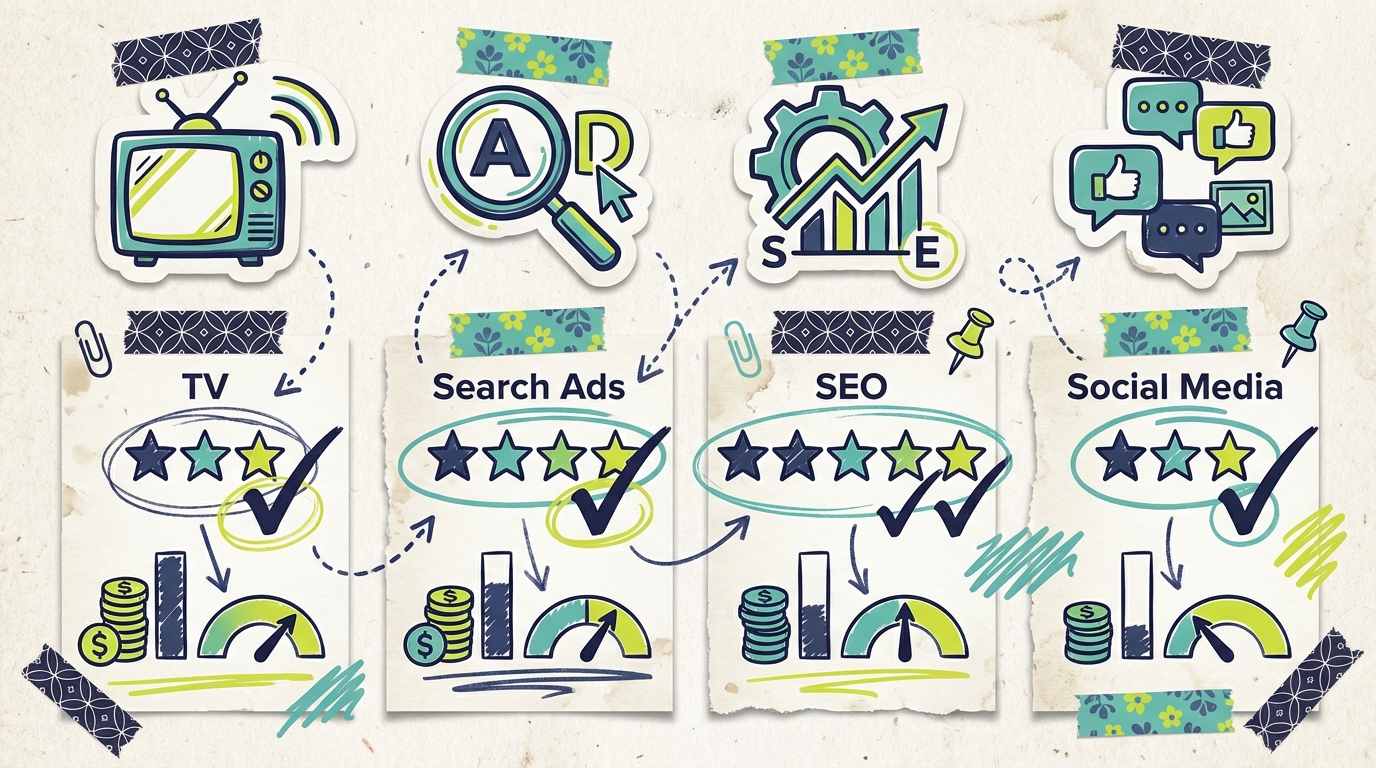
Comparing Advertising Channels
Different channels serve different purposes in legal marketing.
Building an Integrated Approach
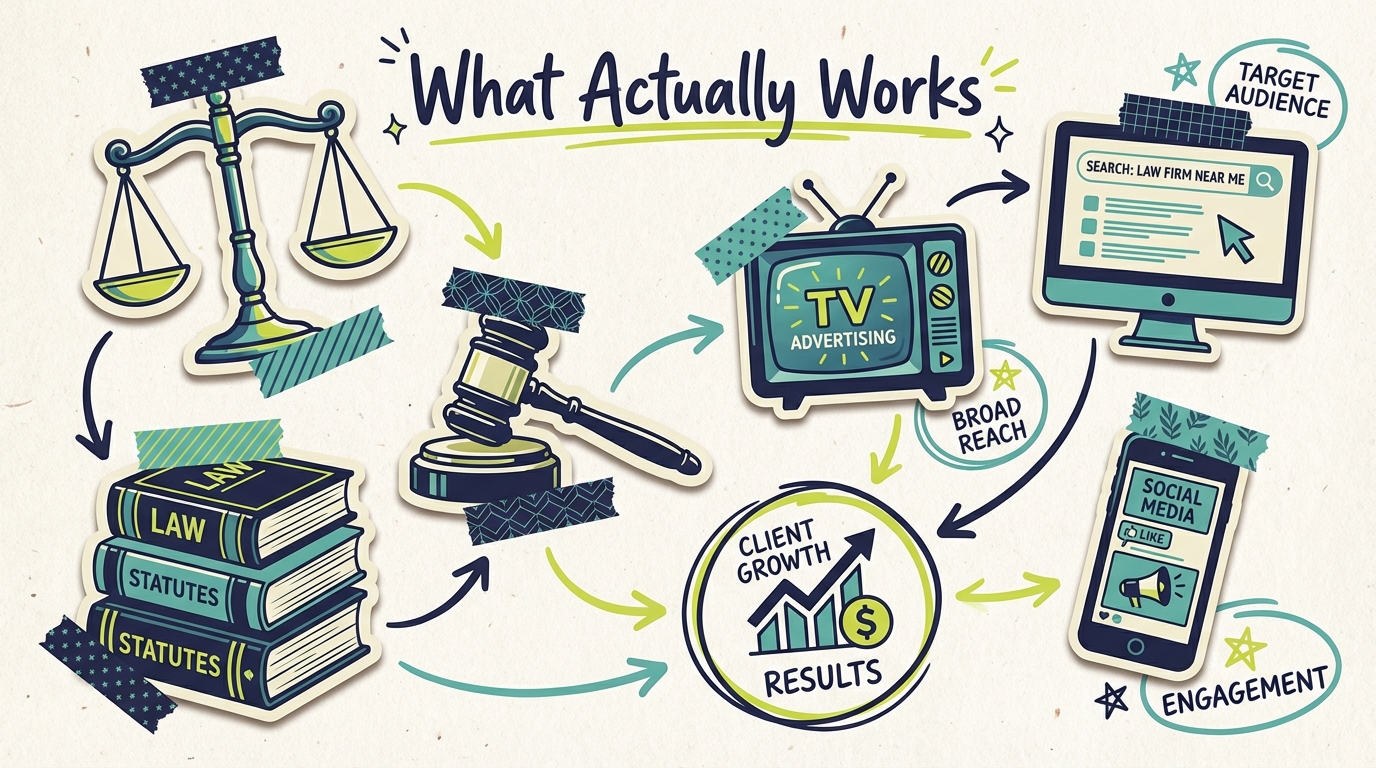
The most effective legal marketing combines multiple channels strategically.
Foundation: Credibility and Trust
Start with television. TV advertising establishes credibility that makes all other marketing more effective. People who see your TV ads respond better to search ads, recognize your name in organic results, and trust your social content more.
Ensure website quality. Every advertising channel ultimately drives people to your website. Invest in professional design, clear messaging, and easy contact methods before scaling advertising.
Collect and showcase reviews. Social proof matters enormously in legal services. Systematically collect Google reviews and feature testimonials throughout your marketing.
Capture: Converting Interest to Inquiries
Implement search advertising. Capture high-intent searchers actively looking for legal help. Start with highest-value keywords and expand based on performance.
Optimize for local search. Ensure Google Business Profile is complete and optimized. Local search visibility captures nearby prospects.
Build retargeting programs. Most website visitors don't convert immediately. Retargeting keeps your firm visible as they continue researching and deciding.
Nurture: Long-Term Visibility
Invest in content and SEO. Build long-term organic visibility through consistent, quality content that demonstrates expertise.
Maintain social presence. Regular social media activity maintains referral relationships and supports overall brand presence.
Continue television presence. Ongoing TV advertising maintains awareness for when needs arise. The legal matter someone handles next year may be triggered by the accident that happens today.
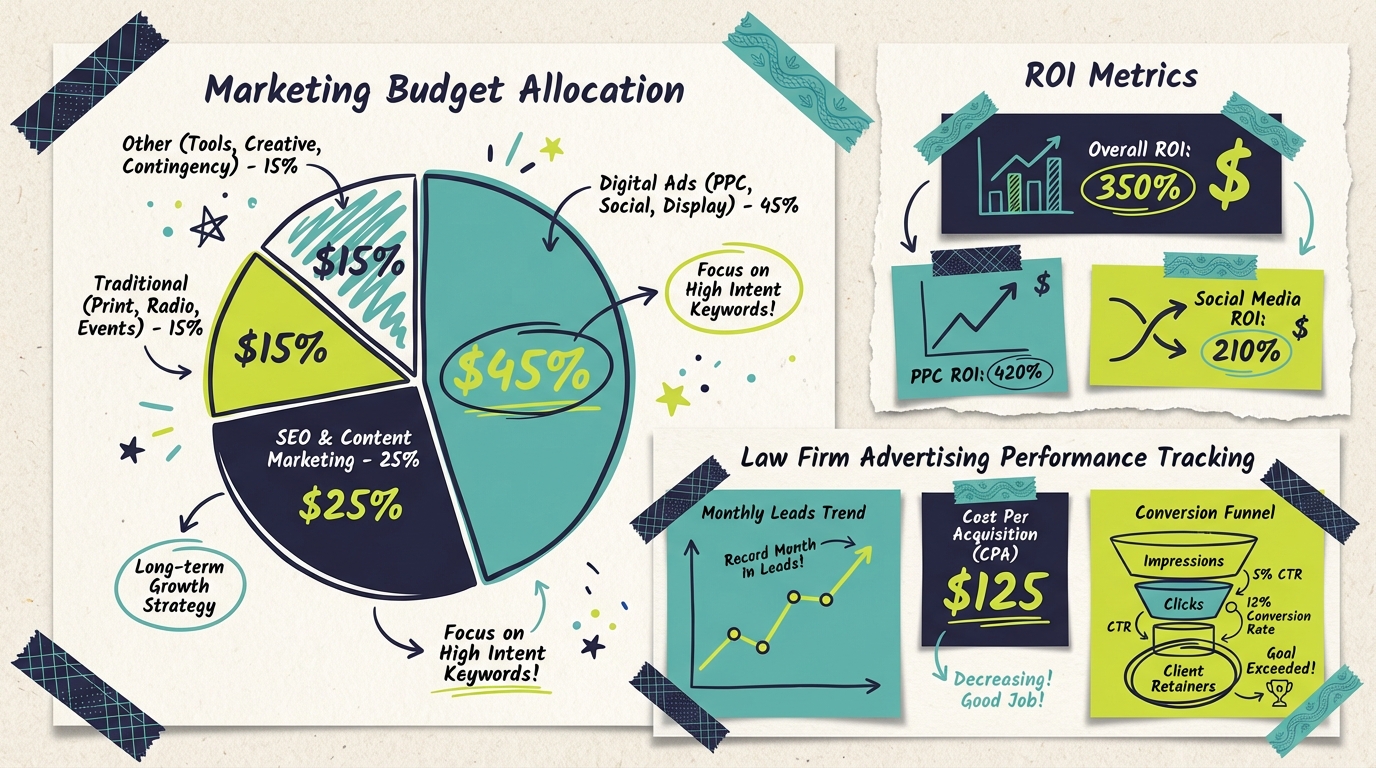
Budget Allocation Guidance
How much should law firms spend on advertising, and how should they allocate it?
Total Marketing Budget
Industry benchmarks suggest law firms allocate 2-10% of gross revenue to marketing, with growth-focused firms at the higher end.
Small firms (under $1M revenue): $20,000-50,000 annually Mid-size firms ($1-5M revenue): $50,000-250,000 annually Larger firms ($5M+ revenue): $250,000+ annually
Allocation Suggestions
For firms building integrated programs:
Television (streaming + broadcast): 25-35% of budget Search advertising: 30-40% of budget SEO and content: 15-20% of budget Social and other digital: 10-15% of budget Traditional media: 5-10% if relevant to practice
Adjust based on practice area, competition, and results. Track performance and shift spending toward channels that deliver best returns.
Measuring Advertising Effectiveness
Track what matters to optimize results over time.
Key Metrics
Cost per inquiry. Total advertising spend divided by number of inquiries received. Track by channel to compare efficiency.
Cost per client. Inquiries that become paying clients. The metric that ultimately matters.
Lifetime client value. Total revenue from client relationships over time. High lifetime values justify higher acquisition costs.
Return on advertising spend (ROAS). Revenue generated divided by advertising cost. Target minimum 3:1 for sustainable growth.
Attribution Challenges
Legal clients often interact with multiple marketing touchpoints before converting. Someone might see your TV ad, search your name later, click a search ad, browse your website, see a retargeting ad, then finally call.
Ask every prospect. "How did you hear about us?" provides directional information, though people often credit only the final touchpoint.
Track trends. Compare overall inquiry volume and quality to advertising activity. Correlations reveal what's working even without perfect attribution.
Accept imperfection. Marketing attribution is inherently imprecise. Focus on overall results rather than demanding perfect channel-level measurement.
Common Questions Answered
What is the best advertising for law firms? The most effective legal advertising combines television for credibility and broad awareness with search advertising for capturing high-intent prospects. Television builds the trust and recognition that makes all other advertising more effective, while search advertising captures people actively looking for legal help. Firms that integrate both typically outperform those relying on either alone.
How much should law firms spend on advertising? Industry benchmarks suggest 2-10% of gross revenue, with growth-focused firms at higher levels. A firm generating $1 million annually might allocate $50,000-100,000 to marketing. Newer firms or those entering competitive markets may need to invest more heavily initially to establish presence.
Does TV advertising work for small law firms? Yes. Streaming TV advertising has made television accessible at budgets starting around $500-1,000 monthly. Small firms can target specific geographic areas and demographics efficiently, building credibility without the massive budgets that broadcast television once required. The credibility boost from TV presence often improves conversion rates across all marketing channels.
How do law firms measure advertising ROI? Track cost per inquiry and cost per client acquired by channel. Compare advertising spend to revenue generated from new clients. For channels that build awareness rather than driving immediate response, measure overall inquiry volume and quality trends over time. Accept that perfect attribution is impossible in legal marketing where clients often interact with multiple touchpoints.
What makes legal advertising different from other industries? Legal services involve high stakes, significant trust requirements, and unpredictable timing. People don't plan to need lawyers, so firms must maintain visibility before needs arise. Ethical rules also constrain what firms can say and promise in advertising. These factors favor advertising that builds credibility and trust over time rather than hard-sell approaches.
The Bottom Line
Effective law firm advertising builds trust before pushing for action. The firms that win don't shout the loudest or make the boldest claims. They establish credibility, maintain visibility, and stay present in minds until the moment someone needs legal help.
Television advertising anchors effective legal marketing by building the credibility that makes all other channels more effective. Search advertising captures people actively looking for help. SEO and content build long-term visibility. Social media maintains relationships and supports overall presence.
The right mix depends on your practice areas, competitive landscape, and growth goals. But the firms that integrate multiple channels around a foundation of trust-building consistently outperform those seeking silver-bullet solutions.
Ready to build credibility with television advertising? Create your first TV ad in minutes and start reaching potential clients on streaming platforms, starting at just $50.
Sources
- American Bar Association: Legal marketing surveys and ethics guidance
- Clio Legal Trends Report: Law firm marketing benchmarks
- Legal Marketing Association: Industry best practices
Internal Links Used
- /resources/why-customers-trust-tv-brands
- /resources/what-is-connected-tv-advertising
- /how-it-works
- /pricing
- /try-free
Version history
| Version | When | Summary |
|---|---|---|
| v1 | 6/20/2026, 3:11:54 AM | migration import |