Physical Therapy Advertising: 7 Channels to Attract More Patients
slug: physical-therapy-advertising-attracting-patients · status: draft · score: 83% · 1 versions
View published version → · Contentful entry: 2iVpp8Mc9X89h8UZ3V5LW2
Validation
| Rule | Detail | |
|---|---|---|
| pass | No banned competitors | No banned competitors |
| pass | No emdashes | No emdashes |
| pass | Avoid AI telltale words | No AI telltale words |
| pass | Primary keyword in title | No primary keyword to check |
| pass | Use contractions | Contractions used |
| fail | Minimum internal links | Internal links not in sitemap: /resources/how-to-optimize-your-google-business-profile-for-more-calls, /how-it-works, /resources/ai-tv-commercials-small-business, /resources/why-customers-trust-tv-brands, /resources/how-to-get-more-patients, /resources/healthcare-marketing-ideas-small-practices, /how-it-works |
| pass | FAQ section required | FAQ section present |
| fail | Author assigned | No author assigned (never use 'Adwave Team' for new content) |
| pass | Title length 50-60 | Title length 65 |
| pass | Minimum 4 images | 4 images |
| warn | SEO description under 160 | seoDescription 164 chars (keep under 160) |
| pass | Adwave mention cadence | 1 Adwave mentions |
| pass | Short description present | shortDescription 195 chars |
| pass | Word count by type | Word count 3595 within target |
| warn | Year-dated title for evergreen types | Year-dated type should include (2026) in the title |
| pass | No manual table of contents | No manual TOC |
Images (4)

Content
Physical Therapy Advertising: 7 Channels to Attract More Patients
Physical therapy practices face a unique marketing challenge. Most PT clinics rely heavily on physician referrals, which means your growth is tied to someone else's schedule and preferences. And with direct access laws now active in all 50 states (with varying levels of restriction), patients can walk through your door without a referral in most cases, but only if they know you exist.
Here's the thing: the average physical therapy patient is worth $1,500-3,000 over a course of treatment, according to the American Physical Therapy Association's practice management data. For patients who return for future episodes of care or refer family members, that number climbs significantly. That math means investing in advertising isn't just smart, it's one of the best investments you can make.
This guide breaks down seven advertising channels that work for physical therapy practices, with honest cost estimates, pros, cons, and recommendations based on where your clinic stands today.
What Makes Physical Therapy Marketing Different
Before picking channels, it helps to understand the factors that shape how PT patients find and choose a provider.
Referrals still matter, but they aren't enough. Physician referrals account for roughly 60-70% of new PT patients at most practices, according to data from WebPT's annual state of rehab therapy report. That's a significant pipeline, but it means your growth is capped by referral volume and vulnerable to referral pattern changes.
Direct access is underused. While nearly every state allows some form of direct access to physical therapy, only about 10-15% of patients arrive through direct access, per the APTA. That's a massive untapped market of people who don't know they can skip the doctor's visit and come straight to PT.
Trust and credentials drive decisions. Patients choosing a PT on their own (not via referral) need to feel confident in your expertise. They're dealing with pain or limited mobility, and picking the wrong provider feels risky. Your advertising needs to communicate clinical credibility without feeling cold or clinical.
Geography is tight. Most PT patients travel 10-15 minutes to their clinic, and since they're coming two to three times per week for several weeks, convenience matters enormously. Any advertising that reaches people outside your service radius is wasted spend.
Insurance confusion creates friction. Patients worry about whether you take their insurance, how much they'll owe out of pocket, and how many visits are covered. Advertising that addresses these concerns head-on converts better than ads that ignore them.
Google Ads and Search Advertising
When someone searches "physical therapy near me" or "knee pain treatment [your city]," they're ready to act. Google Ads puts your clinic at the top of those results.
How it works: You bid on keywords related to physical therapy services in your area. When someone searches those terms, your ad appears above the organic results. You pay only when someone clicks.
Costs: Physical therapy keywords typically run $8-20 per click depending on your market. A monthly budget of $1,000-2,500 is a reasonable starting point for most markets. Urban areas and competitive markets run higher.
Best for: Capturing patients actively searching for PT, promoting specialty services (sports rehab, post-surgical recovery, pelvic floor therapy), driving appointment requests.
Strengths:
- Reaches people with immediate intent to find a PT
- Only pay when someone actually clicks your ad
- Trackable cost per lead and cost per new patient
- Can target specific conditions, services, and locations
- Fast results, often within the first week
Limitations:
- Costs add up quickly in competitive markets
- Only captures existing demand (people already searching)
- Requires ongoing management and optimization
- Click fraud from competitors is a real issue
- Stops producing leads the moment you stop paying
Verdict: Google Ads is the fastest path from advertising dollar to new patient appointment. Every PT practice should at least maintain a well-optimized Google Business Profile (which is free). Paid search ads make sense when you need patients quickly or want to capture high-intent searches for specific services. Just don't rely on Google alone, because it only reaches people who already know they need PT.
Meta and Instagram Advertising
Facebook and Instagram let you put your practice in front of local patients who aren't actively searching but fit your ideal patient profile.
How it works: You create ads targeting people within your service area based on demographics, interests, and behaviors. Ad formats include images, videos, carousels, and stories. Meta's algorithm finds people most likely to engage with your content.
Costs: CPMs (cost per 1,000 impressions) average $8-15 for healthcare advertisers. A monthly budget of $500-1,500 produces meaningful results for most PT practices.
Best for: Building awareness of your practice, promoting specialty programs (sports performance, fall prevention for seniors, prenatal PT), showcasing your team and facility, advertising direct access availability.
Strengths:
- Visual format lets you show your facility and team in action
- Precise targeting by age, interests, and location
- Great for promoting specific programs and seasonal campaigns
- Video ads showing exercises or patient stories perform well
- Cost-effective per impression
Limitations:
- Users aren't in a "finding a PT" mindset when scrolling social media
- Ad fatigue sets in fast, requiring frequent creative refreshes
- Apple's privacy changes have reduced targeting accuracy
- Organic reach without paid spend is nearly zero
- Difficult to prove direct patient acquisition
Verdict: Social media advertising works best for PT practices when you have something visual and specific to promote: a new clinic opening, a specialty program, a community event, or educational content about direct access. It's less effective as a pure lead generation tool. Pair it with search advertising so you're building awareness and capturing demand at the same time.
Local SEO and Google Business Profile
When patients search for a physical therapist, your Google Business Profile is often the first thing they see, even before your website. Optimizing it is one of the highest-return activities for any PT clinic.
How it works: Claim and fully optimize your Google Business Profile with accurate hours, services, photos, and descriptions. Build local citations (directory listings) consistently across the web. Create location-specific website content that targets PT-related searches in your area.
Costs: Google Business Profile optimization is free. Professional local SEO services typically cost $500-2,000/month if you hire an agency. DIY is possible but time-intensive.
Best for: Appearing in "near me" searches, building long-term organic visibility, establishing credibility through reviews, capturing patients comparing options. For a deeper look at making the most of your Google listing, check out this guide on how to optimize your Google Business Profile for more calls.
Strengths:
- Google Business Profile is free and drives real patient inquiries
- Local pack results (map listings) get significant click volume
- Reviews build powerful social proof
- Organic traffic compounds over time without per-click costs
- Patients trust organic results more than paid ads
Limitations:
- Takes 3-6 months to see meaningful organic ranking improvements
- Google's algorithm changes can affect visibility overnight
- Requires consistent effort (review management, content creation, citation building)
- Competitive in markets with many PT practices
Optimization tips for PT practices:
- Add photos of your clinic, equipment, and team monthly
- List every specialty and condition you treat in your services
- Respond to every review, positive or negative, within 48 hours
- Post weekly updates (exercises, patient tips, clinic news)
- Ensure your name, address, and phone number are identical everywhere online
Verdict: Local SEO is foundational. It's not fast, but it's one of the few channels that keeps producing results without ongoing ad spend. Every PT practice should have a fully optimized Google Business Profile as a baseline, then build organic visibility over time while using faster channels for immediate growth.
Physician Referral Programs
Physician referrals are still the backbone of most PT practices. The difference between clinics that get a steady stream of referrals and those that struggle often comes down to having a structured program rather than leaving it to chance.
How it works: Build and maintain relationships with referring physicians through regular outreach, co-marketing, progress reporting, and education. Make it ridiculously easy for physicians to refer patients to your clinic.
Costs: Minimal direct costs. Lunch-and-learn events run $200-500 each. Referral pads and materials cost $100-300 to produce. The biggest investment is time, typically 5-10 hours per week for a dedicated marketing or liaison role.
Best for: Maintaining your core referral pipeline, building relationships with new physicians in your area, differentiating from competing PT practices.
Key tactics:
- Physician liaison program: Assign someone to visit referring offices monthly, bringing updates on shared patients (within HIPAA guidelines) and clinical education
- Progress reports: Send timely, professional updates to referring physicians about their patients' outcomes
- Lunch-and-learn sessions: Host educational events at physician offices showcasing your clinical specialties
- Easy referral process: Provide referral pads, a simple fax/online referral form, and same-day or next-day appointment availability
- Outcome tracking: Share outcome data showing your patient results compared to benchmarks
Strengths:
- Highest conversion rate of any channel (referred patients almost always show up)
- Builds sustainable, long-term patient volume
- Referred patients tend to be more compliant with treatment plans
- Low direct cost per acquisition
- Strengthens your clinical reputation
Limitations:
- Growth is limited by the number of referring physicians in your area
- Vulnerable to changes in referral patterns (physician retirement, new hospital-owned clinics)
- Time-intensive to maintain relationships
- Doesn't reach direct access patients
- Can feel dependent and out of your control
Verdict: Don't abandon physician referral efforts. Formalize them. A structured referral program outperforms passive hope every time. But if referrals are your only patient source, you're one physician retirement or hospital acquisition away from a significant revenue drop. That's why building direct-to-patient channels alongside referral programs is so important.
Yelp and Healthcare Directories
Healthcare-specific directories and review platforms serve as a research layer for patients comparing PT options, especially those using direct access.
How it works: Claim and optimize your profiles on Yelp, Healthgrades, Zocdoc, and PT-specific platforms. Encourage satisfied patients to leave reviews. Consider paid listings for enhanced visibility in competitive markets.
Costs: Basic profiles are free on most platforms. Enhanced Yelp listings run $300-800/month. Zocdoc charges per booking ($35-100 depending on specialty). Healthgrades premium profiles start around $200/month.
Best for: Capturing patients who are actively comparing PT providers, building social proof through reviews, increasing visibility for direct access patients.
Key platforms for PT practices:
- Yelp: Broad consumer audience, especially for urban practices
- Healthgrades: Healthcare-specific with clinical credential displays
- Zocdoc: Online booking integration, growing patient usage
- WebMD/Vitals: Patient search and review platform
- Psychology Today (for pain management): Relevant if you offer chronic pain programs
Strengths:
- Reaches patients actively evaluating PT options
- Reviews provide powerful social proof
- Free basic listings on most platforms
- Healthcare-specific platforms lend clinical credibility
- Patients arriving from directories have high intent
Limitations:
- Yelp's review filter can suppress legitimate positive reviews
- Multiple paid platforms add up quickly
- Limited control over how your practice is presented
- Negative reviews are visible and can deter patients
- Some platforms prioritize paid listings over quality
Verdict: Claim and optimize your profiles on every relevant platform, especially Yelp, Healthgrades, and Google. Focus your review-generation efforts on Google (highest impact) and one or two healthcare-specific platforms. Paid promotion is worth testing in competitive markets, but track your cost per patient carefully.
Streaming TV and CTV Advertising
Television used to be out of reach for independent PT practices. That's changed. Connected TV (CTV) advertising lets you run commercials on premium streaming platforms with the same local targeting you'd get from digital ads, but with the trust-building power of TV.
How it works: Your commercial airs on streaming services like Hulu, Peacock, Tubi, ESPN, and 100+ other networks. You target viewers by geography, demographics, and interests, so your ad reaches potential patients in your service area. With Adwave, you can create a professional TV commercial from your website and launch a campaign starting at just $50.
Costs: CPMs average $15-35, meaning you reach 1,000 local viewers for $15-35. A $500/month budget delivers meaningful local reach. Creating a commercial with AI-powered tools takes minutes instead of weeks and costs nothing upfront.
Best for: Building practice awareness, educating your community about direct access, differentiating from hospital-owned PT chains, establishing trust before patients need you.
Strengths:
- Full-screen, sound-on format showcases your clinic and team
- Premium network placement builds credibility that digital ads can't match
- Geographic targeting ensures you only pay to reach your service area
- Reaches patients before they're in pain (demand creation)
- Video lets you demonstrate expertise and show your facility
Limitations:
- Not a direct-response channel (patients won't click through from their TV)
- Results build over weeks, not days
- Requires some visual content (facility photos, team shots)
For a deeper look at using TV to grow your patient base, see our guide on how to get more patients.
Verdict: Streaming TV fills a gap that most PT practices don't realize they have: awareness among people who don't yet know they need physical therapy or don't know they can come directly without a referral. It's the channel that makes all your other channels work harder, because patients who've seen your practice on TV are more likely to click your Google ad, choose you from a directory, or remember your name when their doctor suggests PT.
Email Marketing and Patient Retention
Your best source of future revenue isn't a new patient. It's the patients who've already trusted you with their care. Email marketing keeps your practice top of mind for return visits, referrals, and new episodes of care.
How it works: Build an email list from current and former patients (with proper consent). Send regular newsletters, exercise tips, program announcements, and re-engagement campaigns. Segment your list by condition type, discharge date, and engagement level.
Costs: Email platforms like Mailchimp or Constant Contact run $20-100/month for most practice list sizes. Content creation time is the bigger investment, roughly 2-4 hours per week.
Best for: Re-engaging former patients, promoting new services, driving referrals from satisfied patients, maintaining relationships between episodes of care.
Effective email campaigns for PT practices:
- Discharge follow-up series: Check in at 30, 60, and 90 days after discharge with relevant exercises and an invitation to return if needed
- Seasonal wellness tips: Injury prevention content tied to seasons (winter fall prevention, spring running tips, summer sports safety)
- New program announcements: Promote specialty programs like dry needling, pelvic floor therapy, or sports performance
- Referral requests: Ask satisfied patients to refer friends and family, with a simple link to share
- Annual wellness check-in: Yearly email encouraging patients to schedule a movement screen or check-up
Strengths:
- Extremely low cost per touch
- Reaches patients who already trust your practice
- Drives re-engagement for new episodes of care
- Easy to track open rates, clicks, and appointment bookings
- Supports referral generation
Limitations:
- Only reaches people already on your list
- Open rates for healthcare emails average 20-25% (Mailchimp industry benchmarks)
- HIPAA compliance requires careful handling of patient information
- Won't help you reach new patients who've never visited
Verdict: Email is the lowest-cost, highest-return channel for patient retention and reactivation. Every PT practice should have at least a basic email program running. The patients most likely to come back are the ones who hear from you regularly. Just make sure your email practices comply with HIPAA requirements for patient communications.
Channel Comparison at a Glance
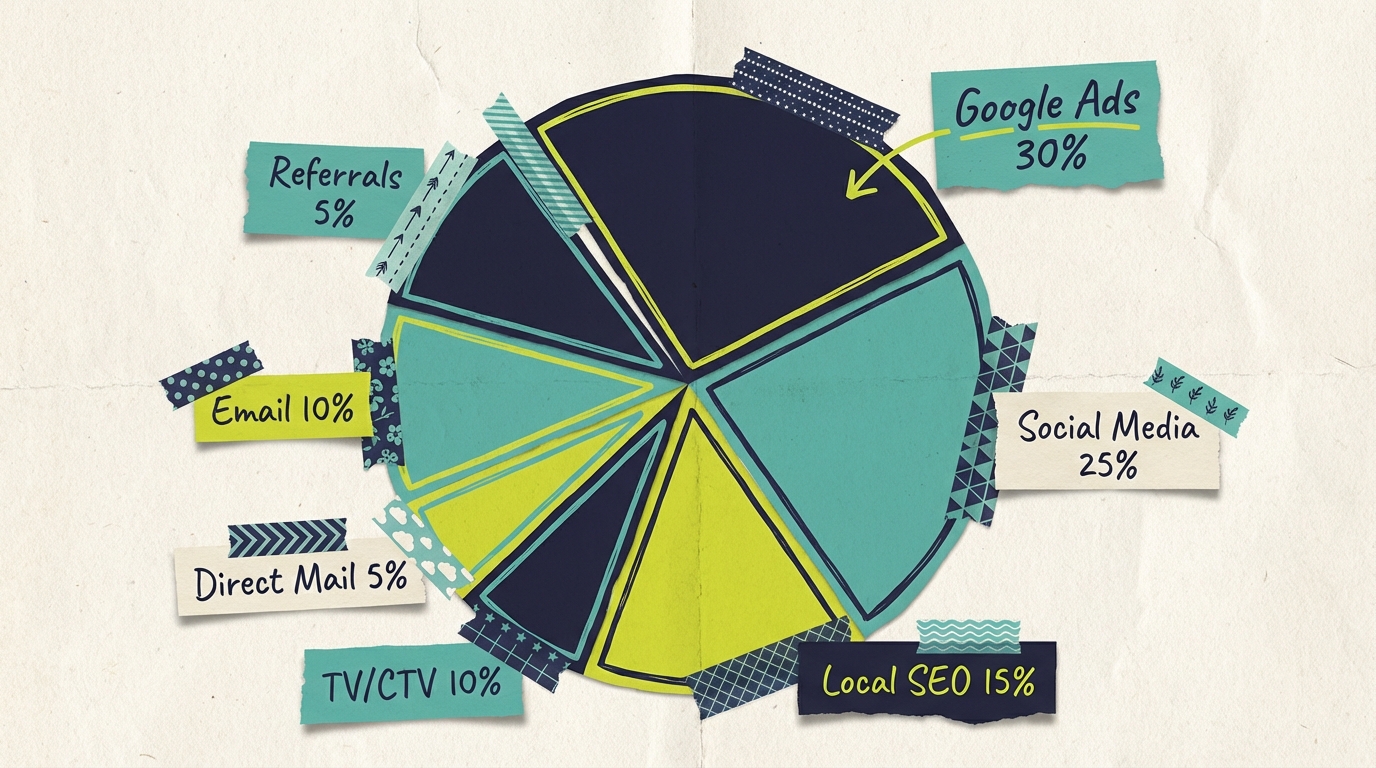
Recommended Budget Allocation
How you split your advertising budget depends on where your practice is right now.
New Practice (First 12 Months)
Total recommended budget: $2,000-4,000/month
- Google Ads: 35% (capture patients searching now)
- Physician referral program: 15% (build the referral pipeline from scratch)
- Streaming TV: 20% (build local awareness quickly)
- Local SEO setup: 15% (lay the organic foundation)
- Social media ads: 10% (announce your opening, build community)
- Directory profiles: 5% (claim and optimize everywhere)
Established Practice Looking to Grow
Total recommended budget: $1,500-3,500/month
- Streaming TV: 25% (expand reach beyond referral-dependent patients)
- Google Ads: 25% (capture high-intent searches)
- Local SEO: 15% (maintain and grow organic rankings)
- Email marketing: 10% (reactivate former patients)
- Social media: 10% (promote specialties and programs)
- Physician referral program: 10% (maintain and expand referral network)
- Directories: 5% (enhanced listings where competition is high)
Practice Competing with Hospital-Owned Clinics
Total recommended budget: $2,500-5,000/month
- Streaming TV: 30% (match hospital marketing visibility in your area)
- Google Ads: 25% (defend your search presence)
- Local SEO and content: 15% (build authority that hospital chains struggle to replicate)
- Physician referral program: 15% (personal relationships beat corporate outreach)
- Directories and reviews: 10% (use your higher patient satisfaction scores to stand out)
- Social media: 5% (humanize your practice vs. corporate competitors)
Common Questions Answered
Do physical therapy practices really need to advertise? Yes, and increasingly so. The rise of hospital-owned PT clinics, urgent care centers offering physical therapy, and retail health clinics means more competition for patients than ever before. Practices that rely solely on physician referrals are vulnerable to referral pattern changes. According to the APTA, direct access patients represent a growing but still underused segment. Advertising helps you reach those patients directly.
What's the best advertising channel for a new PT practice? Start with Google Ads to capture patients actively searching, and pair it with streaming TV to build local awareness fast. Get your Google Business Profile optimized immediately (it's free) and start building physician referral relationships in your first month. This combination covers both immediate lead generation and long-term brand building. For more ideas on attracting new patients, explore healthcare marketing ideas for small practices.
How much should a physical therapy practice spend on marketing? Industry benchmarks from the APTA suggest allocating 5-10% of revenue to marketing. For a practice generating $500,000 annually, that translates to $25,000-50,000 per year, or roughly $2,000-4,200 per month. Newer practices and those in competitive markets should invest toward the higher end, while established practices with strong referral networks can invest less.
Can I advertise direct access physical therapy? Yes, and you should. Direct access awareness is low among the general public. Most patients don't know they can see a PT without a physician referral. Advertising that educates patients about this option creates a new channel of patients who come to you directly. Just be sure to note any state-specific limitations on direct access treatment in your marketing.
How do I track which advertising channels are working? Ask every new patient how they heard about your practice and log it consistently. Use unique phone numbers or landing pages for different advertising channels. Track Google Ads conversions through call tracking and form submissions. For streaming TV, monitor increases in branded search volume and website traffic during campaign periods. Review your data monthly and shift budget toward what's producing the lowest cost per new patient.
Is it worth advertising specialties like sports rehab or pelvic floor therapy? Absolutely. Specialty promotion is one of the highest-return advertising strategies for PT practices. Patients searching for specific treatments ("pelvic floor physical therapy near me" or "sports rehab for ACL recovery") have high intent and are often willing to travel further for a specialist. Google Ads and social media are particularly effective channels for specialty promotion because you can target very specific audiences.
Grow Your Practice Beyond Referrals
The physical therapy practices that thrive in the years ahead will be the ones that build a patient pipeline they control. Physician referrals are valuable, and you should keep investing in them. But adding direct-to-patient channels gives your practice stability and growth potential that referrals alone can't provide.
Start with the basics: a well-optimized Google Business Profile, a structured physician referral program, and an active presence on healthcare directories. Then layer in advertising channels that create demand, like streaming TV and social media, so patients in your community know your name before they ever need a physical therapist.
Ready to put your PT practice on streaming TV? Create a free commercial and start reaching local patients on 100+ premium channels, starting at just $50.
Sources
- American Physical Therapy Association (APTA): Direct access statistics, practice management benchmarks, marketing budget guidelines
- WebPT State of Rehab Therapy Report: Physician referral patterns, practice growth data
- Mailchimp: Email marketing benchmarks by industry
- Google Economic Impact Report: Local search and advertising data
- Healthgrades/Zocdoc: Healthcare directory pricing and patient usage statistics
Internal Links Used
- /resources/how-to-optimize-your-google-business-profile-for-more-calls
- /resources/why-customers-trust-tv-brands
- /how-it-works
- /resources/ai-tv-commercials-small-business
- /resources/how-to-get-more-patients
- /resources/healthcare-marketing-ideas-small-practices
Version history
| Version | When | Summary |
|---|---|---|
| v1 | 6/20/2026, 3:11:54 AM | migration import |