Best Advertising for Senior Care & Assisted Living (2026)
slug: best-advertising-senior-care-assisted-living · status: draft · score: 85% · 1 versions
View published version → · Contentful entry: 3jTC64axXYrOyYHeLKSxRi
Validation
| Rule | Detail | |
|---|---|---|
| pass | No banned competitors | No banned competitors |
| pass | No emdashes | No emdashes |
| pass | Avoid AI telltale words | No AI telltale words |
| pass | Primary keyword in title | No primary keyword to check |
| pass | Use contractions | Contractions used |
| fail | Minimum internal links | Internal links not in sitemap: /resources/what-is-connected-tv-advertising, /resources/test-tv-advertising-without-big-budget, /resources/how-to-get-more-patients, /resources/tv-advertising-medical-practices-guide, /resources/how-much-does-it-cost-to-advertise, /how-it-works |
| pass | FAQ section required | FAQ section present |
| fail | Author assigned | No author assigned (never use 'Adwave Team' for new content) |
| pass | Title length 50-60 | Title length 57 |
| pass | Minimum 4 images | 4 images |
| pass | SEO description under 160 | seoDescription 156 chars |
| pass | Adwave mention cadence | 4 Adwave mentions |
| pass | Short description present | shortDescription 178 chars |
| warn | Word count by type | Word count 2120 below target (2500-5000) |
| pass | Year-dated title for evergreen types | Title carries year 2026 |
| pass | No manual table of contents | No manual TOC |
Images (4)



Content
Best Advertising for Senior Care & Assisted Living (2026)
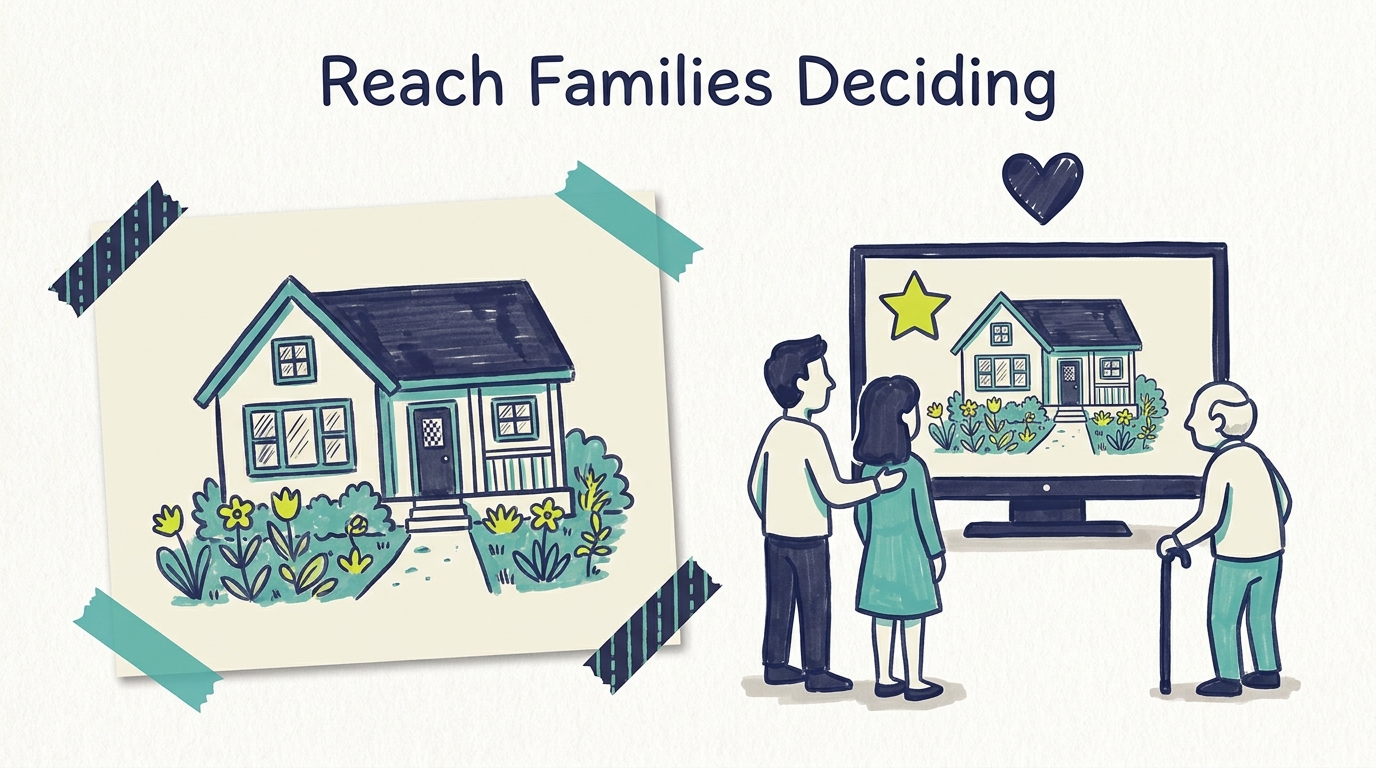
Senior care advertising has a structural quirk that most marketing advice ignores: the person who finds you is almost never the person who moves in. Adult children, usually daughters and sons in their late 40s to mid 60s, do the research, build the shortlist, and book the tours. The senior decides with them, on criteria that are as emotional as they are practical. Your advertising has to work on both audiences, across a decision that can take anywhere from 48 hours (post-hospitalization) to two years (planned transitions).
Add an unusually high trust threshold (families are choosing where a parent will live) and unusually strong economics (a single resident often represents $4,000-$8,000 in monthly revenue and a multi-year stay), and you get a category where advertising deserves more care, and more budget confidence, than most operators give it. This guide compares the seven channels that fill senior living communities in 2026, what each costs, and how to combine them.
What "best" means when a move-in is worth six figures
Run the math before judging any channel. At $5,000 monthly revenue and a typical two-to-three-year stay, one move-in represents $120,000-$180,000 in lifetime revenue. Even at modest margins, spending $1,500-$4,000 in blended advertising cost per move-in is healthy, and the channels that look "expensive" per inquiry are often the cheapest per move-in once quality is counted.
Three outcomes matter:
- Qualified tours. Families in your service radius, with care needs you serve and budgets that fit. Tours, not clicks, are the unit of progress in this category.
- Cost per move-in. The only number that settles channel debates.
- Occupancy durability. A community that's familiar and trusted in its market refills faster after every move-out. That asset is built before it's needed.
The seven channels worth considering
1. Google Ads (Search)
"Assisted living near me" and "memory care [city]" are among the highest-intent searches in local marketing, and among the most expensive: $8-30 per click is routine, and competitive metros run higher because referral platforms bid aggressively on the same terms.
Search works, with two disciplines. Bid on specificity (care level, neighborhood) where competition thins out, and send clicks to pages that answer what families actually compare: pricing transparency, photos, availability. Expect $1,500-$3,500 monthly to produce consistent signal, and remember you're often paying to win the click back from a directory that will sell your own inquiry back to you.
2. Senior care directories and referral platforms
A Place for Mom, Caring.com, and their peers dominate the search results you aren't winning. They produce real inquiries, at a real price: referral fees commonly equal one full month of rent or a sizable placement fee per move-in.
The honest framing: directories are a demand tax you pay while your own presence is weak. They're worth using when occupancy is urgent, and worth gradually outgrowing as your direct channels strengthen. Track them by net revenue after fees, not inquiry volume, and never let them be your only pipeline.
3. Meta and Facebook ads
The 45-65 adult-child decision-maker is Facebook's core demographic, and seniors themselves are the platform's fastest-aging-in cohort. Paid social earns its slot with story-driven creative: life inside the community, staff longevity, resident activities, family testimonials.
Targeting by geography and age band gets you in front of plausible families for $500-$1,500 a month. The job is mid-funnel: planting your name and a feeling months before the search begins, and retargeting site visitors who weren't ready yet. Direct response expectations kill social campaigns in this category; brand-building expectations make them.
4. Streaming TV (CTV)
TV is unusually well-matched to senior care, for three reasons that compound:
It reaches both deciders at once. Connected TV reaches the 45-65 adult children on streaming and seniors on the same screens; the household-level reach mirrors the household-level decision.
Trust transfers. Consumers report trusting TV ads at roughly twice the rate of social ads, and "I've seen their commercials" carries singular weight when the product is where Mom will live. A community that's been on the living-room screen for months enters the shortlist pre-trusted.
The tour is visual. Thirty seconds of real community life (dining room, gardens, staff greeting residents by name) does what no search ad can. With AI generation from your website taking about two minutes and subscriptions from $50, the production barrier that kept communities off TV is gone; typical CTV rates run $15-35 CPM with zip-code targeting around your draw radius.
Budget guidance: $800-$2,500 monthly sustains presence across a typical service area. The playbook for testing TV without a big budget applies directly, with one category note: senior care's long planned-transition cycle means TV's full effect reads out over two to three quarters, while the post-hospitalization segment responds much faster.
5. Local SEO, Google Business Profile, and reviews
Every family Googles every community on the shortlist. Your GBP photos, your review count, and your rating are the second screening round whether you participate or not. A community at 4.7 stars with 120 reviews and current photos beats a beautiful campus with 9 reviews and a stock-photo profile.
Build the review ask into move-in anniversaries and family councils; respond to every review, especially critical ones, with the tone families hope to see. Cost is attention, not dollars, and it compounds for years. The fundamentals mirror what works for getting more patients in any healthcare-adjacent category.
6. Healthcare referral relationships
Hospital discharge planners, rehab facilities, primary care physicians, elder law attorneys, and home health agencies steer a large share of urgent placements. These referrals close fast and trust-forward, and they respond to relationship investment rather than media spend: case manager lunches, clear availability communication, easy admission processes, and reliability when you say you have a bed.
Communities that treat referral development as a weekly discipline rather than an occasional outreach typically count it among their top two sources. Pairs naturally with the medical practice TV playbook when your market includes physician-owned practices.
7. Community events and open houses
Lunch-and-learns, caregiver support groups, holiday open houses, and educational seminars (Medicare, downsizing, dementia care) convert anxiety into familiarity. Families who have been inside your building twice before the need arrives skip the cold-shortlist phase entirely. Cost is catering and staff time; the events also feed your social and TV creative with authentic imagery.
Side-by-side channel comparison
A budget allocation that fits the category
For a community investing $5,000-$8,000 monthly in paid channels:
- Google Ads: 35%. Capture the active search you can win directly.
- CTV: 25%. Build the household trust that raises every other channel's close rate and slowly reduces directory dependence.
- Meta: 15%. Mid-funnel storytelling and retargeting.
- Events and community presence: 15%. Familiarity that converts years later.
- Directories: 10% and falling. Use while needed; measure net of fees; let direct strength shrink the slice.
Referral relationships and reviews sit outside the percentage math because they cost discipline rather than dollars; fund them with calendar time, weekly.
The pattern worth naming: senior care operators habitually over-spend on bottom-funnel (search and directories) because it's measurable, then wonder why cost per move-in keeps climbing. The fix is the trust layer: TV, events, and reviews making families arrive pre-sold. Where the overall numbers land for your market is covered in how much it costs to advertise.
Measuring across a two-speed funnel
Senior care demand arrives at two speeds, and your measurement should separate them:
Urgent placements (hospital discharge, sudden decline) decide in days. Referral relationships and search dominate; track source-to-move-in conversion weekly and keep availability data flowing to case managers.
Planned transitions decide over 6-24 months. This is where TV, social, events, and reviews do their slow work. Track tour requests against trailing-quarter baselines, ask every family "where did you first hear of us?" at inquiry AND at move-in (the answers differ, and the gap is your awareness channels working), and watch branded search volume as the early indicator.
Cost per move-in, blended and by source, quarterly, settles the budget arguments. Expect awareness channels to look expensive in month two and cheap by month nine.
Common questions answered
What's the most effective advertising for assisted living communities?
No single channel fills a community; the effective pattern is search ads capturing active demand, CTV and events building pre-need trust with both adult children and seniors, reviews validating the shortlist, and healthcare referral relationships covering urgent placements. Communities that run only bottom-funnel channels pay more per move-in every year; the trust layer is what bends the cost curve down.
How much should a senior living community spend on marketing?
Industry practice runs roughly $400-$900 per unit per year for stabilized communities, more during lease-up. A 60-unit community typically lands at $4,000-$8,000 monthly in paid channels. The better governor is cost per move-in against resident lifetime value: with move-ins worth $120,000+ in revenue, most communities under-spend on the trust-building that lowers acquisition cost over time.
Are senior care referral directories worth the placement fees?
They're worth it situationally: during lease-up, after an occupancy dip, or in markets where they own the search results. A fee equal to a month's rent on a multi-year stay can still be sound economics. The strategic error is permanence: treat directories as scaffolding while you build direct channels (search, TV, reviews, referrals) that make families find you first.
Does TV advertising work for senior living?
Unusually well, because the medium matches the decision. TV reaches the adult-child decision-maker and the senior on the same household screen, carries the trust weight this choice demands, and shows real community life in a way text never can. Streaming TV made it practical at local scale: zip-code targeting around your draw radius, $15-35 CPMs, and AI-generated creative from your website in about two minutes with Adwave.
How do we market to adult children versus the seniors themselves?
Same channels, layered messages. Adult children respond to reassurance on safety, staffing, transparency, and "you're doing the right thing" emotional permission. Seniors respond to autonomy, community, and life continuing (gardens, friendships, activities), not care language. Strong campaigns lead with the resident's life and let the safety story support it; TV's 30 seconds can do both in one spot, which is part of why it performs here.
How long does senior care advertising take to produce move-ins?
Two clocks run simultaneously. Search and referral channels produce urgent-placement move-ins within weeks. The planned-transition majority decides over 6-24 months, so awareness channels (TV, social, events) show tour-volume effects in one to two quarters and full move-in attribution over a year. Communities that quit awareness spending at 90 days pay for the restart twice.
Fill the community before the need
Bottom line: senior care marketing is won upstream. The communities with stable occupancy aren't the ones with the cleverest search bids; they're the ones families already knew and trusted before the hospital discharge forced a decision. Capture the urgent demand, absolutely, but spend deliberately on becoming the name that comes pre-approved at the kitchen-table conversation.
TV is the most direct way to be in that conversation, and it's never been more accessible. See how Adwave works: generate a spot from your community's website in about two minutes and be on 100+ networks in your draw radius this week.
Internal Links Used
- /resources/what-is-connected-tv-advertising
- /resources/test-tv-advertising-without-big-budget
- /resources/how-to-get-more-patients
- /resources/tv-advertising-medical-practices-guide
- /resources/how-much-does-it-cost-to-advertise
Sources
- TV vs social trust ratio: Adwave consumer trust snapshot (Q4 2025)
- Senior living marketing spend benchmarks ($400-$900/unit/year): senior housing industry practice, widely reported
- Adwave product facts: $15-35 CPM, from $50, ~2 min generation, 100+ networks
Version history
| Version | When | Summary |
|---|---|---|
| v1 | 6/20/2026, 3:11:54 AM | migration import |