Political TV Advertising: The Complete 2026 Campaign Guide
slug: political-tv-advertising-2026-guide · status: draft · score: 85% · 1 versions
View published version → · Contentful entry: 6Gk96ssaXrrfMv6Vjlz2MA
Validation
| Rule | Detail | |
|---|---|---|
| pass | No banned competitors | No banned competitors |
| pass | No emdashes | No emdashes |
| pass | Avoid AI telltale words | No AI telltale words |
| pass | Primary keyword in title | No primary keyword to check |
| pass | Use contractions | Contractions used |
| fail | Minimum internal links | Internal links not in sitemap: /pricing, /industries/political/local-campaigns/tv-advertising-political-campaigns, /how-it-works, /resources/what-is-geo-targeting-drive-growth, /resources/ai-tv-commercials-small-business, /industries/political/local-campaigns/tv-advertising-political-campaigns, /try-free |
| pass | FAQ section required | FAQ section present |
| fail | Author assigned | No author assigned (never use 'Adwave Team' for new content) |
| pass | Title length 50-60 | Title length 58 |
| pass | Minimum 4 images | 5 images |
| warn | SEO description under 160 | seoDescription 171 chars (keep under 160) |
| pass | Adwave mention cadence | 4 Adwave mentions |
| pass | Short description present | shortDescription 161 chars |
| pass | Word count by type | Word count 3011 within target |
| pass | Year-dated title for evergreen types | Title carries year 2026 |
| pass | No manual table of contents | No manual TOC |
Images (5)
Content
--- title: "Political TV Advertising: The Complete 2026 Campaign Guide" slug: political-tv-advertising-2026-guide shortDescription: Learn how to use TV advertising for political campaigns in 2026. Complete guide covering CTV, costs, targeting, compliance, and strategy for candidates and PACs. seoDescription: Political TV advertising guide for 2026. Learn how campaigns use CTV and streaming to reach voters, with costs starting at $50. Covers targeting, compliance, and strategy. resourceType: Guides resourceDate: 2026-01-15 ---
Political TV Advertising: The Complete 2026 Campaign Guide
The 2026 midterm elections will be the most expensive in history. AdImpact projects $10.8 billion in political ad spending, with $2.5 billion flowing to connected TV and streaming platforms alone. That's a 20% increase from 2022.
For campaign managers and candidates, this means both opportunity and competition. Voters are watching more streaming content than ever before. Reaching them requires understanding how modern TV advertising works - and how to use it effectively without the massive budgets that only major campaigns can afford.
This guide covers everything you need to know about political TV advertising in 2026: where to run ads, how much it costs, how to target voters, and how to stay compliant with FCC regulations.
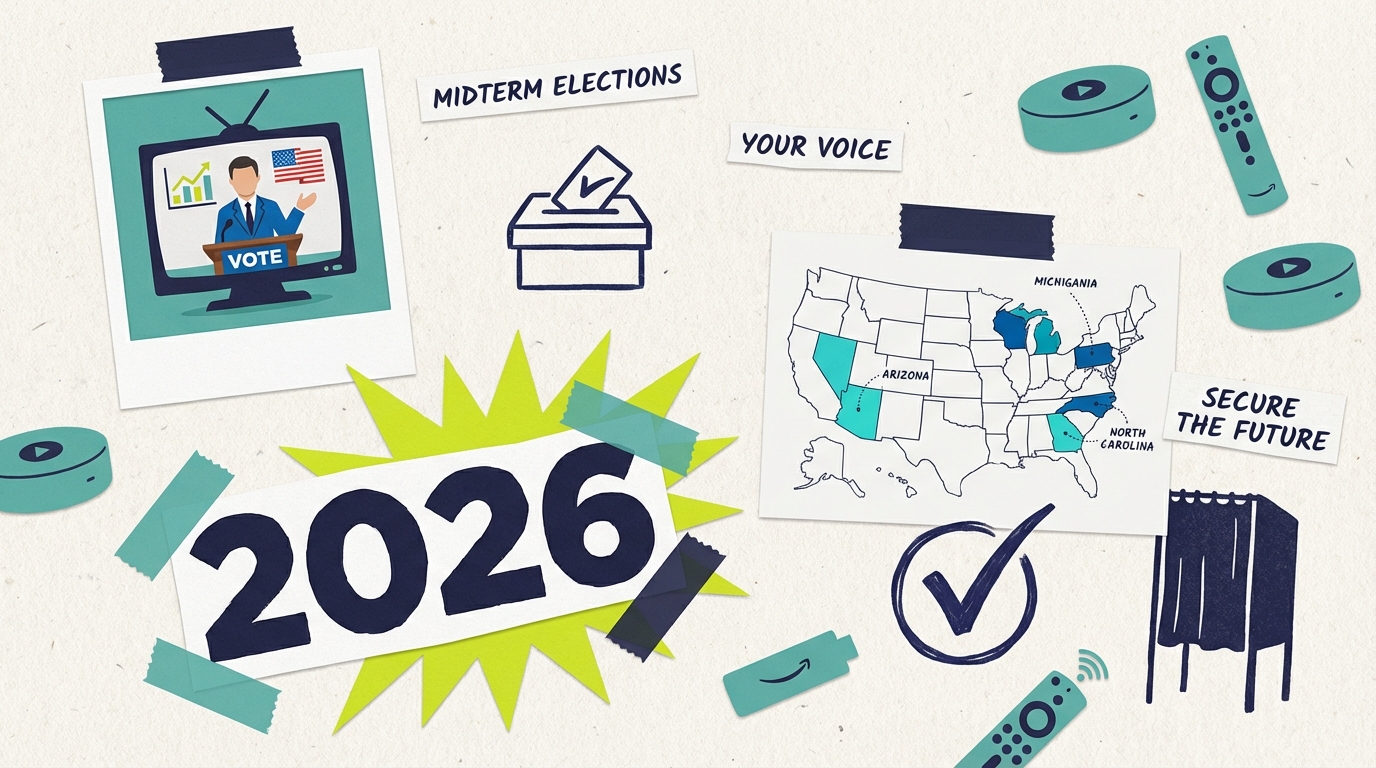
!Political TV Advertising 2026 Concept
The 2026 political advertising market
Understanding the market helps you plan your budget and timing. Here's what the data shows.
Spending projections
According to AdImpact's 2026 Political Projections Report, the midterm cycle will break records:
- Total political ad spend: $10.8 billion (most expensive midterm ever)
- CTV/streaming spend: $2.5 billion (fastest-growing category)
- House and Senate races: $5 billion combined (nearly half of all spending)
- Digital and social: $1.9 billion projected
The growth in CTV spending reflects how voters consume media. More than 60% of U.S. households now use streaming services as their primary TV source. Political advertisers are following the audience.
Why CTV matters for 2026
Connected TV advertising offers advantages that traditional broadcast can't match:
Precision targeting - Reach specific voter demographics, not just households in a broadcast area. Target by age, interests, viewing habits, and even voter file data.
Geographic control - Target your exact district, zip codes, or DMA. No wasted spend on viewers outside your race.
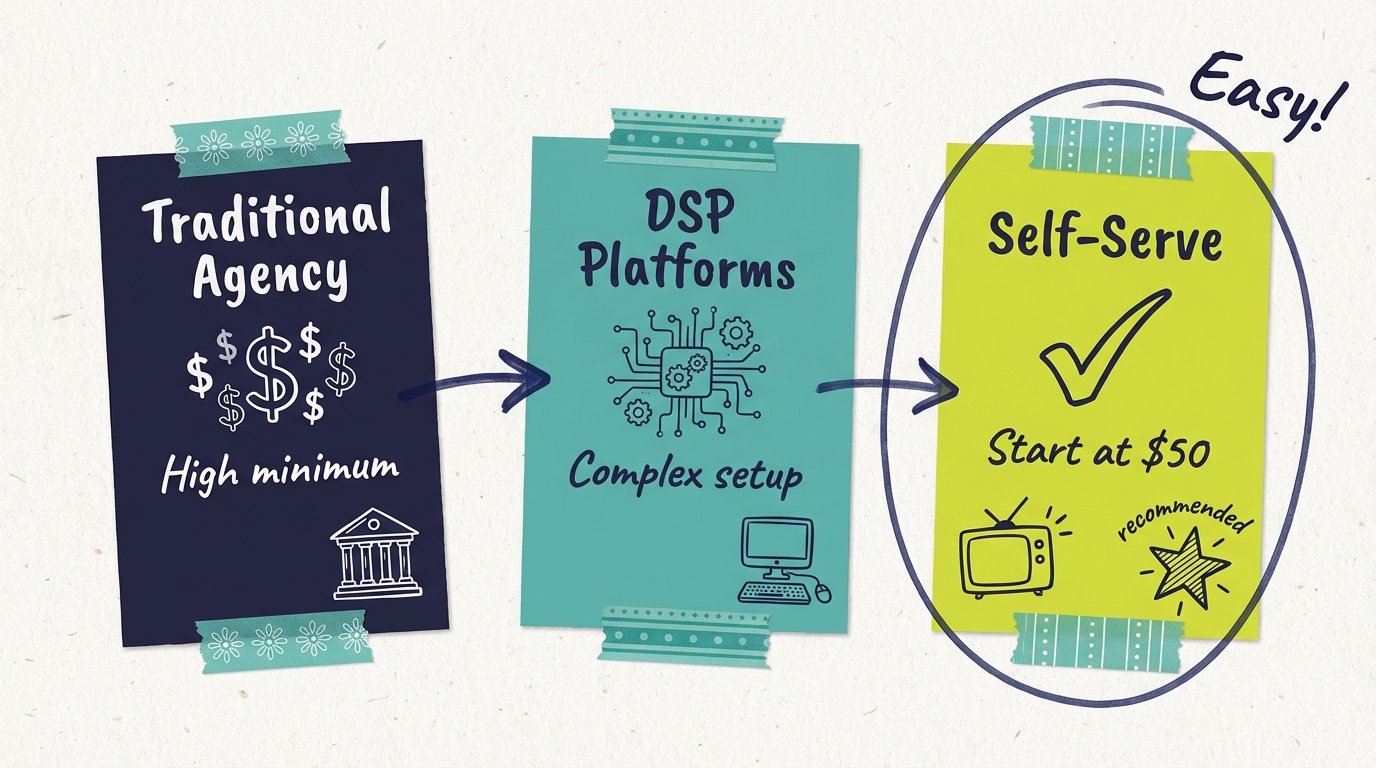
Lower minimums - Traditional TV buys often require $50,000+ commitments. CTV campaigns can start at $50 through platforms like Adwave.
Measurable results - Track impressions, completion rates, and website visits. Know exactly how your ads perform.
Premium inventory - Your ads run alongside major network content on platforms like Hulu, Peacock, and Roku.
For down-ballot races especially, CTV opens doors that broadcast never could. A city council candidate can now run TV ads on the same streaming services as Senate campaigns.
Types of political TV advertising
Different races and organizations have different needs. Here's how TV advertising works for each.
Candidate campaigns
Direct candidate advertising follows specific FCC rules but offers the most control over messaging:
- Federal candidates - Senate and House campaigns must include "I approve this message" disclosure
- State and local - Disclosure rules vary by state but generally require "paid for by" statements
- Primary vs. general - Adjust messaging as you move from primary to general election
Candidate campaigns benefit from the "lowest unit rate" rule on broadcast TV during certain windows before elections. However, this rule doesn't apply to streaming or cable, making CTV advertising consistently priced year-round.
PAC and Super PAC advertising
Political Action Committees operate under different rules:
- Traditional PACs - Can coordinate with candidates within contribution limits
- Super PACs - Can spend unlimited amounts but cannot coordinate with campaigns
- Issue advocacy - Can focus on issues without explicitly endorsing candidates
PACs often run heavier ad loads than candidates because they face fewer restrictions on timing and volume. Many focus on negative or contrast ads while candidates maintain positive messaging.
Issue advocacy and ballot measures
Ballot measure campaigns promote specific policy positions:
- Initiative campaigns - Support or oppose state ballot measures
- Referendum campaigns - Advocate for or against legislative referrals
- Issue education - Build awareness around policy topics
Issue campaigns often run earlier than candidate races, educating voters before election season heats up.
!Political Media Buying Platforms Comparison
How political TV advertising works
Modern political TV advertising combines traditional media buying with digital precision. Here's the process.
Traditional broadcast buying
Broadcast TV (ABC, CBS, NBC, Fox affiliates) requires working with station sales teams:
- Request avails - Ask stations what inventory is available
- Negotiate rates - Discuss pricing and placement
- Submit creative - Provide your ad with required disclosures
- Sign contracts - Commit to specific flights
- Traffic and air - Station schedules and runs your ads
Broadcast offers massive reach but limited targeting. You buy "time," not "audiences." Everyone watching that program sees your ad, whether they're in your district or not.
Cable advertising
Cable networks offer more targeting through zone-based buying:
- Zoned cable - Target specific geographic areas within a cable system
- Network targeting - Choose channels that align with voter demographics
- Lower minimums - Often more accessible than broadcast
However, cable viewership continues declining as audiences shift to streaming.
Connected TV and streaming
CTV advertising works more like digital advertising:
- Set targeting parameters - Geography, demographics, interests, viewing behavior
- Upload creative - Video ads with required disclosures
- Set budget and schedule - Choose daily spend and campaign duration
- Launch and optimize - Ads begin delivering to targeted audiences
- Monitor performance - Track impressions, completion rates, and engagement
Platforms like Adwave simplify this process for smaller campaigns. You provide information about your campaign, AI generates professional video creative, and you launch to your target audience in minutes.
Programmatic political advertising
Programmatic buying automates ad placement across multiple platforms:
Demand-side platforms (DSPs) - Tools that buy inventory across publishers Supply-side platforms (SSPs) - Platforms that sell publisher inventory Real-time bidding (RTB) - Automated auctions for ad placements
Programmatic allows sophisticated campaigns to optimize delivery across channels. However, it typically requires significant technical expertise or agency relationships.
Political TV advertising costs
Costs vary significantly based on market, timing, and platform. Here's what to expect.
Broadcast TV rates
Broadcast costs depend on market size and demand:
Major markets (New York, LA, Chicago):
- Prime time 30-second spot: $5,000-50,000+
- News programs: $1,000-15,000
- Daytime: $500-3,000
Mid-size markets:
- Prime time: $500-5,000
- News: $200-1,500
- Daytime: $100-500
Small markets:
- Prime time: $100-1,000
- News: $50-300
- Daytime: $25-100
During election season, demand drives prices significantly higher. The "lowest unit rate" rule helps federal candidates but doesn't apply to PACs or issue campaigns.
Cable TV rates
Cable typically costs less than broadcast:
- CPM (cost per thousand): $5-25 depending on network and market
- Minimum buys: Often $5,000-10,000 per month
- Zone targeting: Adds 10-20% to base rates
Cable offers more flexibility but declining viewership limits reach.
CTV and streaming rates
Streaming platforms price on CPM basis:
- Premium inventory (Hulu, Peacock): $25-45 CPM
- FAST channels (Tubi, Pluto TV): $15-25 CPM
- Self-serve platforms (Adwave): Starting at $50 total spend
The CPM model means you pay for actual impressions delivered to your target audience. A $500 CTV campaign at $25 CPM delivers 20,000 ad views to targeted voters.
For down-ballot races, this math works. A school board candidate spending $2,000 on CTV can reach 80,000+ targeted impressions in their district - often more effective than a single broadcast buy at the same budget.
!Political Ad Creative Best Practices
!Voter Targeting Funnel for Political Campaigns
Targeting voters on TV
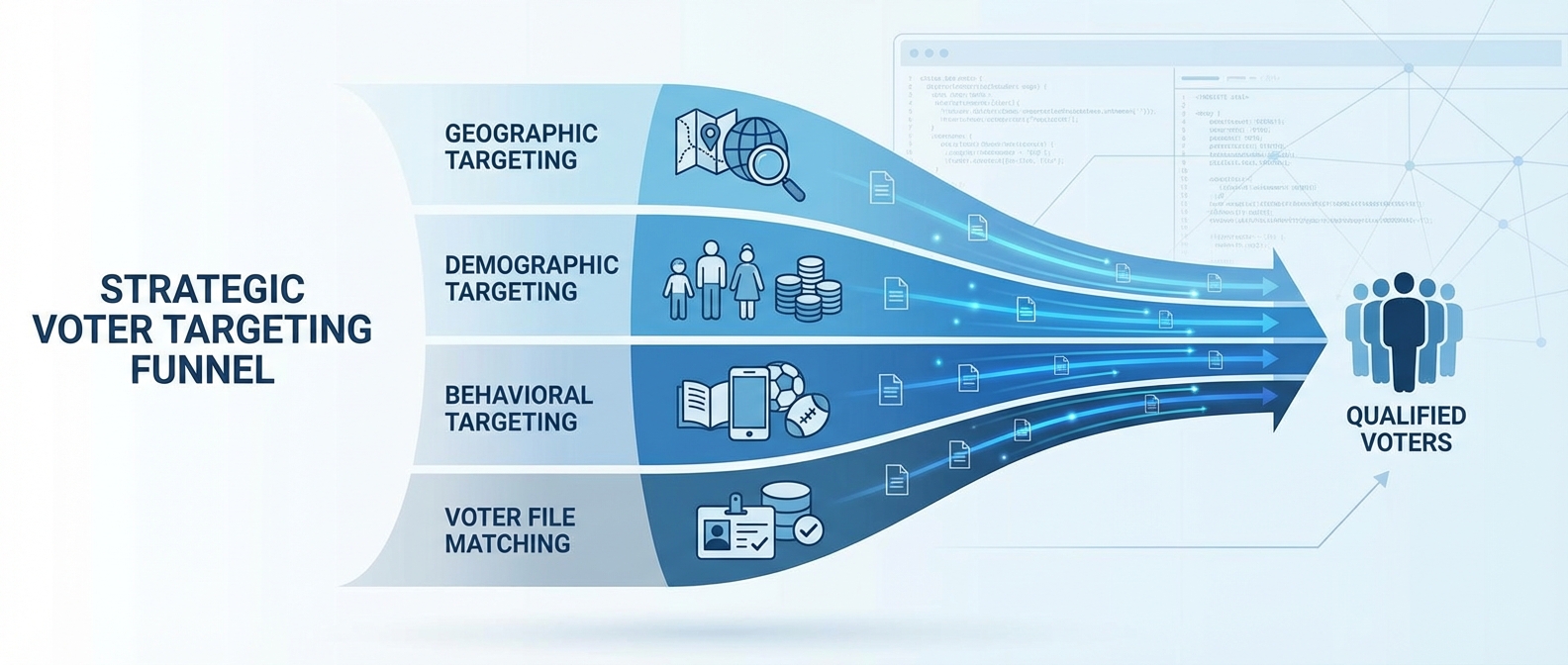
Effective targeting separates successful campaigns from wasted budgets.
Geographic targeting
All political advertising requires geographic precision:
DMA targeting - Designated Market Areas define broadcast TV regions. Good for statewide or congressional races that align with DMA boundaries.
Zip code targeting - CTV platforms allow zip-code-level targeting. Essential for city council, school board, and other hyperlocal races.
District targeting - Advanced platforms can target specific congressional, state legislative, or local districts directly.
Radius targeting - Target households within a certain distance of a location, useful for neighborhood-focused campaigns.
For most down-ballot races, geographic targeting determines campaign success. Every dollar spent outside your district is wasted.
Demographic targeting
Layer demographics on top of geography:
Age - Target age groups most likely to vote or support your campaign Income - Reach households in specific income brackets Education - Target by education level Household composition - Families, singles, empty nesters
Demographic targeting helps stretch budgets by focusing on likely voters rather than all residents.
Voter file targeting
Advanced campaigns use voter file data for precision targeting:
Registered voters - Target only those registered to vote Party affiliation - Reach voters by party (where public) Vote history - Target consistent voters or low-propensity voters you need to mobilize Modeled audiences - Predictive models for issue positions or candidate support
Voter file targeting requires data onboarding - matching your voter lists to TV platform identifiers. Major platforms support this, though it adds complexity and cost.
Behavioral and interest targeting
CTV platforms offer additional targeting layers:
Content affinity - Viewers of news, sports, specific genres Purchase behavior - Recent movers, car buyers, home improvement Life events - New parents, recent graduates, retirees
Political campaigns often combine geographic + demographic + behavioral targeting for maximum precision.
Compliance and regulations
Political advertising faces specific regulatory requirements. Violations can result in fines, pulled ads, and negative publicity.
FCC requirements
The Federal Communications Commission regulates broadcast and cable advertising:
Disclosure requirements - Ads must identify who paid for them Reasonable access - Stations must provide reasonable access to federal candidates Equal opportunity - If a station sells time to one candidate, it must offer equal opportunity to opponents Lowest unit rate - Federal candidates get the lowest rate charged to any advertiser during specific windows
Note: FCC rules apply to broadcast and cable. CTV and streaming platforms operate under different, often platform-specific policies.
Platform policies
Each streaming platform has its own political advertising policies:
Hulu - Accepts political ads with verification requirements Roku - Political advertising allowed with sponsorship identification YouTube - Requires advertiser verification and disclosure Meta/Instagram - Extensive authorization and transparency requirements
Some platforms restrict political advertising entirely or during specific periods. Check current policies before planning campaigns.
State regulations
State laws add additional requirements:
Disclaimer language - Some states require specific disclaimer wording Filing requirements - Many states require filing copies of ads Spending disclosures - Campaign finance reports must include ad spending Timing restrictions - Some states restrict advertising near election day
Work with campaign counsel to ensure compliance with state-specific rules.
Ad content requirements
Political ads must include proper disclosures:
"Paid for by" statements - All ads need sponsor identification "I approve this message" - Required for federal candidate ads Top funder disclosures - Some jurisdictions require listing top contributors Visual and audio requirements - Minimum size and duration for disclosures
Building your political TV strategy
Effective political TV advertising requires strategic planning, not just buying airtime.
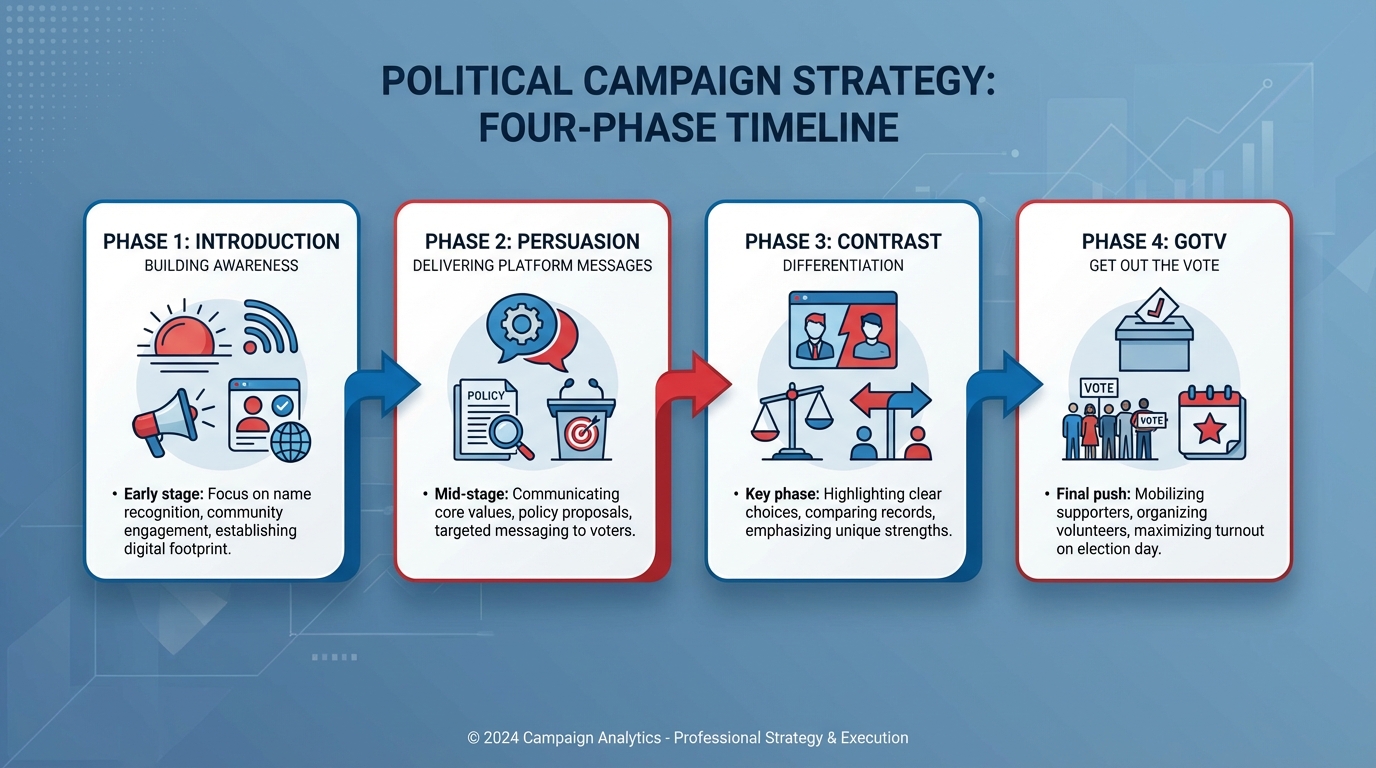
!Political Campaign Strategy Four-Phase Timeline
Define your objectives
Different goals require different approaches:
Name recognition - Build familiarity with undecided voters. Focus on reach and frequency.
Message delivery - Communicate specific platform positions. Use longer-form content and repetition.
Persuasion - Move voters from undecided to supporting. Requires targeted messaging and sustained exposure.
Mobilization - Drive turnout among supporters. Focus on vote-by-mail, early voting, and election day reminders.
Most campaigns need all four at different stages, but primary focus shifts as election day approaches.
Plan your timeline
Political advertising follows predictable patterns:
6-12 months out - Issue education and early awareness (primarily issue campaigns)
3-6 months out - Introduction and platform communication
1-3 months out - Persuasion messaging and contrast advertising
Final 30 days - Saturation and turnout
Final week - Get-out-the-vote messaging and critical election day reminders
Starting early costs less (lower demand) and builds foundation for later messaging. However, most down-ballot campaigns can't sustain year-long advertising.
Allocate your budget
Budget allocation depends on race type and competitive dynamics:
Suggested allocations for competitive races:
- TV/CTV advertising: 40-60% of media budget
- Digital/social: 20-30%
- Mail: 10-20%
- Field/other: 10-15%
Within TV spending:
- CTV/streaming: 50-70% (for most down-ballot races)
- Broadcast: 20-40% (if budget allows)
- Cable: 10-20% (declining importance)
For races under $50,000 total budget, CTV often makes more sense than broadcast due to lower minimums and better targeting.
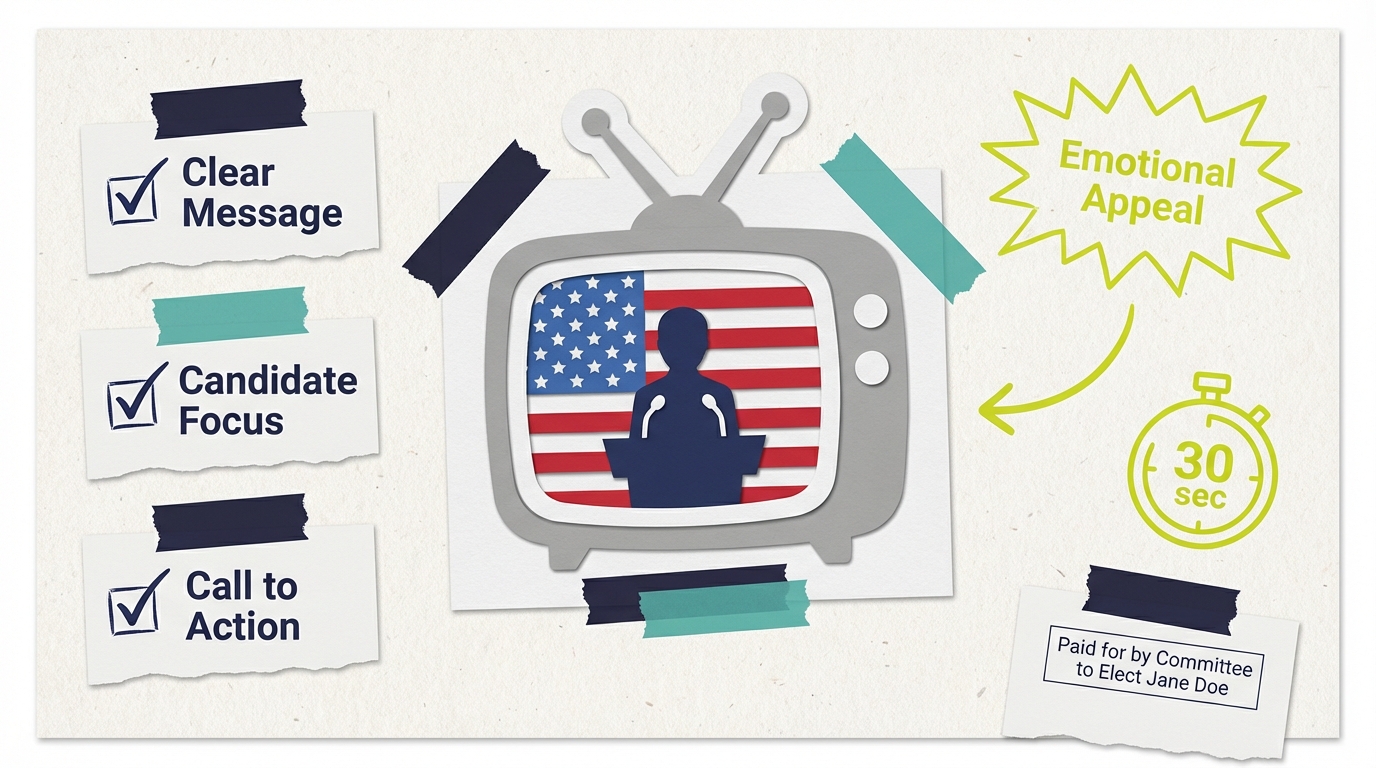
Create effective creative
Political TV ads need to accomplish multiple goals in 15-30 seconds:
Establish the candidate - Face, name, and title/experience Deliver the message - One clear point or value proposition Include required disclosures - "Paid for by" and approval statements Call to action - Visit website, early voting, election day
Avoid trying to cover multiple issues in one ad. Campaigns typically rotate multiple ads with different messages.
Production options range from professional shoots ($10,000-100,000+) to AI-generated ads (included free with some platforms) to simple talking-head videos (DIY with smartphone).
Measure and optimize
Track metrics that connect to campaign goals:
Reach metrics - Unique households reached, frequency per household Engagement metrics - Video completion rate, website visits Conversion metrics - Email sign-ups, donations, volunteer registrations Outcome metrics - Polling movement, vote share
CTV provides more detailed reporting than broadcast. Use data to optimize targeting, creative, and placement throughout the campaign.
Rotate creative for maximum impact
Running the same ad for months leads to voter fatigue. Plan for creative rotation throughout your campaign:
Early phase: Introduction ads establishing who you are and why you're running. Focus on biography and values.
Mid-campaign: Issue-focused ads highlighting your positions on topics voters care about. Test multiple issues to identify what resonates.
Final weeks: Contrast and mobilization messaging. Compare your record or positions to opponents. Drive turnout among supporters.
A/B testing different creative versions helps identify top performers. CTV platforms make this easy by allowing multiple creatives to run simultaneously with detailed performance tracking for each version.
Getting started with political TV advertising
For most 2026 campaigns, the path forward includes CTV as a core component. Here's how to begin.
Assess your race
Answer these questions to shape your strategy:
- What's your total media budget?
- What geography do you need to cover?
- Who are your target voters?
- What's your timeline to election day?
- Do you have existing video creative?
Answers guide platform selection, targeting approach, and budget allocation.
Choose your platforms
For most down-ballot and mid-level races:
Start with CTV/streaming - Lower minimums, better targeting, measurable results. Platforms like Adwave make this accessible for campaigns of all sizes.
Add broadcast strategically - If budget allows and your race aligns with DMA coverage, broadcast adds reach among older voters and news audiences.
Skip or minimize cable - Declining viewership makes cable less efficient for most races.
Launch your first campaign
Getting started doesn't require massive budgets or agency relationships:
- Define your target - Geography, demographics, voter type
- Create or obtain video - Professional production, DIY, or AI-generated
- Set budget and duration - Start with what you can sustain
- Launch and monitor - Track performance and adjust
- Scale what works - Increase spend on successful approaches
Many campaigns start with $500-1,000 test campaigns to validate targeting before scaling.
Build for the long campaign
The 2026 cycle is already underway. Early advertisers benefit from:
- Lower CPMs (less competition)
- Time to test and optimize
- Voter familiarity before opponent advertising begins
- Longer runway for message penetration
Whether you're running for city council or Congress, TV advertising in 2026 means streaming. The voters are there. The tools are accessible. The only question is whether your campaign will reach them.
Ready to start? Create your campaign ad and see how your message looks on streaming TV. It takes about 2 minutes and costs nothing to try.
Common questions
How much does political TV advertising cost in 2026?
Costs vary by platform and market. Broadcast TV ranges from $100 to $50,000+ per spot depending on market size and timing. CTV/streaming advertising typically costs $15-45 CPM. Campaigns can start CTV advertising for as little as $50 through self-serve platforms, making TV accessible for races of all sizes.
Can small campaigns afford TV advertising?
Yes. CTV and streaming platforms have made TV advertising accessible to campaigns with limited budgets. A school board candidate can run targeted streaming TV ads to their district for $500-2,000 - often more effective than traditional media buys at similar budgets. The key is precise targeting to avoid wasting spend on non-voters.
What's the difference between broadcast TV and CTV for political advertising?
Broadcast TV (ABC, NBC, CBS, Fox affiliates) reaches mass audiences but offers limited targeting and high minimums. CTV (streaming) allows precise demographic and geographic targeting, real-time optimization, and lower minimums. Most 2026 campaigns will use CTV as their primary TV channel, supplementing with broadcast only if budgets allow.
Do political TV ads require specific disclosures?
Yes. All political ads must identify who paid for them. Federal candidate ads must include "I approve this message" statements. State and local rules vary but generally require "paid for by" disclosures. CTV platforms have specific size and duration requirements for on-screen disclosures. Work with campaign counsel to ensure compliance.
When should political campaigns start TV advertising?
Most campaigns benefit from starting earlier than they think. Issue campaigns often begin 6-12 months before elections. Candidate campaigns typically start 3-6 months out for introduction and platform messaging, intensifying in the final 60-90 days. Early advertising faces less competition and lower costs while building voter familiarity.
How do campaigns target specific voters on TV?
CTV platforms offer multiple targeting layers: geography (state, DMA, zip code, district), demographics (age, income, education), interests and behavioral signals, and in some cases, voter file matching. This precision allows campaigns to reach likely voters in their district rather than broadcasting to entire markets.
Version history
| Version | When | Summary |
|---|---|---|
| v1 | 6/20/2026, 3:11:54 AM | migration import |