Retargeting TV Viewers: CTV to Conversion (2026 Guide)
slug: retargeting-tv-viewers-ctv-conversions · status: draft · score: 85% · 1 versions
View published version → · Contentful entry: 2MvEKpq6i4gagE5k9DuXKj
Validation
| Rule | Detail | |
|---|---|---|
| pass | No banned competitors | No banned competitors |
| pass | No emdashes | No emdashes |
| pass | Avoid AI telltale words | No AI telltale words |
| pass | Primary keyword in title | No primary keyword to check |
| pass | Use contractions | Contractions used |
| fail | Minimum internal links | Internal links not in sitemap: /resources/ctv-retargeting-guide, /resources/ad-with-qr-code, /resources/retargeting-ads-small-business, /resources/lower-funnel-marketing, /resources/cross-screen-campaigning-mobile-tv-strategies, /resources/how-to-measure-advertising-effectiveness, /how-it-works |
| pass | FAQ section required | FAQ section present |
| fail | Author assigned | No author assigned (never use 'Adwave Team' for new content) |
| pass | Title length 50-60 | Title length 54 |
| pass | Minimum 4 images | 4 images |
| pass | SEO description under 160 | seoDescription 157 chars |
| pass | Adwave mention cadence | 3 Adwave mentions |
| pass | Short description present | shortDescription 176 chars |
| warn | Word count by type | Word count 1873 below target (2500-5000) |
| pass | Year-dated title for evergreen types | Title carries year 2026 |
| pass | No manual table of contents | No manual TOC |
Images (4)
Content
Retargeting TV Viewers: CTV to Conversion (2026 Guide)
A TV ad does its job the moment a household watches it: awareness rises, trust accrues, your name lodges somewhere useful. But TV's job ends at intent. Nobody checks out, books, or calls from their couch mid-show. The viewers your campaign just warmed up will convert later, somewhere else, on another screen, and whether they convert with you depends on what you've built to catch them.
That catching system is what this guide covers: the four paths that turn CTV impressions into completed conversions, how to sequence them, and how to measure across the gap. One housekeeping note first: this is the reverse of CTV retargeting, which puts your TV ad in front of people who already visited your website. Both loops are worth running; this one starts from the TV impression and follows the viewer forward.
The conversion gap is a feature, not a bug
Direct-response thinking treats TV's lack of a click as a weakness. It's actually how the medium works: TV reaches people in a lean-back state, builds memory and preference, and the action comes minutes to weeks later through whatever path is convenient. Second-screen behavior research consistently shows large shares of viewers picking up a phone during or right after TV exposure; the search bar is TV's click.
So the design question isn't "how do I make TV convert immediately?" It's "when this household acts on what they saw, will every door they try lead to me?" Four doors matter.
Path 1: QR codes, the direct line
The QR code in your spot's closing seconds is the closest thing TV has to a native click. The viewer scans from the couch, lands on a dedicated page, and you have an identified, high-intent visitor whose source is unambiguous.
Make the scan worth it: a dedicated landing page matched to the ad's promise (not your homepage), a concrete next step (book, claim, browse), and ideally a reason to act now. Adwave spots support QR codes natively, and scan data gives you household-level response by geography, the cleanest direct-response readout TV offers. Our guide to ads with QR codes covers design specifics.
Expect QR to capture the most motivated slice, not the majority. Its other job is diagnostic: scan volume tells you which creative and which zips are generating action this week.
Path 2: Own your branded search
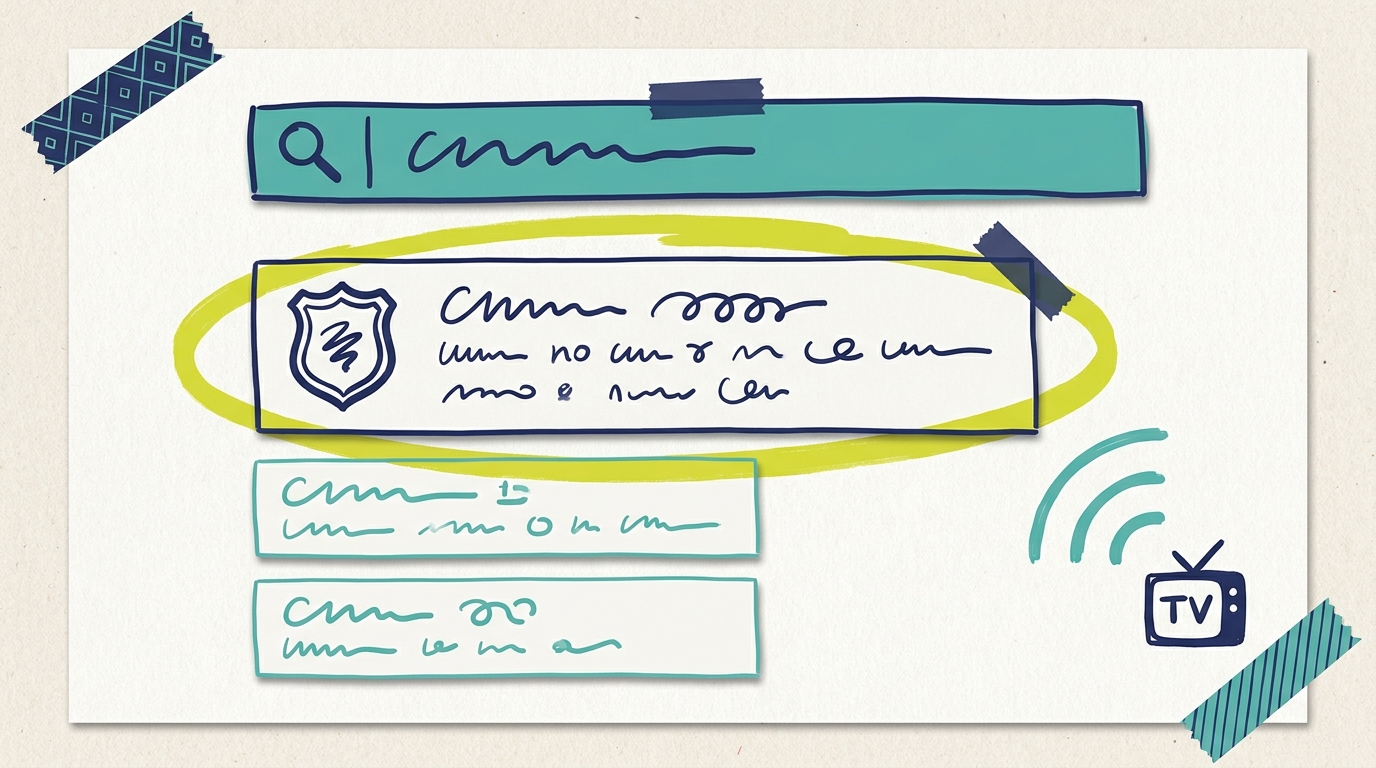
The largest share of TV-driven action arrives as a search for your name, often misspelled, hours or days after exposure. This door is yours to lose, and businesses lose it constantly:
- Run branded search ads during your TV flight, even though you "already rank." Competitors and directories bid on your name precisely because your TV is creating the demand; the few cents per branded click is the cheapest conversion insurance in marketing.
- Match the SERP to the spot. If the ad promised "same-week appointments," your search ad copy and landing page should say it back. Recognition completes the loop.
- Watch the branded query report weekly. Rising branded search in your targeted zips is the first reliable sign your TV is working, before any conversion math is possible.
Path 3: Pixel the visit, close on digital
A TV-warmed viewer who searches you, browses for two minutes, and leaves isn't lost; they've just moved from "aware" to "considering." This is where conventional retargeting for small business becomes the second stage of your TV campaign:
- Your site pixel (Meta, Google) catches the TV-driven visitor automatically; no special integration needed, since they arrive like any visitor.
- Retargeting ads on social and display do the reminding over the following weeks, at the cheapest CPMs in your mix, against an audience your TV already qualified.
- Creative continuity does the heavy lifting: same faces, same tagline, same offer as the spot. The feed ad should feel like a memory of the commercial.
During TV flights, expect your retargeting pool to grow and, more interestingly, to convert better. TV-sourced visitors arrive with trust pre-loaded, and retargeting them costs exactly what retargeting cold visitors costs. This is the quiet arbitrage of the whole system: TV improves the quality of every pool downstream of it. The lower-funnel mechanics stay the same; the inputs get better.
Path 4: Synchronized social in the same zips
The fourth path doesn't wait for a visit. Run social and display campaigns in the same zip codes, during the same weeks, as your TV flight: matched geography, matched timing, matched creative.
The household that saw your spot Tuesday scrolls past your feed ad Thursday and experiences something close to familiarity ("these folks are everywhere"). Frequency across channels compounds in a way single-channel frequency doesn't; the cross-screen playbook covers the coordination details. For small budgets, even $300-500 of synchronized social per month measurably amplifies a TV flight, because it's not building awareness from scratch, just echoing it.
The sequencing playbook
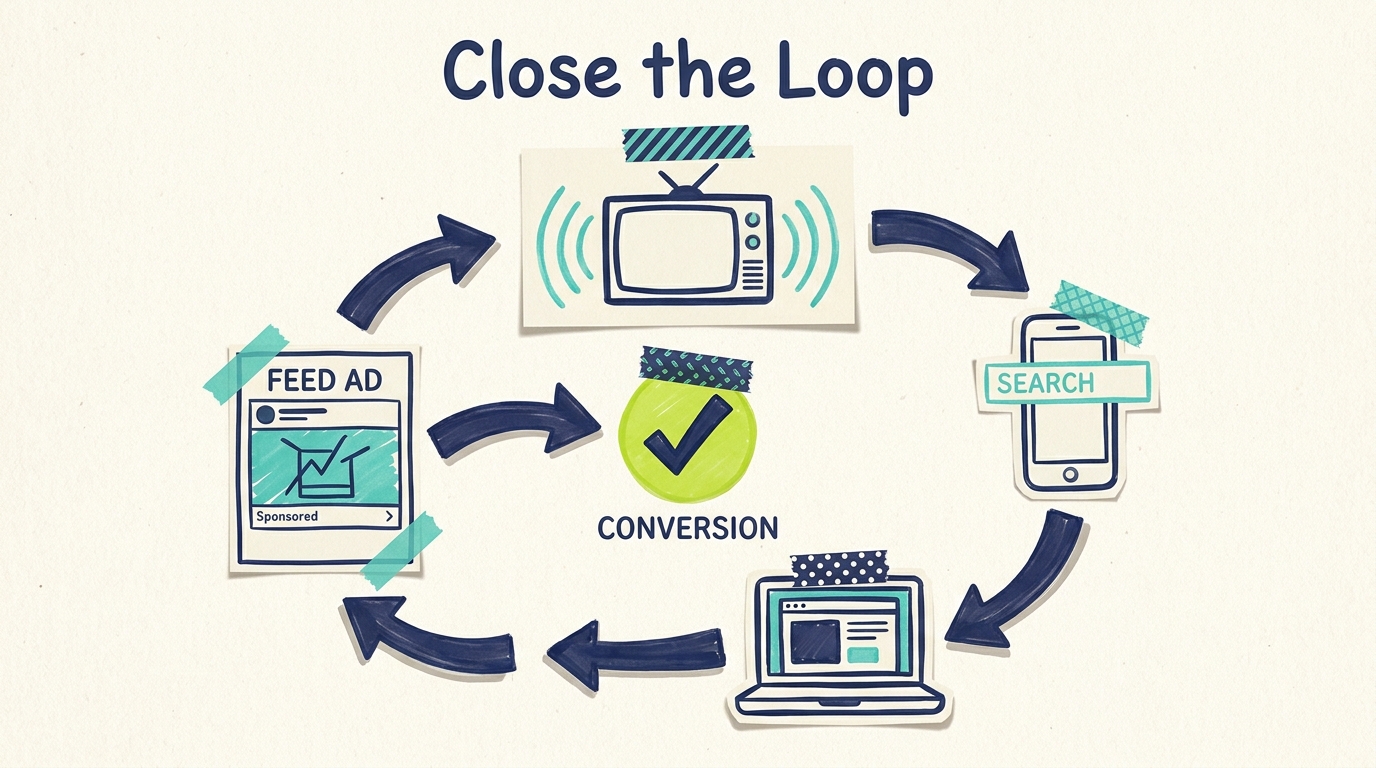
Put the four paths on a timeline and the system looks like this:
Three sequencing rules keep it honest:
Build the catchers before the flight. Branded search ads, the pixel, the QR landing page, and the retargeting campaigns should all be live the day your TV starts, not bolted on in week six. The most expensive TV mistake isn't bad creative; it's warm viewers arriving at doors nobody built.
Keep one message across all stages. The system works through recognition. A household that sees four different value propositions across four channels experiences four strangers instead of one familiar business.
Let each stage do its own job. Don't ask the TV spot to close, the retargeting ad to introduce, or the branded search ad to persuade. Introduction, reminder, capture: in that order.
Measuring across the gap
The TV-to-conversion path breaks last-click attribution by design, so measure the system rather than the click:
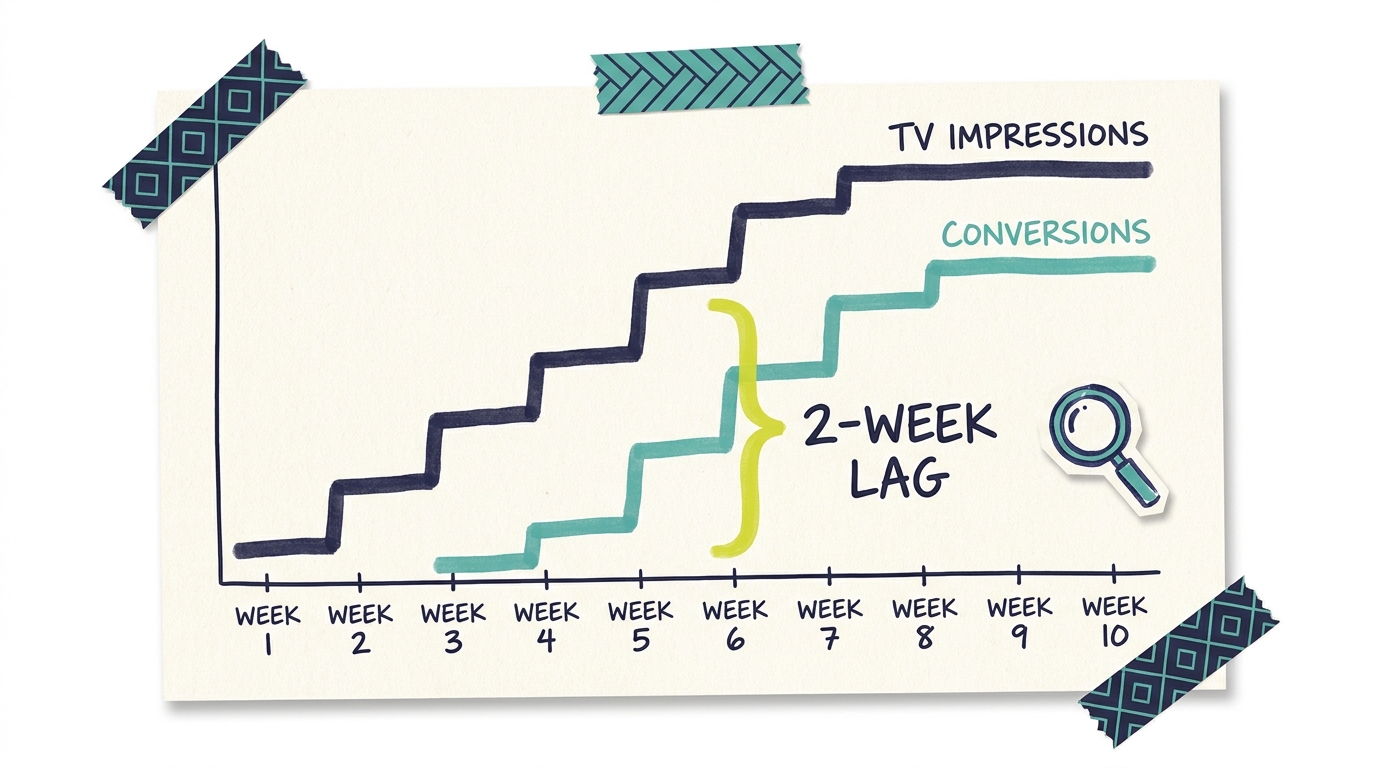
- Time-lagged correlation. Plot TV impressions by week against conversions by week, expecting a 1-3 week lag for most local categories. The pattern across a quarter is usually unmistakable.
- Branded search as the leading indicator. It moves first, within days, and localizes to your targeted zips. Flat branded search under heavy TV frequency means a creative problem; rising branded search with flat conversions means a website or offer problem. The diagnosis is free.
- Assisted-conversion reports. In your analytics, watch conversions where retargeting or branded search assisted. During TV flights, the assisted share grows; that growth is the system working.
- QR scans as the per-creative pulse. Scans won't be your biggest conversion source, but they're your fastest read on which spot and which geography are responding.
The broader principles live in our guide on how to measure advertising effectiveness; the TV-specific habit is patience with the lag and attention to the leading indicators.
A worked example
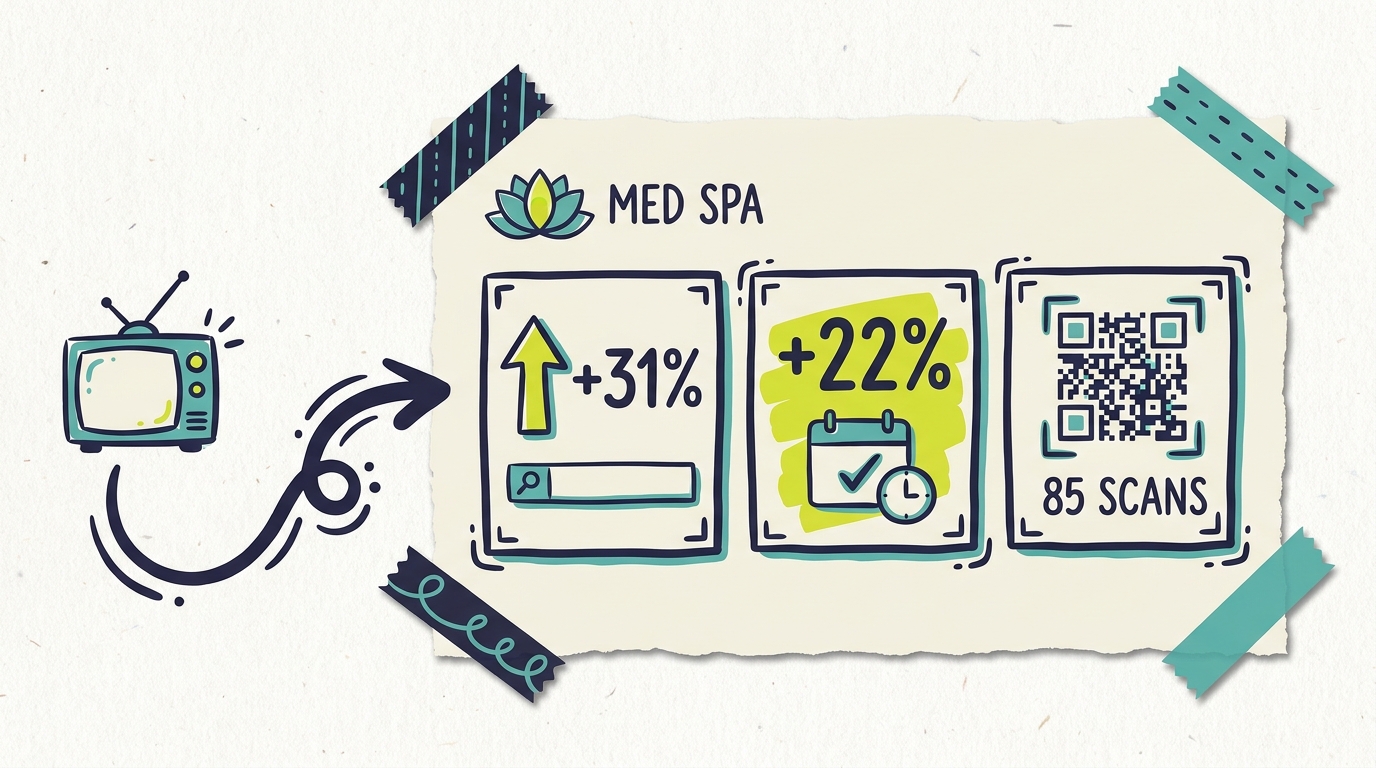
A local med spa runs a $1,200/month CTV flight across eight zip codes. Before launch, they stand up: branded search ads ($150/month), a QR landing page with a first-visit offer, the Meta pixel, and a $400/month retargeting plus synchronized-social layer using stills from the TV spot.
Week 2: branded searches up 31% in the targeted zips. Week 3: site traffic up, retargeting pool doubles. Weeks 4-8: bookings climb 22% over baseline; assisted-conversion reports show branded search and retargeting touching most new-patient bookings; QR scans total 85, of which 19 booked directly.
Last-click attribution credits search and social for nearly everything. The owner, reading the system instead of the click, sees that the search and social numbers only moved when the TV turned on. That's the report that keeps the program funded.
Common questions answered
Can I retarget the actual households that saw my TV ad?
Device-graph retargeting of exposed households exists at the enterprise level, but small businesses don't need it. The practical system (QR direct response, branded search capture, site-pixel retargeting, and zip-synchronized social) recreates the same effect with tools you already have, at no added data cost, and without the privacy complexity.
How long after a TV flight should I keep retargeting running?
Keep the digital layers live for at least 30-45 days after the TV flight ends. Awareness decays slowly, and households warmed in the flight's final weeks are still converting a month later. Many advertisers see their best blended efficiency in the two weeks immediately after a flight, when the retargeting pool is at its largest and the TV spend has stopped.
What budget split makes sense between TV and the follow-up layers?
A useful starting ratio is 70/30: roughly 70% to the CTV flight that creates the demand and 30% across branded search, retargeting, and synchronized social to capture it. Below $1,000 total, simplify to TV plus branded search plus the pixel, which costs almost nothing and preserves the core loop.
Do I need different creative for the retargeting ads?
Different format, same identity. Pull stills, key lines, and the offer straight from the TV spot so the feed ad triggers recognition. The one addition that earns its place in retargeting creative is a sharper call to action and, where appropriate, a deadline, since you're now talking to people who already know who you are.
How do I know the TV is driving the conversions and not just the search ads?
Turn the layers on and off deliberately. Branded search volume that rises and falls with TV flight timing, in TV-targeted zips and not elsewhere, is the fingerprint. If you want a harder test, run the full system in one market and digital-only in a comparable one for a quarter; the gap is your TV effect, measured the way multi-location operators do it.
Build the doors before you knock
Bottom line: TV creates the intent; the conversion happens wherever you've prepared for it. QR for the motivated, branded search for the curious, retargeting for the considering, synchronized social for the compounding. Stand the system up before the first impression airs and every TV dollar starts working twice.
See how Adwave works: generate your spot in about two minutes, add your QR code, target your zips, and launch the flight your funnel is ready to catch.
Internal Links Used
- /resources/ctv-retargeting-guide
- /resources/ad-with-qr-code
- /resources/retargeting-ads-small-business
- /resources/lower-funnel-marketing
- /resources/cross-screen-campaigning-mobile-tv-strategies
- /resources/how-to-measure-advertising-effectiveness
Sources
- Second-screen usage during TV viewing: widely reported viewer-behavior research (Nielsen)
- Adwave product facts: QR support, ~2 min generation, zip targeting
Version history
| Version | When | Summary |
|---|---|---|
| v1 | 6/20/2026, 3:11:54 AM | migration import |