CTV vs. Meta Ads: Which Channel Delivers Better ROI for SMBs?
slug: ctv-vs-meta-ads-comparison · status: draft · score: 76% · 1 versions
View published version → · Contentful entry: 5CyI3yew8BvBGs1GyhKQAC
Validation
| Rule | Detail | |
|---|---|---|
| pass | No banned competitors | No banned competitors |
| pass | No emdashes | No emdashes |
| pass | Avoid AI telltale words | No AI telltale words |
| pass | Primary keyword in title | No primary keyword to check |
| pass | Use contractions | Contractions used |
| fail | Minimum internal links | Internal links not in sitemap: /resources/what-is-connected-tv-advertising, /pricing, /how-it-works, /features, /how-it-works, /try-free |
| fail | FAQ section required | Missing FAQ / 'Common questions answered' section |
| fail | Author assigned | No author assigned (never use 'Adwave Team' for new content) |
| pass | Title length 50-60 | Title length 61 |
| pass | Minimum 4 images | 4 images |
| pass | SEO description under 160 | seoDescription 146 chars |
| pass | Adwave mention cadence | 4 Adwave mentions |
| pass | Short description present | shortDescription 162 chars |
| warn | Word count by type | Word count 2334 below target (2500-5000) |
| warn | Year-dated title for evergreen types | Year-dated type should include (2026) in the title |
| pass | No manual table of contents | No manual TOC |
Images (4)
Content
CTV vs. Meta Ads: Which Channel Delivers Better ROI for SMBs?
Subtitle: A head-to-head comparison of costs, targeting, and real-world results
SEO Description: Comparing CTV vs Facebook ads for small business? This guide breaks down costs, targeting, and ROI to help you decide which channel (or both) belongs in your marketing mix.
---
If you've been running Facebook or Instagram ads for your small business, you've probably noticed something frustrating: the results aren't what they used to be. CPMs keep climbing, iOS privacy changes have thrown a wrench in targeting, and the competition for attention in those feeds is fiercer than ever.
You're not imagining it. And you're not alone in wondering if there's a better way to reach customers.
That's why more SMB marketers are asking about CTV vs Facebook ads (and CTV vs Instagram ads), specifically whether streaming ads vs Facebook could be a smarter use of their budget. It's a fair question, and one that deserves a fair answer, not marketing hype.
Here's the honest comparison. Both channels have real strengths. Both have limitations. The right choice depends on your goals, budget, and what you're trying to accomplish. Let's break it down.
How CTV and Meta Ads Actually Compare
Before diving into metrics, it's worth understanding the fundamental difference between these channels. They're not just different platforms. They're different advertising experiences entirely.
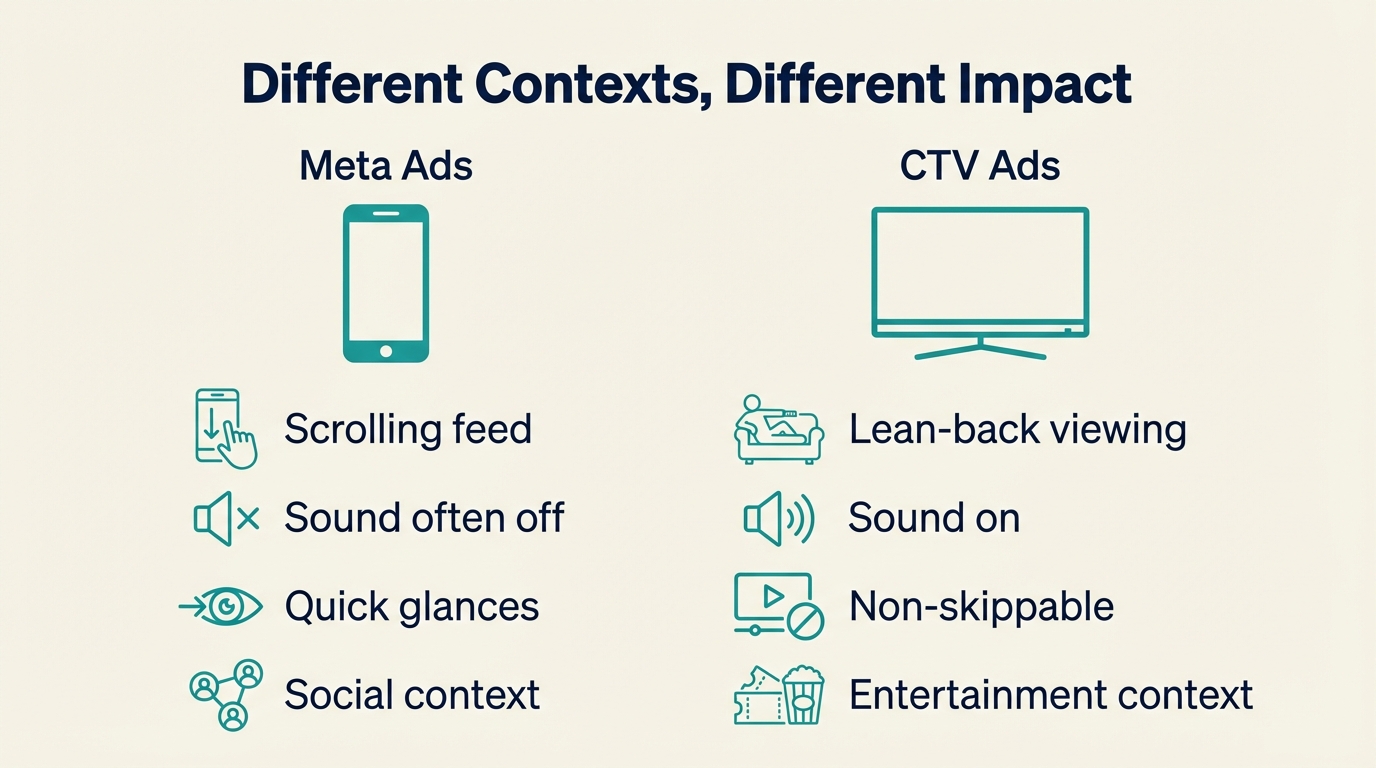
Meta ads (Facebook and Instagram) appear in a social feed where users are scrolling quickly, often distracted, and conditioned to skip past anything that looks like an ad. The format is typically static images or short video, often with sound off. The context is social: users are catching up with friends, browsing content, killing time.
CTV ads (connected TV/streaming) appear on the biggest screen in the house during intentional viewing. The viewer chose to watch something. They're leaned back, engaged, and ads are typically non-skippable. The context is entertainment: movie night, catching up on a show, watching the game.
This context difference matters more than most marketers realize. A study of connected TV advertising shows that CTV ads achieve 90%+ completion rates, while the average Facebook video ad gets watched for less than 6 seconds.
That doesn't mean one is "better." It means they work differently.
Targeting Capabilities: CTV vs Meta Ads Head-to-Head
One of Meta's historic advantages has been targeting precision. You could reach "women aged 25-34 interested in yoga who recently engaged with fitness content." That granularity was powerful.
But here's what's changed: iOS 14.5's App Tracking Transparency gutted Meta's ability to track users across apps. The targeting that once felt surgical now feels more like buckshot.
Meta's current targeting strengths:
- Interest and behavior targeting (though less precise than before)
- Lookalike audiences based on customer lists
- Retargeting website visitors (with limitations)
- Detailed demographic slicing
Meta's targeting limitations:
- iOS users increasingly opt out of tracking
- Third-party data restrictions growing
- Less visibility into cross-platform behavior
- Audience quality declining in many verticals
CTV's targeting capabilities:
- Geographic targeting (down to zip code or radius)
- Household-level demographic data
- Content genre targeting (sports viewers, news watchers, etc.)
- Device and platform targeting
- First-party data from streaming platforms
CTV's targeting limitations:
- Less granular interest targeting than Meta's peak
- Household-level (not individual) in most cases
- Newer audience segments still maturing
For local businesses, CTV's geographic precision is often more valuable than Meta's interest targeting. If you're a restaurant, reaching every household within 15 miles who watches cooking shows is more useful than reaching yoga enthusiasts nationwide.
Cost Comparison: Real Numbers for CTV vs Facebook Ads
Let's talk actual costs. This is where many comparisons get muddy because they compare different metrics.
Wait, CTV has a higher CPM but lower effective CPM? Yes. Here's why that matters.
When you pay for a Meta video ad impression, many viewers scroll past in under 2 seconds. You paid for an "impression" that made no impression. CTV ads are non-skippable and typically 15-30 seconds. When you pay for an impression, you get the full message delivered.
The math works out like this: If you pay $12 CPM on Meta but only 25% watch your video, your effective cost per completed view is $48 CPM. If you pay $25 CPM on CTV with 95% completion, your effective cost is $26 CPM.
That said, Meta wins on minimum barrier to entry. You can test with $5/day. CTV platforms like Adwave start at $50 total, which is still accessible but requires slightly more commitment.
Creative Requirements: What Each Channel Demands
This is where connected TV vs social media advertising shows another key difference.
Meta ad creative:
- Static images work (and often outperform video)
- Square or vertical formats preferred
- Sound-off optimization important
- Text overlays crucial for silent viewing
- Can test many variations quickly
- Production: iPhone photos can work
CTV ad creative:
- Video required (15-30 seconds typical)
- Horizontal 16:9 format
- Sound expected and important
- Broadcast-quality expectations
- Fewer variations (TV production historically expensive)
- Production: Traditionally required professional production
The production gap used to be CTV's biggest barrier for small businesses. A professional TV commercial could cost $5,000-$50,000+.
That's changed. AI creative tools now generate broadcast-quality TV ads from just a website URL or product photos. Adwave's platform, for example, creates professional 30-second commercials in minutes with zero production budget. You can edit via chat, swap images, adjust music, and launch same-day.
This fundamentally shifts the CTV vs Facebook ads equation. When creative costs approach zero for both channels, the comparison becomes purely about performance and reach.
Measurement & Attribution: The Honest Truth
Here's where we need to be straightforward: neither channel offers perfect attribution for small businesses.
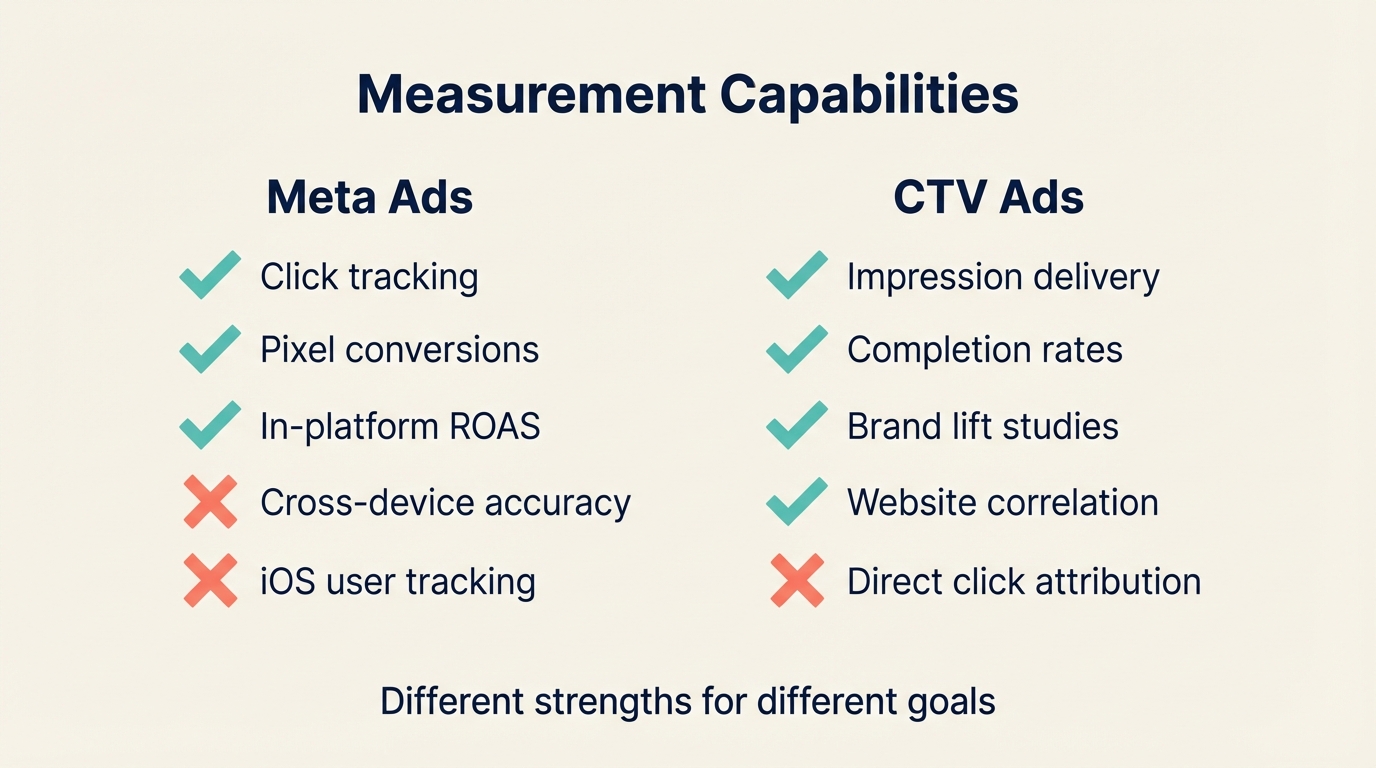
Meta's measurement:
- Click-through tracking (but declining in accuracy)
- Pixel-based conversion tracking (affected by iOS changes)
- In-platform ROAS reporting (increasingly modeled, not measured)
- A/B testing capabilities
CTV's measurement:
- Impression delivery verification
- Video completion rates
- Brand lift studies (for larger campaigns)
- Website visit correlation
- QR code scans (if included in creative)
- Foot traffic attribution (for local businesses)
The honest reality: Meta promises precise attribution but delivers increasingly modeled estimates. CTV promises awareness and brand building, which is harder to attribute directly but shows up in downstream metrics like branded search, direct traffic, and "how did you hear about us" mentions.
For SMBs, the practical approach is tracking what you can: website traffic during campaigns, branded search volume, new customer acquisition rates, and direct customer feedback.
When to Use Each Channel: A Decision Framework
Rather than declaring a winner, here's when each channel makes sense.
Choose Meta ads when:
- You need immediate, trackable action (click to buy, sign up, etc.)
- Your product is highly visual and social-proof driven
- You're testing messaging or offers quickly
- Budget is extremely limited (under $500/month)
- Your audience is highly defined by interests/behaviors
- You have strong retargeting audiences already built
Choose CTV/streaming ads when:
- Brand awareness is a primary goal
- You want to reach households in a specific geography
- Credibility and trust matter (professional services, healthcare, etc.)
- You're competing against established brands with TV presence
- Your Meta performance has plateaued or declined
- You want to reach cord-cutters who aren't on linear TV
Consider both when:
- You have $1,000+/month total ad budget
- You want full-funnel coverage (awareness + conversion)
- You're seeing diminishing returns on Meta alone
- You want to amplify Meta results with top-of-funnel reach
The Case for Using Both: Full-Funnel Strategy
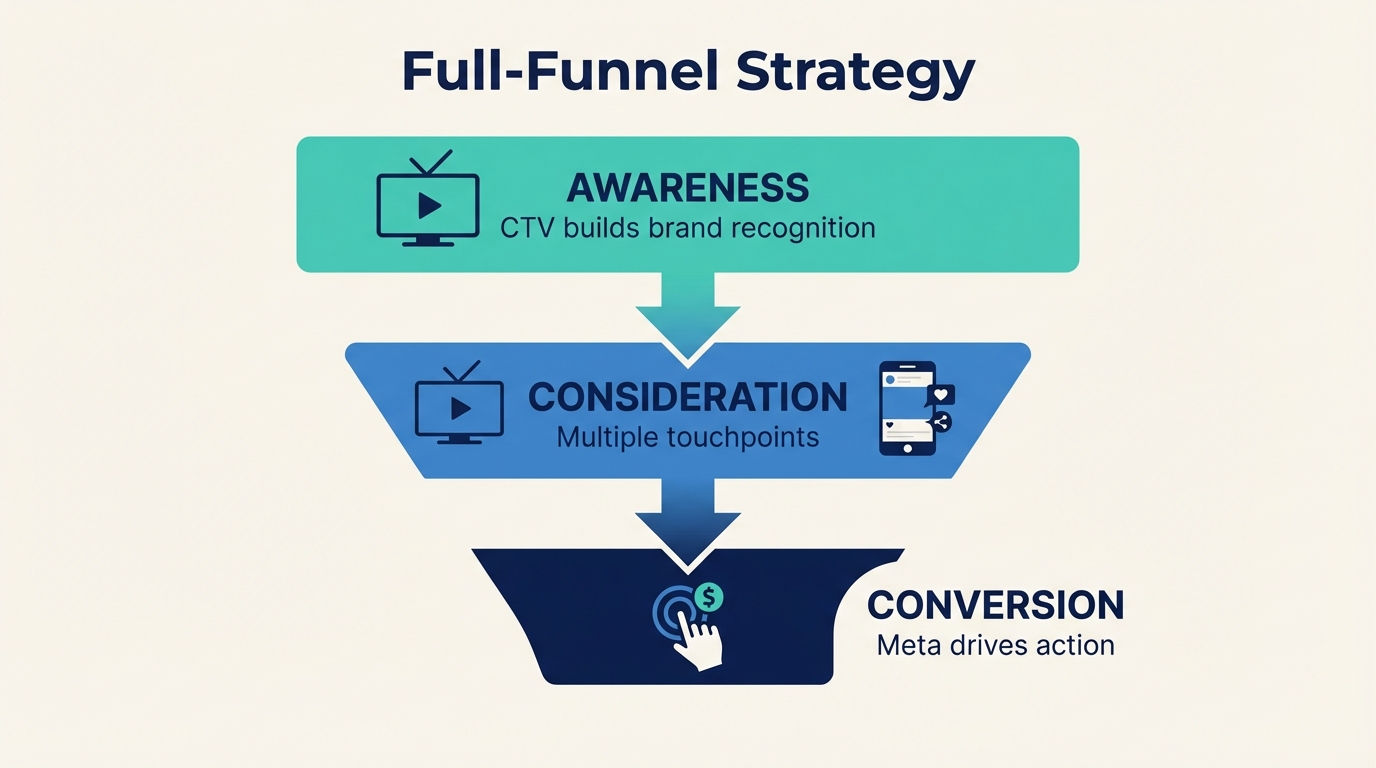
Here's what sophisticated marketers know: CTV vs Meta ads isn't really an either/or question. They work better together.
CTV builds awareness and credibility. Meta captures demand and drives action. When someone sees your brand on their TV, they're more likely to stop scrolling when they see your Meta ad later.
A practical budget allocation for SMBs trying both:
- $500-1,000/month total: 70% Meta, 30% CTV (test CTV waters)
- $1,000-2,500/month: 50% Meta, 50% CTV (balanced approach)
- $2,500+/month: 40% Meta, 60% CTV (lean into brand building)
The specific split depends on your goals. If you're a new business nobody knows, weight toward CTV for awareness. If you have strong brand recognition but need sales, weight toward Meta for conversion.
Adwave's retargeting capabilities can also bridge the two: reach people who visited your website with CTV ads, or use CTV to build audiences you can target on other platforms.
Making the Decision: CTV vs Facebook Ads for Your Business
Both channels deserve a place in your consideration set. Neither is universally "better."
Meta ads remain powerful for direct response, quick testing, and capturing demand that already exists. They're also easier to start with minimal budget.
CTV ads excel at building the awareness and credibility that creates demand in the first place. They put small businesses on the same big screen as national brands, building trust that social media can't replicate.
The old barrier to CTV, production cost, is largely gone. With AI-powered platforms, you can create professional TV commercials from your website in minutes.
If your Meta results have plateaued, if you're tired of fighting for attention in crowded feeds, or if you want to build real brand awareness in your local market, streaming TV advertising deserves a serious look.
The question isn't really CTV vs Meta ads. It's whether you're ready to add a new channel to your mix that reaches customers in a completely different context, on the screen that still commands the most attention in the home.
Ready to Test CTV for Your Business?
Adding streaming TV to your marketing mix doesn't require a massive budget or video production expertise. With Adwave, you can create a professional TV commercial from your website in minutes and launch a targeted local campaign for as little as $50.
See how your business looks on the big screen. You might be surprised how affordable premium advertising has become.
Version history
| Version | When | Summary |
|---|---|---|
| v1 | 6/20/2026, 3:11:54 AM | migration import |