Salon Advertising: 7 Channels to Grow Your Beauty Business
slug: salon-advertising-growing-your-beauty-business · status: draft · score: 85% · 1 versions
View published version → · Contentful entry: 3L9eSMgXFNPLEjPKNv3nag
Validation
| Rule | Detail | |
|---|---|---|
| pass | No banned competitors | No banned competitors |
| pass | No emdashes | No emdashes |
| pass | Avoid AI telltale words | No AI telltale words |
| pass | Primary keyword in title | No primary keyword to check |
| pass | Use contractions | Contractions used |
| fail | Minimum internal links | Internal links not in sitemap: /resources/how-to-optimize-your-google-business-profile-for-more-calls, /resources/why-customers-trust-tv-brands, /how-it-works, /resources/ai-tv-commercials-small-business, /industries/beauty-wellness/hair-salons/tv-advertising-salons-spas-beauty, /resources/how-to-measure-advertising-effectiveness, /resources/how-to-optimize-your-google-business-profile-for-more-calls, /resources/why-customers-trust-tv-brands, /how-it-works, /resources/ai-tv-commercials-small-business, /resources/how-to-measure-advertising-effectiveness, /industries/beauty-wellness/hair-salons/tv-advertising-salons-spas-beauty |
| pass | FAQ section required | FAQ section present |
| fail | Author assigned | No author assigned (never use 'Adwave Team' for new content) |
| pass | Title length 50-60 | Title length 58 |
| pass | Minimum 4 images | 4 images |
| pass | SEO description under 160 | seoDescription 157 chars |
| pass | Adwave mention cadence | 2 Adwave mentions |
| pass | Short description present | shortDescription 185 chars |
| pass | Word count by type | Word count 3720 within target |
| warn | Year-dated title for evergreen types | Year-dated type should include (2026) in the title |
| pass | No manual table of contents | No manual TOC |
Images (4)
Content
Salon Advertising: 7 Channels to Grow Your Beauty Business
Running a salon is personal. Your clients trust you with how they look and feel, and that relationship starts long before they sit in your chair. It starts the moment they discover you. The challenge? Most salon owners rely on word of mouth and Instagram alone, leaving massive growth opportunities on the table.
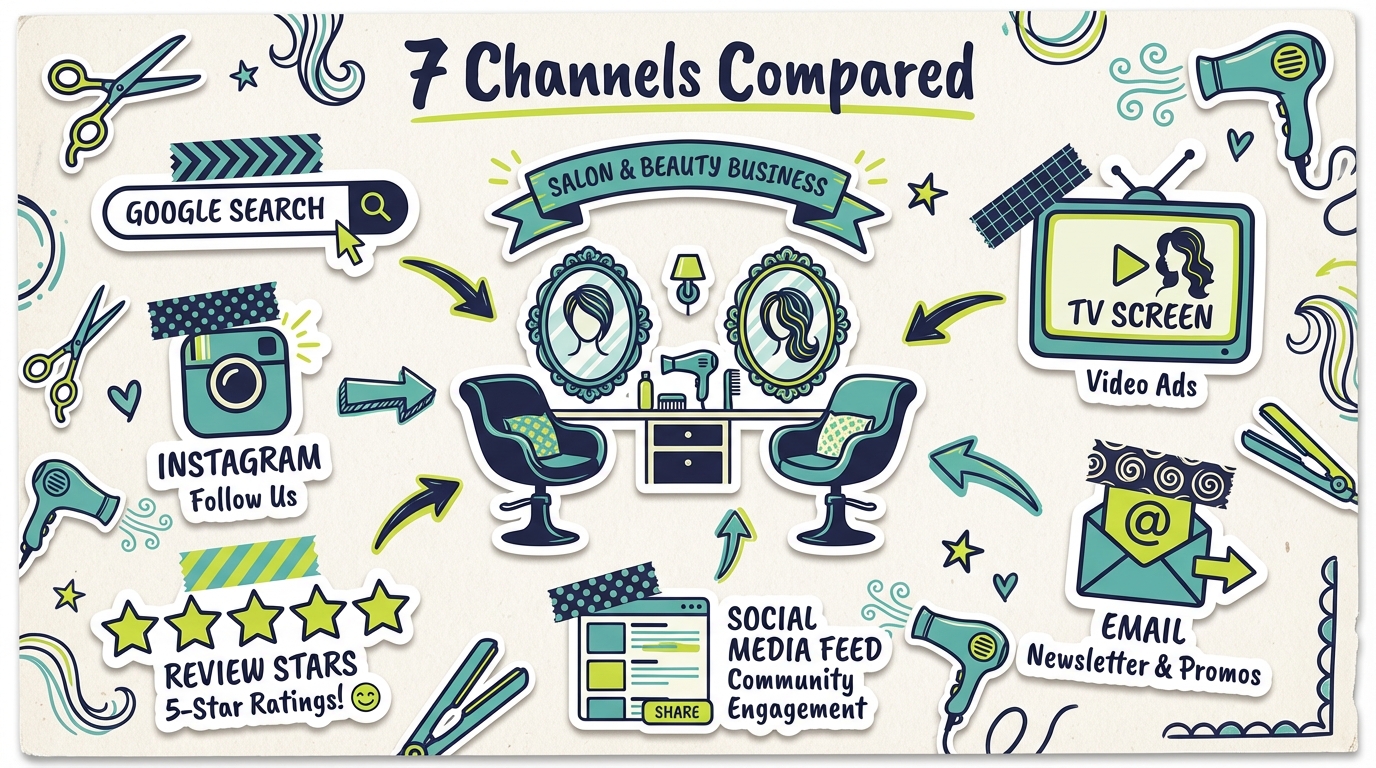
Whether you run a hair salon, nail studio, barbershop, or full-service beauty business, the right advertising mix can keep your appointment book full and bring in the kind of clients you actually want. This guide breaks down seven advertising channels that work for salons, compares their strengths, and shows you how to split your budget for the best results.
Why Salons Need a Multi-Channel Advertising Strategy
Word of mouth still matters in the beauty industry. It always will. But relying on it exclusively is like cutting hair with one pair of scissors: it works, but you're limiting yourself.
Here's the thing. Your potential clients are everywhere. They're searching Google for "balayage near me." They're scrolling Instagram looking at before-and-after transformations. They're reading Yelp reviews before booking with a new stylist. And yes, they're watching streaming TV at night, absorbing the brands that show up between episodes.
A multi-channel approach means you're meeting people wherever they happen to be, not just hoping they stumble across your name. According to the Harvard Business Review, businesses that use three or more marketing channels see 287% higher purchase rates than those relying on a single channel (Harvard Business Review, 2023). For salons, that could mean the difference between a half-empty Tuesday and a waitlist.
The good news is that you don't need a massive budget to make this work. Several of these channels cost nothing upfront, and even the paid options can start small and scale as you see results.
Google Ads: Capturing Clients When They're Ready to Book
Google Ads is one of the highest-intent advertising channels available to salons. When someone types "hair salon near me" or "best colorist in [your city]," they're not browsing casually. They're ready to book.
How Google Ads Works for Salons
Google Ads operates on a pay-per-click model, meaning you only pay when someone actually clicks your ad. For salons, the most effective campaign types are:
Search Ads: These appear at the top of Google results when someone searches for salon-related terms. You bid on keywords like "hair salon [city]," "keratin treatment near me," or "bridal hair stylist [neighborhood]." The key is matching your ads to specific services, not just generic salon terms.
Local Services Ads (LSAs): These show up above standard search ads with a "Google Guaranteed" badge. LSAs charge per lead rather than per click, which can be more cost-effective for salons. You'll need to pass Google's screening process, but the trust signal that badge provides is worth the effort.
Performance Max Campaigns: These automated campaigns show your ads across Google Search, Maps, YouTube, and Display all at once. They work well for salons because Google's algorithm learns which placements drive the most bookings.
What to Budget
Expect to pay $2 to $8 per click for salon-related keywords, depending on your market. A monthly budget of $300 to $800 is a reasonable starting point for most local salons. In competitive metro areas like Los Angeles or New York, costs run higher, so focus on long-tail keywords (like "organic hair color salon Brooklyn") to keep costs down.
Tips for Better Results
- Link your ads directly to a booking page, not your homepage
- Use ad extensions to show your phone number, address, and review ratings
- Schedule ads during the hours people typically book (evenings and weekends tend to convert well)
- Create separate ad groups for each service category: cuts, color, treatments, bridal
Meta and Instagram Ads: Showcasing Your Work Visually
If Google Ads captures demand, Instagram and Facebook create it. The beauty industry is inherently visual, and Meta's platforms give you the tools to put your best work in front of exactly the right people.
Why Meta Works for Salons
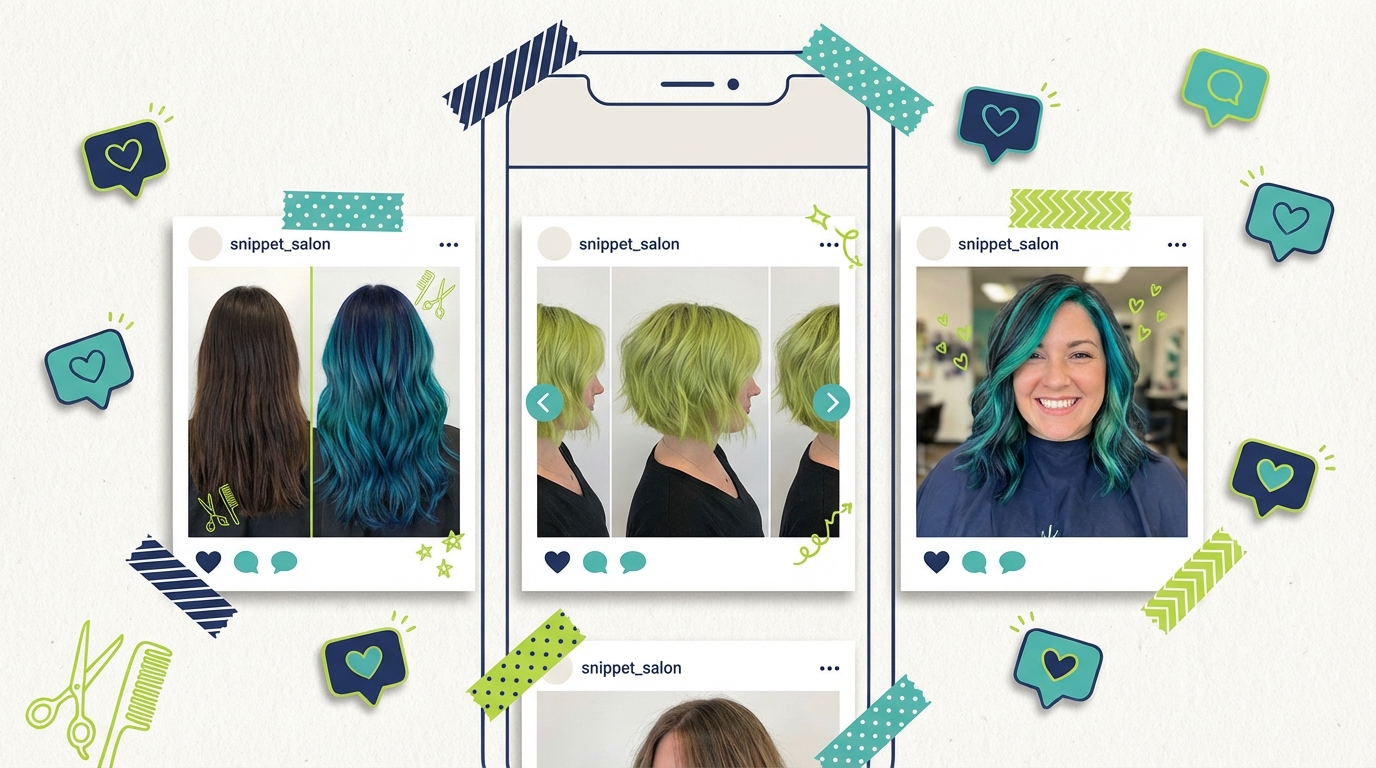
Beauty services sell through visuals. Before-and-after photos, styling videos, and transformation reels are the content that stops people mid-scroll. Meta's advertising platform lets you take that organic content and put paid dollars behind it, reaching people who match your ideal client profile but haven't found you yet.
According to a 2024 Meta Business report, beauty and personal care ads on Instagram see an average click-through rate of 1.2%, nearly double the platform's overall average (Meta for Business, 2024). People on Instagram expect to see beauty content, so your ads feel native rather than intrusive.
Campaign Types That Work
Awareness Campaigns: Show before-and-after transformations, salon tours, or stylist introductions to people within a 10 to 15-mile radius of your location. The goal is familiarity, not immediate bookings.
Engagement Campaigns: Boost your best-performing organic posts (the ones already getting likes and comments) to reach a wider audience. This is often the easiest entry point for salons new to paid advertising.
Conversion Campaigns: Drive direct bookings using a "Book Now" button that links to your online scheduling tool. These work best when you're promoting a specific offer, like a new-client discount or a seasonal package.
What to Budget
Meta advertising costs for local businesses typically run $5 to $15 per lead. A starting budget of $200 to $600 per month lets you test different audiences and creative formats. Start with your strongest before-and-after content, then expand into video as you learn what resonates.
Creative Best Practices
- Use carousel ads to show multiple angles of a single transformation
- Keep video content under 15 seconds for Stories and Reels placements
- Feature real clients (with permission) rather than stock photos
- Test different calls to action: "Book Now" vs. "Send Message" vs. "Learn More"
- Retarget people who visited your website or engaged with previous posts
Local SEO and Google Business Profile: Free Visibility That Compounds
If you're not investing time in local SEO, you're invisible to a huge chunk of potential clients. When someone searches "salon near me" on their phone, Google shows a map pack with three local businesses before any other results. Getting into that map pack is free, but it takes consistent effort.
Your Google Business Profile Is Your Digital Storefront
Your Google Business Profile is often the first impression a potential client gets. It shows your photos, reviews, hours, location, and services before anyone clicks through to your website. For salons, optimizing this profile is one of the highest-return activities you can do.
Here's what a fully optimized salon Google Business Profile includes:
- Complete service list with descriptions and prices
- High-quality photos updated monthly (interior, stylists at work, results)
- Accurate hours including holiday schedules
- Regular posts sharing promotions, new services, or tips
- Review responses to every review, positive and negative
Local SEO Beyond Your Profile
Your Google Business Profile is the foundation, but local SEO extends further:
Website optimization: Make sure your website includes your city and neighborhood names naturally throughout the content. Create individual pages for each service you offer (cuts, color, extensions, treatments) with location-specific titles.
Citations: Ensure your salon's name, address, and phone number (NAP) are consistent across every directory: Google, Yelp, Apple Maps, Bing, Facebook, and industry-specific sites like StyleSeat or Booksy.
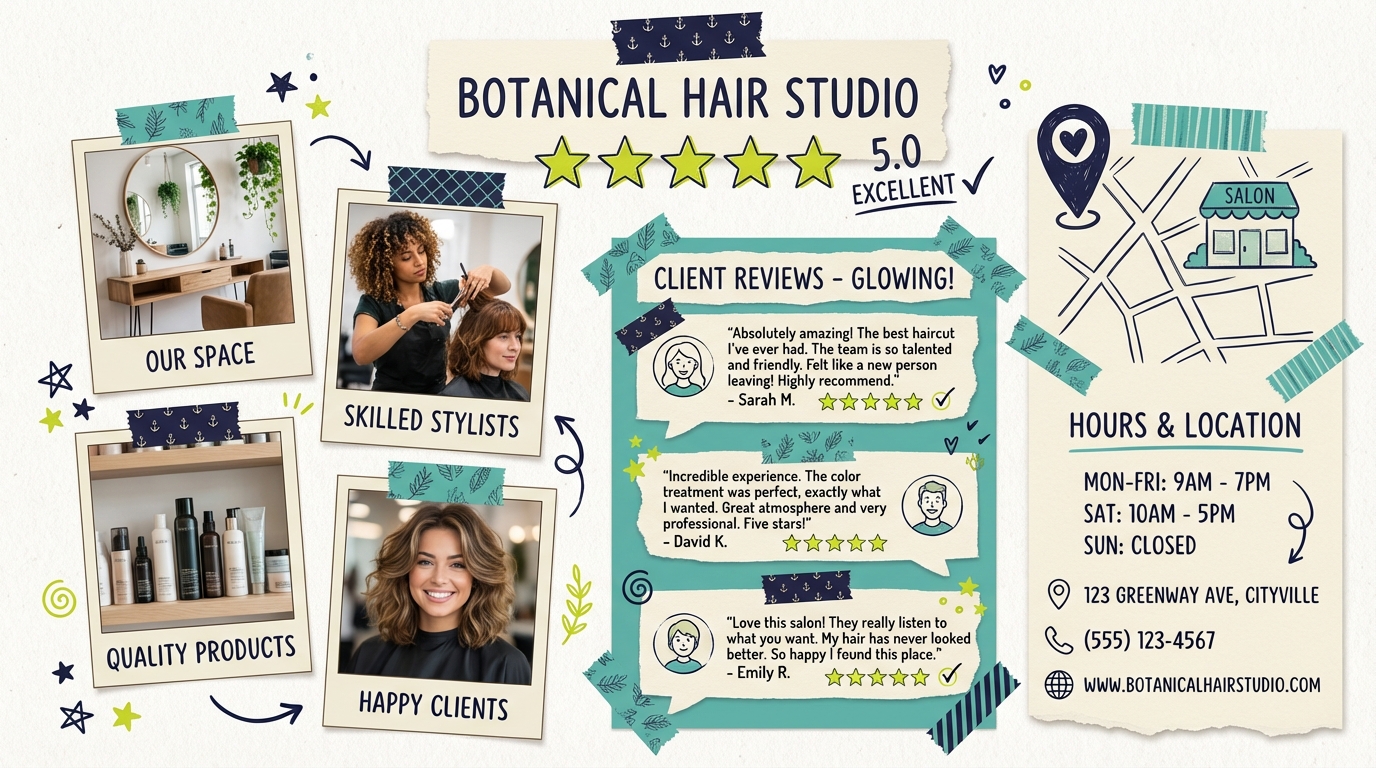
Review generation: According to BrightLocal's 2024 Local Consumer Review Survey, 87% of consumers read online reviews for local businesses, and 73% only pay attention to reviews written in the last month (BrightLocal, 2024). A steady flow of fresh reviews signals to both Google and potential clients that your salon is active and trusted.
What to Budget
Local SEO is primarily a time investment. If you handle it yourself, it costs nothing but a few hours per month. If you hire a local SEO specialist, expect $300 to $800 per month for ongoing optimization.
Yelp and Online Directories: Building Trust Through Reviews
Yelp holds special importance for beauty businesses. It's one of the first places people check when choosing a new salon, especially if they're new to an area or unhappy with their current stylist.
Why Yelp Matters for Salons
A 2023 Yelp economic impact study found that beauty and personal care is one of the top five categories on the platform, with millions of searches per month (Yelp, 2023). Unlike Google, where people might compare a handful of options, Yelp users often read detailed reviews before making a decision. They're looking for specifics: "She's amazing with curly hair" or "The salon is clean and they actually listen."
Free vs. Paid Yelp
Free Yelp profile: Claim your business, add photos, respond to reviews, and list your services. This alone can drive significant traffic for salons with strong reviews.
Yelp Ads ($150 to $500 per month): Your listing appears above organic results when people search for salons in your area. Yelp ads also remove competitor ads from your business page. Whether the paid option is worth it depends on your market. In cities where Yelp usage is high (San Francisco, New York, Chicago), the investment often pays off.
Other Directories Worth Claiming
Don't stop at Yelp. Claim and optimize your profiles on:
- StyleSeat and Booksy: Industry-specific platforms where clients actively search for beauty professionals
- Apple Maps: Many iPhone users search directly through Maps
- Nextdoor: Hyper-local recommendations carry significant weight
- The Knot / WeddingWire: Essential if you offer bridal services
Tips for Managing Reviews
- Ask satisfied clients for reviews at checkout (a simple card or QR code works well)
- Respond to every review within 24 to 48 hours
- Address negative reviews professionally, offering to make things right offline
- Never offer incentives for reviews, as this violates most platform policies
Direct Mail: Old School, Still Effective
In an era of digital everything, physical mail stands out precisely because fewer businesses use it. For salons, direct mail can be surprisingly effective, especially for reaching people who don't spend much time on social media.
Why Direct Mail Works for Salons
The Data & Marketing Association reports that direct mail achieves a 4.4% response rate, compared to 0.12% for email (Association of National Advertisers, 2023). For salons, the physical nature of mail has an advantage: a well-designed postcard or flyer can sit on a kitchen counter for weeks, serving as a constant reminder.
Types of Direct Mail That Work
New mover campaigns: Services like USPS Every Door Direct Mail (EDDM) let you target households that recently moved into your area. New residents are actively looking for a salon, making this a high-conversion audience. EDDM lets you mail to every address on a postal route for as little as $0.23 per piece.
Radius mailers: Target every household within a 3 to 5-mile radius of your salon. Include a compelling first-visit offer and clear directions.
Seasonal promotions: Send postcards ahead of prom season, wedding season, or the holidays. These tie a specific offer to a time-sensitive occasion.
Referral cards: Give existing clients physical referral cards they can hand to friends. Include a reward for both the referrer and the new client.
What to Budget
EDDM campaigns typically cost $0.23 to $0.50 per piece, including design, printing, and postage. A mailing to 2,000 homes runs about $500 to $1,000. For most salons, quarterly mailings (four per year) strike a good balance between staying visible and controlling costs.
Design Tips
- Use high-quality photos of your salon's best work
- Include one clear offer (not three competing promotions)
- Make the call to action obvious: "Book your first visit at [website] or call [number]"
- Add a QR code linking directly to your booking page
TV and CTV Advertising: Building Brand Trust on the Big Screen
Television advertising used to be reserved for national brands with six-figure budgets. That's changed. Streaming TV (also called connected TV or CTV) now lets local salons run professional ads on premium networks like Hulu, Peacock, and ESPN, starting at just $50.
Why TV Builds Trust for Salons
There's a reason consumers trust brands they see on TV more than those they encounter only on social media. Television carries an implicit credibility signal. When a potential client sees your salon ad during their favorite show, it signals that you're established, professional, and worth their trust.
For salons, where the service is intimate and personal, that trust matters enormously. Nobody wants to hand their hair over to a business that feels fly-by-night.
How CTV Works for Salons
CTV advertising lets you target viewers by location, demographics, interests, and even household income. A salon in Austin can run ads exclusively to women aged 25 to 54 within a 15-mile radius who have shown interest in beauty and wellness content.
With platforms like Adwave, you can create a broadcast-quality 30-second TV commercial using AI, generated from your website or social media profiles in about two minutes. No film crew, no production budget, no six-week timeline.
For a deeper look at how TV advertising works specifically for beauty businesses, check out our TV advertising for salons and spas guide.
What to Budget
CTV campaigns through Adwave start at $50, with an average CPM of $15 to $35. A monthly budget of $200 to $500 gives a local salon meaningful reach in its target area. That's less than the cost of a single page in most local magazines.
Email Marketing: Keeping Clients Coming Back
While new client acquisition gets the most attention, retention is where salons build real profitability. It costs five times more to acquire a new client than to keep an existing one, and email marketing is one of the most effective retention tools available.
Why Email Works for Salons
Email gives you a direct line to clients who've already chosen you. Unlike social media, where algorithms decide who sees your posts, email lands in their inbox every time. For salons, this means you can:
- Send appointment reminders that reduce no-shows
- Promote seasonal specials to your warmest audience
- Share styling tips that keep your salon top of mind between visits
- Announce new services, products, or stylist additions
According to Campaign Monitor's 2024 benchmark report, the beauty and personal care industry sees an average email open rate of 36.7%, well above the cross-industry average of 21.5% (Campaign Monitor, 2024). Your clients want to hear from you.
Types of Emails That Drive Revenue
Rebooking reminders: The single most valuable email a salon can send. Set up automated emails that go out when a client is due for their next appointment (every 4 to 6 weeks for cuts, 6 to 8 weeks for color). Include a one-click booking link.
Birthday and anniversary emails: A personalized discount or free add-on service for a client's birthday feels thoughtful and drives bookings during what might otherwise be a slow period.
Seasonal campaigns: Promote holiday packages, summer hair care tips, or back-to-school specials. Tie these to specific services and limited-time pricing.
Win-back campaigns: Target clients who haven't visited in 90 or more days with a "We miss you" email and a compelling reason to return.
What to Budget
Email marketing platforms like Mailchimp, Constant Contact, or industry-specific tools like GlossGenius start free for small lists and run $20 to $100 per month as your list grows. The cost per email sent is essentially zero, making this one of the highest-ROI channels available.
Tips for Growing Your List
- Collect emails at checkout (your booking software likely does this already)
- Offer a first-visit discount in exchange for an email signup on your website
- Add a sign-up link to your Instagram bio and Google Business Profile
- Never buy email lists; they hurt deliverability and violate most platform terms
Channel Comparison: Finding Your Best Mix
Not every channel serves the same purpose. Here's how they stack up across the metrics that matter most for salons:
Key takeaway: Google Ads and email marketing deliver the fastest results. Local SEO takes longer but compounds over time. TV/CTV and Instagram build the brand awareness that makes every other channel more effective. For a detailed look at measuring results across channels, check out our measurement guide.
Recommended Budget Allocation for Salons
Your ideal budget split depends on your stage of business. Here are two frameworks:
New or Growing Salon (Budget: $500 to $1,500 per month)
Focus on channels that drive immediate bookings and build your review base:
- Google Ads: 30% ($150-$450) for capturing search demand
- Meta/Instagram Ads: 25% ($125-$375) for visual awareness
- Local SEO: 20% (time investment plus any tools)
- Email Marketing: 10% ($50-$100 for platform costs)
- TV/CTV: 10% ($50-$150) for brand credibility
- Yelp/Direct Mail: 5% (claim free profiles, plan first mailer)
Established Salon (Budget: $1,500 to $3,000 per month)
Shift toward brand building and retention while maintaining acquisition:
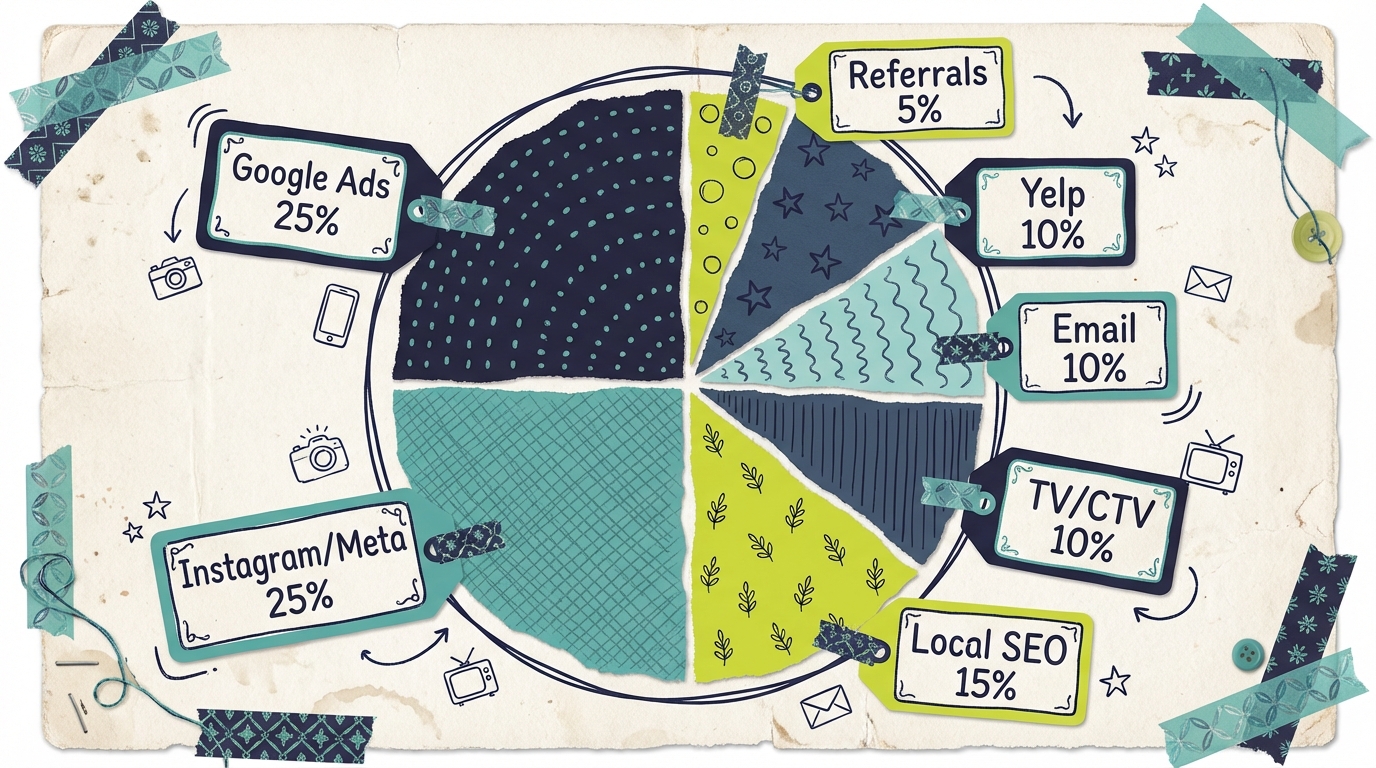
- Meta/Instagram Ads: 25% ($375-$750) for creative storytelling
- Google Ads: 20% ($300-$600) for high-intent searches
- TV/CTV: 15% ($225-$450) for brand trust and awareness
- Local SEO: 15% (ongoing optimization and content)
- Email Marketing: 10% ($150-$300 for advanced automation)
- Direct Mail: 10% ($150-$300 for quarterly campaigns)
- Yelp: 5% (paid ads if you're in a competitive market)
These aren't rigid rules. Track what's working each month and shift dollars toward the channels producing the best return. The important thing is spreading your investment across multiple touchpoints so no single channel becomes a single point of failure.
Common Questions Answered
How much should a salon spend on advertising? Most successful salons invest 5% to 10% of their gross revenue in advertising. For a salon generating $200,000 annually, that's $10,000 to $20,000 per year, or roughly $800 to $1,700 per month. Start at the lower end and increase as you identify which channels produce the best return for your specific business.
What is the most effective advertising channel for salons? It depends on your goal. Google Ads is the most effective for immediate bookings because you're reaching people actively searching for a salon. Instagram is the most effective for building your brand and showcasing your work visually. For long-term growth, local SEO delivers the best compounding returns. The most successful salons use a mix of three to five channels rather than relying on any single one.
Do salons really need TV advertising? TV advertising isn't required, but it fills a gap that digital channels can't. Television builds brand credibility and trust in a way that social media ads simply don't match. With CTV, you can start for as little as $50 and target only viewers in your local area. For salons looking to stand out from competitors who are all running the same Instagram and Google Ads playbook, TV provides a meaningful edge.
How can I advertise my salon with a small budget? Start with free channels: optimize your Google Business Profile, claim your Yelp listing, and set up a basic email marketing system. These three cost nothing and can drive meaningful results. When you're ready to add paid advertising, start with a $50 CTV campaign or a small Google Ads budget ($10 per day). Scale up as you see results and can measure what's working.
How do I know if my salon advertising is working? Track three core metrics: new client bookings (where did they hear about you?), cost per new client (total ad spend divided by new clients acquired), and client retention rate (what percentage rebook within 8 weeks?). Most booking platforms can attribute new clients to specific sources. For TV and brand campaigns, watch for increases in branded Google searches for your salon name.
Should I hire a marketing agency for my salon? Most salons under $500,000 in annual revenue can handle their own advertising with the tools and platforms available today. Google Ads, Meta, and email platforms are all designed for self-service. If you're spending more than $2,000 per month on advertising and don't have time to manage campaigns, an agency or freelancer who specializes in local beauty businesses can be worth the investment. Avoid agencies that require long-term contracts or won't share performance data.
Start Growing Your Salon Today
You don't need to launch all seven channels at once. Pick the two or three that align with your biggest gaps right now. If you're struggling to attract new clients, start with Google Ads and local SEO. If your chair time is full but clients aren't coming back, invest in email marketing. If you want to build the kind of brand recognition that makes every other channel work harder, add TV advertising to the mix.
The salons that grow consistently are the ones that treat advertising as an ongoing investment, not a one-time experiment. Start small, measure what works, and build from there.
---
Sources
- Harvard Business Review, "The New Science of Customer Emotions," 2023
- Meta for Business, "Beauty & Personal Care Advertising Benchmarks," 2024
- BrightLocal, "Local Consumer Review Survey," 2024
- Yelp, "Yelp Economic Impact Report," 2023
- Association of National Advertisers (ANA), "Response Rate Report," 2023
- Campaign Monitor, "Email Marketing Benchmarks by Industry," 2024
Internal Links Used
Version history
| Version | When | Summary |
|---|---|---|
| v1 | 6/20/2026, 3:11:54 AM | migration import |