CTV vs YouTube Ads: Which Delivers Better Results for Local Business?
slug: ctv-vs-youtube-ads-comparison · status: draft · score: 74% · 1 versions
View published version → · Contentful entry: 3JvSzlJeNnQZmdEXIL1eDJ
Validation
| Rule | Detail | |
|---|---|---|
| pass | No banned competitors | No banned competitors |
| pass | No emdashes | No emdashes |
| pass | Avoid AI telltale words | No AI telltale words |
| pass | Primary keyword in title | No primary keyword to check |
| pass | Use contractions | Contractions used |
| fail | Minimum internal links | Internal links not in sitemap: /industries/health-and-wellness/tv-advertising-dentists, /industries/real-estate/tv-advertising-real-estate-agents, /industries/legal/tv-advertising-law-firms, /how-it-works, /how-it-works, /try-free |
| fail | FAQ section required | Missing FAQ / 'Common questions answered' section |
| fail | Author assigned | No author assigned (never use 'Adwave Team' for new content) |
| warn | Title length 50-60 | Title length 69 (aim 50-60 chars) |
| pass | Minimum 4 images | 4 images |
| pass | SEO description under 160 | seoDescription 148 chars |
| pass | Adwave mention cadence | 2 Adwave mentions |
| pass | Short description present | shortDescription 168 chars |
| warn | Word count by type | Word count 1545 below target (2500-5000) |
| warn | Year-dated title for evergreen types | Year-dated type should include (2026) in the title |
| pass | No manual table of contents | No manual TOC |
Images (4)
Content
CTV vs YouTube Ads: Which Delivers Better Results for Local Business?
Article Brief
Publish Date: 2025-06-20 URL Slug: ctv-vs-youtube-ads-comparison Category: Guides Funnel Stage: MOFU Strategy: Gap Target Word Count: 1,800-2,200
Primary Keyword: CTV vs YouTube ads Secondary Keywords: streaming TV advertising, YouTube advertising for small business, CTV advertising ROI, video advertising comparison
Meta Description: Compare CTV and YouTube advertising for local businesses. Learn costs, targeting, completion rates, and when each channel delivers the best ROI for your budget.
---
You have video content. You want to get it in front of potential customers. The question is: where should it run?
YouTube and Connected TV (CTV) are both video advertising platforms, but they deliver very different experiences. One catches viewers between videos on their phone. The other reaches them during their favorite shows on the big screen.
For local businesses with limited budgets, choosing the right platform matters. This guide breaks down the real differences so you can make an informed decision.
The Viewing Context Difference
The biggest difference between YouTube and CTV isn't technical. It's contextual.
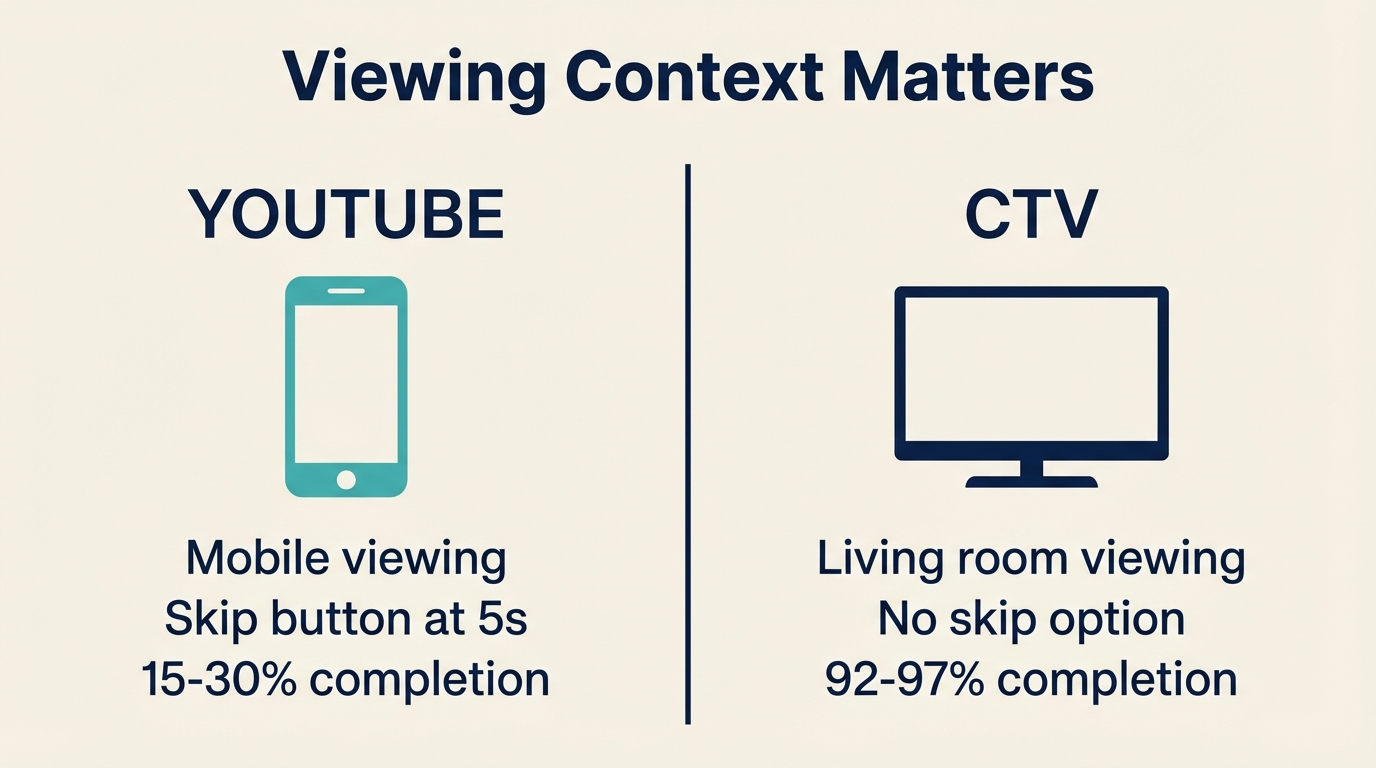
YouTube viewing:
- Often on mobile devices (phone, tablet)
- Viewers are actively browsing, clicking, searching
- Ads interrupt the content they chose
- Skip button appears after 5 seconds (for skippable ads)
- Viewers are in "consumption mode" but ready to move on
CTV viewing:
- On the TV (the largest screen in the house)
- Viewers are relaxed, leaned back, often with others
- Ads appear in natural commercial breaks
- No skip option on most CTV ads
- Viewers are in "entertainment mode" and expect commercials
Why context matters:
When your ad runs during someone's favorite show on their living room TV, it carries weight. That's the same screen where they watch the Super Bowl, award shows, and content from brands they trust.
YouTube is valuable, but it's a different experience. Viewers are often multi-tasking, and the skip button is always calling.
Completion Rates: The Numbers
Here's where the difference gets measurable.
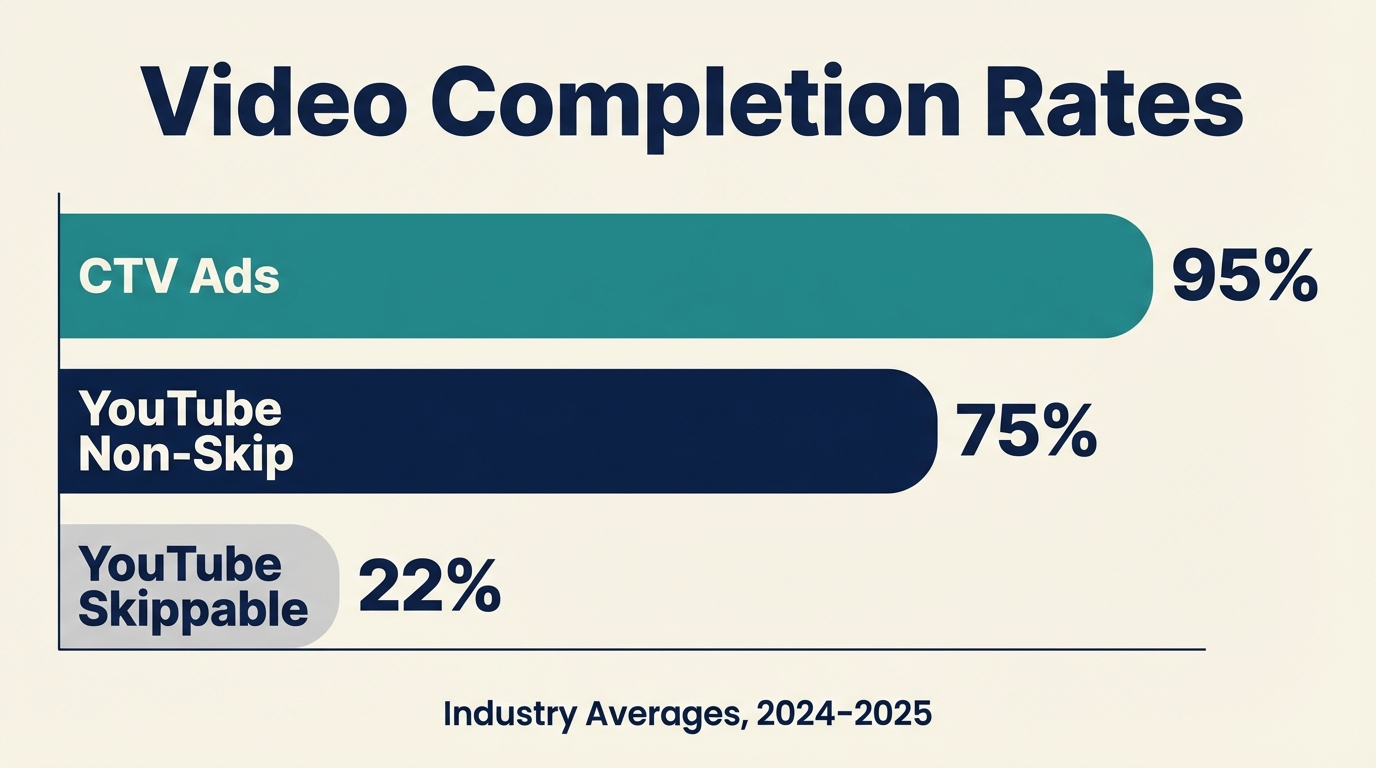
Average video completion rates:
- CTV ads: 92-97% completion rate
- YouTube skippable ads: 15-30% completion rate
- YouTube non-skippable ads: 70-80% completion rate (but limited to 15-20 seconds)
!Video completion rates comparison
CTV's high completion rates come from the format: ads run in commercial breaks just like traditional TV, and viewers can't skip them. Your 30-second message gets delivered in full.
On YouTube, most advertisers use skippable TrueView ads because you only pay when someone watches 30 seconds (or the full ad if shorter). But that means most viewers skip before your message lands.
What this means for your campaigns:
If brand awareness and message delivery are your goals, CTV's completion rates matter. If you're optimizing for cost-per-view at any length, YouTube's pay-per-completed-view model has advantages.
Targeting Capabilities
Both platforms offer sophisticated targeting, but they work differently.
YouTube targeting strengths:
- Intent signals: Target based on search history and video watching behavior
- Affinity audiences: People interested in specific topics
- In-market audiences: People actively researching purchases
- Custom audiences: Based on website visits, app usage
- Demographics: Age, gender, parental status, household income
CTV targeting strengths:
- Geographic precision: Down to ZIP code level
- Household-level data: Target actual households, not just devices
- First-party data: Streaming platforms know their subscribers
- Contextual placement: Run alongside specific content genres
- Demographic targeting: Age, income, interests
For local businesses:
CTV's geographic targeting is often more precise for reaching your service area. You can target specific ZIP codes and ensure your ad reaches households (not just individual devices) within your market.
YouTube's strength is intent. If someone searched for "best dentist near me" yesterday, you can target them with video ads today. That's powerful for businesses where search intent signals buying readiness.
Cost Comparison
Budget matters. Here's how the platforms compare.
YouTube advertising costs:
- CPV (Cost Per View): $0.10-$0.30 for TrueView (skippable) ads
- CPM: $10-$30 for non-skippable and bumper ads
- Minimum budget: No minimum; start with any amount
- View definition: 30 seconds watched (or full video if shorter)
CTV advertising costs:
- CPM: $15-$35 (average $25 for small businesses)
- Minimum budget: Varies; Adwave starts at $50
- View definition: Full ad completion (typically 15-30 seconds)
True cost comparison:
The CPM numbers look similar, but remember: YouTube's CPMs are often for shorter formats, and completion rates differ dramatically.
If you spend $500 on each platform:
- YouTube: Roughly 20,000-50,000 impressions, but only 3,000-15,000 completed views (depending on format)
- CTV: Roughly 14,000-20,000 impressions, with 13,000-19,000 completed views
CTV delivers more complete message exposures per dollar when you factor in completion rates.
Audience Quality and Trust
Where your ad appears affects how it's perceived.
The TV trust factor:
Research consistently shows that TV advertising (including CTV) is viewed as more trustworthy than digital advertising. There's something about appearing on the same screen as major brands and trusted content that lends credibility.
For local businesses competing against larger competitors, that trust factor matters. A local dentist appearing on the same screen as national brands gains implicit credibility.
YouTube's credibility challenge:
YouTube ads appear alongside user-generated content of varying quality. While YouTube has made strides in brand safety, your ad might run before a viral video or alongside content you wouldn't choose.
That said, YouTube's massive reach means you can find quality content to advertise against with proper channel targeting.
When YouTube Makes More Sense
YouTube advertising is the better choice when:
You need immediate, trackable response: YouTube's click-through capabilities make it better for direct response campaigns where you want immediate website visits or conversions.
Your audience is searching: YouTube is the world's second-largest search engine. If your business benefits from search intent (people actively looking for solutions), YouTube's targeting can find them.
Budget is extremely limited: With no minimum spend and pay-per-view options, YouTube lets you test video advertising with very small budgets.
You have content for short formats: YouTube's bumper ads (6 seconds) and skippable formats work well for simple, punchy messages that don't need 30 seconds to land.
Your target demographic skews young: Younger audiences (18-34) spend significant time on YouTube. If that's your market, meet them there.
When CTV Makes More Sense
CTV advertising is the better choice when:
Brand awareness is the primary goal: If you want people to remember your name, CTV's high completion rates and TV-screen credibility deliver.
You need geographic precision: Local businesses with defined service areas benefit from CTV's ZIP code-level targeting. Reach households in your market, not viewers everywhere.
Your message needs 30 seconds: Some stories need time. Real estate agents, law firms, and other services with complex value propositions benefit from CTV's full-length format.
You're competing with bigger brands: Appearing on the TV screen alongside national advertisers creates competitive parity that YouTube can't match.
You want to reach cord-cutters: CTV reaches the growing audience that has canceled cable but still watches content on their TV through streaming services.
The Both/And Approach
Here's the truth: for many businesses, the answer isn't YouTube OR CTV. It's both, at different stages.
A common strategy:
- Use CTV for brand awareness (make people know you exist)
- Use YouTube for retargeting (reach people who've shown interest)
- Use both for different audience segments
Budget allocation example:
A local business with $1,000/month for video advertising might split:
- $600 on CTV: Broad awareness in their service area
- $400 on YouTube: Retargeting website visitors and targeting search intent
This leverages each platform's strengths.
Creative Considerations
Your creative needs differ by platform.
CTV creative requirements:
- 30-second format is standard
- Design for the big screen (large text, bold visuals)
- Sound-on environment (use audio effectively)
- Professional broadcast quality expected
YouTube creative requirements:
- Multiple formats needed (6s bumpers, 15s non-skip, 30s+ skippable)
- Hook in first 5 seconds (before skip button appears)
- Works with sound off (many viewers have volume down)
- Can be less polished (authentic sometimes wins)
If you're starting from scratch, AI-powered tools can generate professional video ads from your existing content, making it easier to test both platforms without massive production budgets.
Making Your Decision
Ask yourself these questions:
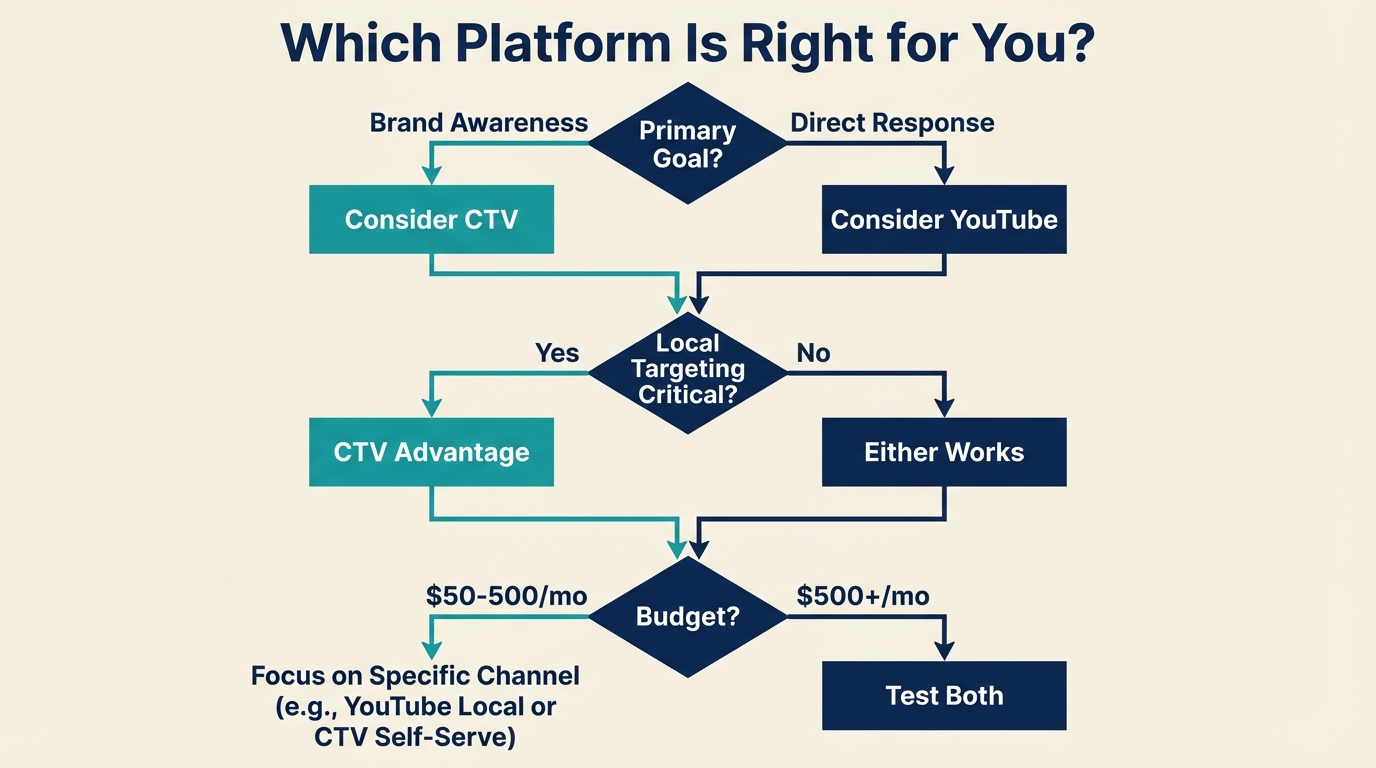
- What's my primary goal? Brand awareness favors CTV. Direct response favors YouTube.
- How important is geographic targeting? Local service areas benefit from CTV's precision.
- What's my budget? Very small budgets ($50-200/month) might start with one platform. Larger budgets can test both.
- Do I need tracking? YouTube's click tracking is more sophisticated. CTV measures awareness differently.
- Where does my audience spend time? Young, mobile-first audiences are on YouTube. Household decision-makers are watching CTV.
Ready to Test Video Advertising?
Both platforms have merit. The best approach for most local businesses is to start with one, learn what works, and expand from there.
Adwave makes CTV advertising accessible starting at $50. Create a professional TV commercial from your existing content, target your local market, and reach viewers during their favorite streaming shows.
Or start with YouTube if direct response and click tracking are your priority.
The worst choice is no choice. Video advertising works. Pick a platform and start testing.
See how CTV advertising works or create your first TV ad free.
Version history
| Version | When | Summary |
|---|---|---|
| v1 | 6/20/2026, 3:11:54 AM | migration import |