Case Study: How a Local Restaurant Built Brand Awareness with CTV Ads
slug: restaurant-ctv-case-study · status: draft · score: 79% · 1 versions
View published version → · Contentful entry: 3UKGVrxdXg5sayhJgX7C2a
Validation
| Rule | Detail | |
|---|---|---|
| pass | No banned competitors | No banned competitors |
| pass | No emdashes | No emdashes |
| pass | Avoid AI telltale words | No AI telltale words |
| pass | Primary keyword in title | No primary keyword to check |
| pass | Use contractions | Contractions used |
| fail | Minimum internal links | Internal links not in sitemap: /resources/what-is-connected-tv-advertising, /resources/local-tv-advertising-costs, /industries/food-beverage/tv-advertising-restaurants, /how-it-works, /success-stories, /try-free |
| fail | FAQ section required | Missing FAQ / 'Common questions answered' section |
| fail | Author assigned | No author assigned (never use 'Adwave Team' for new content) |
| warn | Title length 50-60 | Title length 69 (aim 50-60 chars) |
| pass | Minimum 4 images | 4 images |
| pass | SEO description under 160 | seoDescription 160 chars |
| pass | Adwave mention cadence | 3 Adwave mentions |
| pass | Short description present | shortDescription 101 chars |
| pass | Word count by type | Word count 2114 within target |
| pass | Year-dated title for evergreen types | Type not year-dated |
| pass | No manual table of contents | No manual TOC |
Images (4)
Content
Case Study: How a Local Restaurant Built Brand Awareness with CTV Ads
Subtitle: How Mountain Burger used streaming TV to get on the radar of local diners
SEO Description: This restaurant TV advertising case study shows how a local burger joint used CTV ads to build brand awareness, increase weeknight traffic 18%, and become a household name in their community.
---
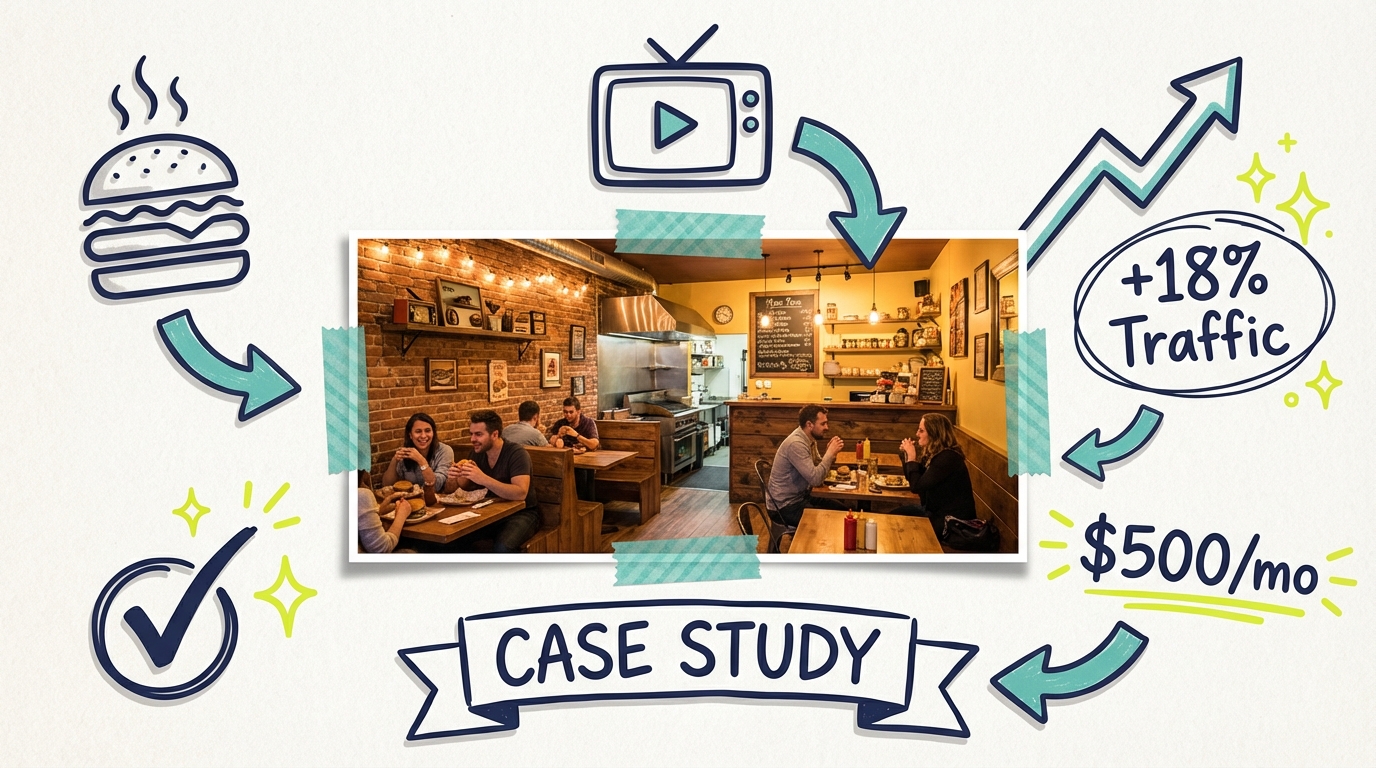
This restaurant TV advertising case study tells the story of Mountain Burger, a local favorite that everyone who visited loved, but not enough people knew existed. Sound familiar? That's the challenge facing most independent restaurants: building awareness beyond your current customers.
What makes this restaurant marketing case study different is the honest approach. We're not going to claim TV ads doubled their revenue overnight. That's not how CTV advertising works. Instead, this is a story about small business TV ad success through steady brand building, realistic expectations, and local business CTV results that compound over time.
Here's what happened when Mountain Burger invested $500 a month in streaming TV advertising.
The Starting Point
Mountain Burger is a three-year-old restaurant in a suburban community about 20 minutes outside a major metro area. They'd built a loyal customer base through quality food and genuine hospitality. The problem? Their reach was limited.
The situation before TV advertising:
- Strong word-of-mouth among existing customers
- Active social media presence (about 2,000 followers)
- Occasional Meta ads with modest results
- Packed weekends but slow weeknight traffic
- Most customers came from within a 5-mile radius
The owners knew that thousands of families within a 15-mile radius had never heard of them. These weren't people who'd rejected Mountain Burger. They simply didn't know it existed.
"We'd get customers who'd been living two miles away for years, and they'd say 'I had no idea you were here,'" says Sarah, one of the owners. "We needed to get on people's radar."
Why They Chose CTV Advertising
Mountain Burger had tried the usual small business marketing playbook. Social media helped maintain relationships with existing customers but didn't reach new ones. Meta ads drove some traffic but felt like shouting into a void.
What attracted them to streaming TV was the perception factor.
"When you see a business on TV, you assume they're established," Sarah explains. "We're competing with chains that have been running TV ads for decades. We wanted that same credibility."
The low barrier to entry sealed the deal. With Adwave, they could start at $500 per month, roughly what they were already spending on Meta ads with inconsistent results. And because CTV allows geographic targeting, they wouldn't waste money reaching viewers outside their delivery area.
The Strategy
Mountain Burger's approach was straightforward: build familiarity with local families, especially during the dinner decision window.
Campaign details:
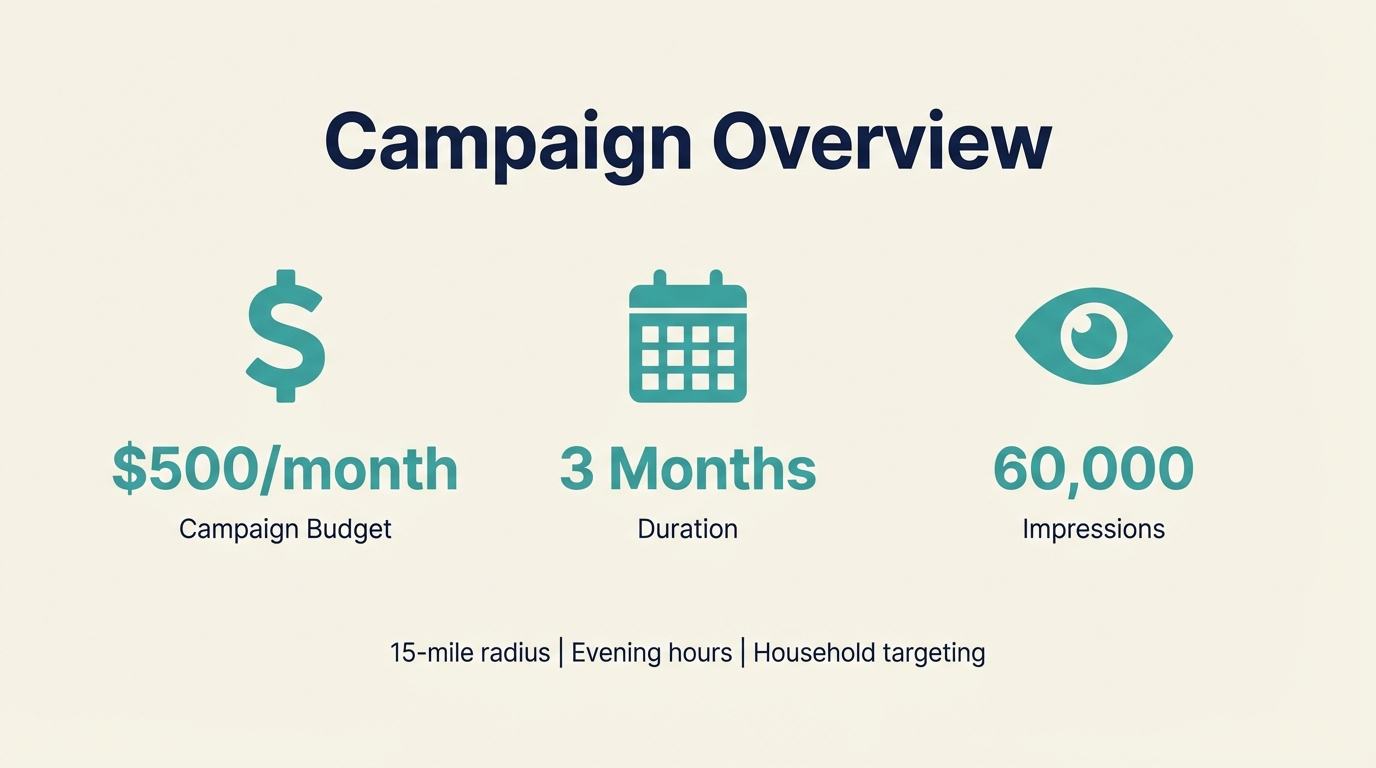
- Geographic focus: 15-mile radius around the restaurant
- Targeting: Households, with emphasis on family composition
- Timing: Evening hours (6-10 PM), when people are deciding what's for dinner
- Budget: $500 per month for three months ($1,500 total investment)
- Primary goal: Brand awareness, not immediate transactions
This last point is crucial. CTV advertising works differently than search or social ads. You're not catching people in the moment they're looking for a restaurant. You're building familiarity so that when they do think "where should we eat tonight?", you're on the list.
"We went in understanding this was a long game," Sarah says. "We weren't expecting the phone to ring off the hook the next day."
The Creative
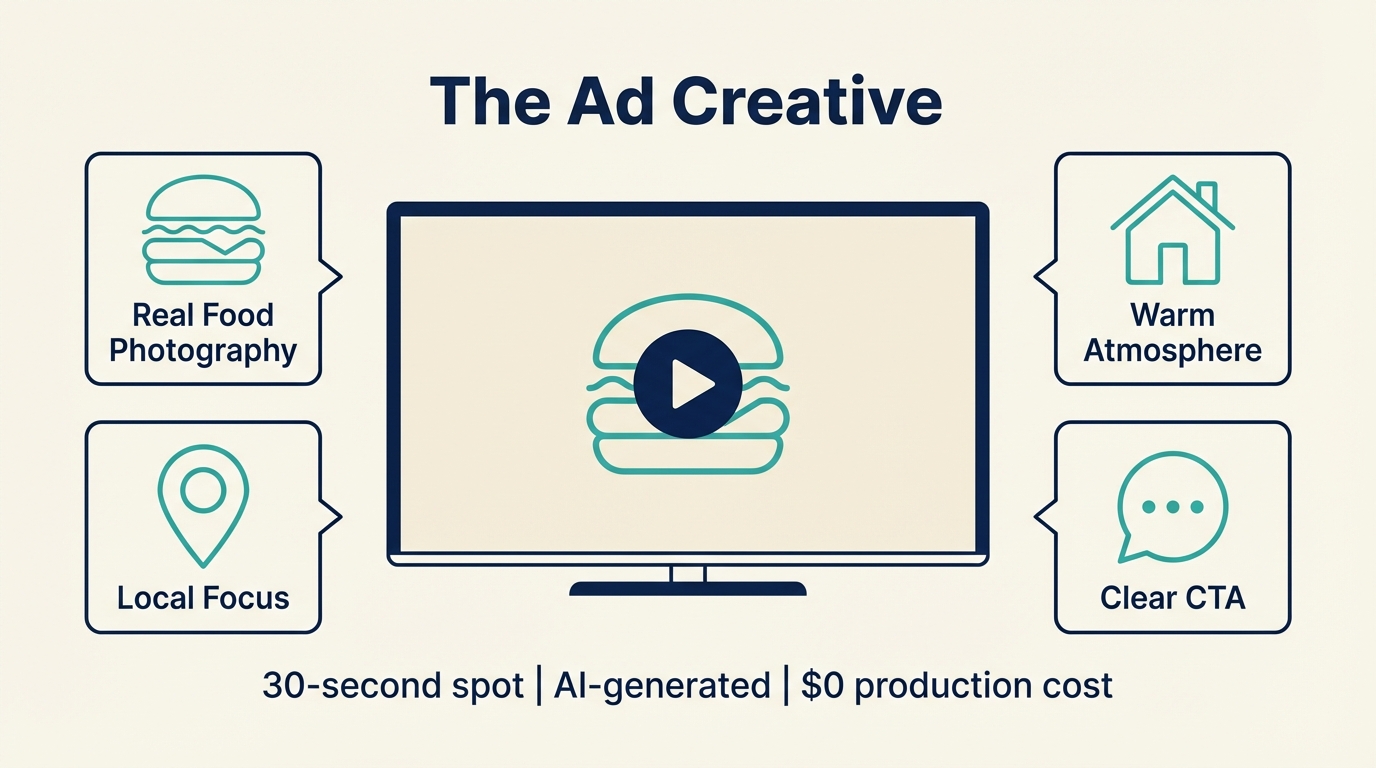
Mountain Burger's 30-second commercial was created using Adwave's AI creative tools, which meant no production budget and no filming days.
The ad featured:
- Real photos of their food (those Instagram-worthy burger shots)
- Interior shots showing the warm, welcoming atmosphere
- Their key message: "Your neighborhood burger joint"
- A simple call to action with their location
"We were skeptical that AI could make something that felt like us," Sarah admits. "But when we saw the first version, it actually captured what we're about. We made a few tweaks to the music and one image swap, and it was ready."
Total time from starting to having a broadcast-ready ad: about 20 minutes.
The Results
Let's be honest about what CTV advertising delivers and what it doesn't.
What they could measure directly:
Over three months, Mountain Burger's campaign generated approximately 60,000 impressions. At their $25 CPM (cost per thousand impressions), that meant their ad was seen 60,000 times by households in their target radius.
But impressions alone don't pay the bills. Here's what happened to their business:
Awareness indicators:
- Noticeable increase in customers mentioning "I saw your ad on TV"
- 25% increase in branded Google searches ("Mountain Burger" searches) over the campaign period
- More first-time visitors citing TV as how they found the restaurant
Business impact:
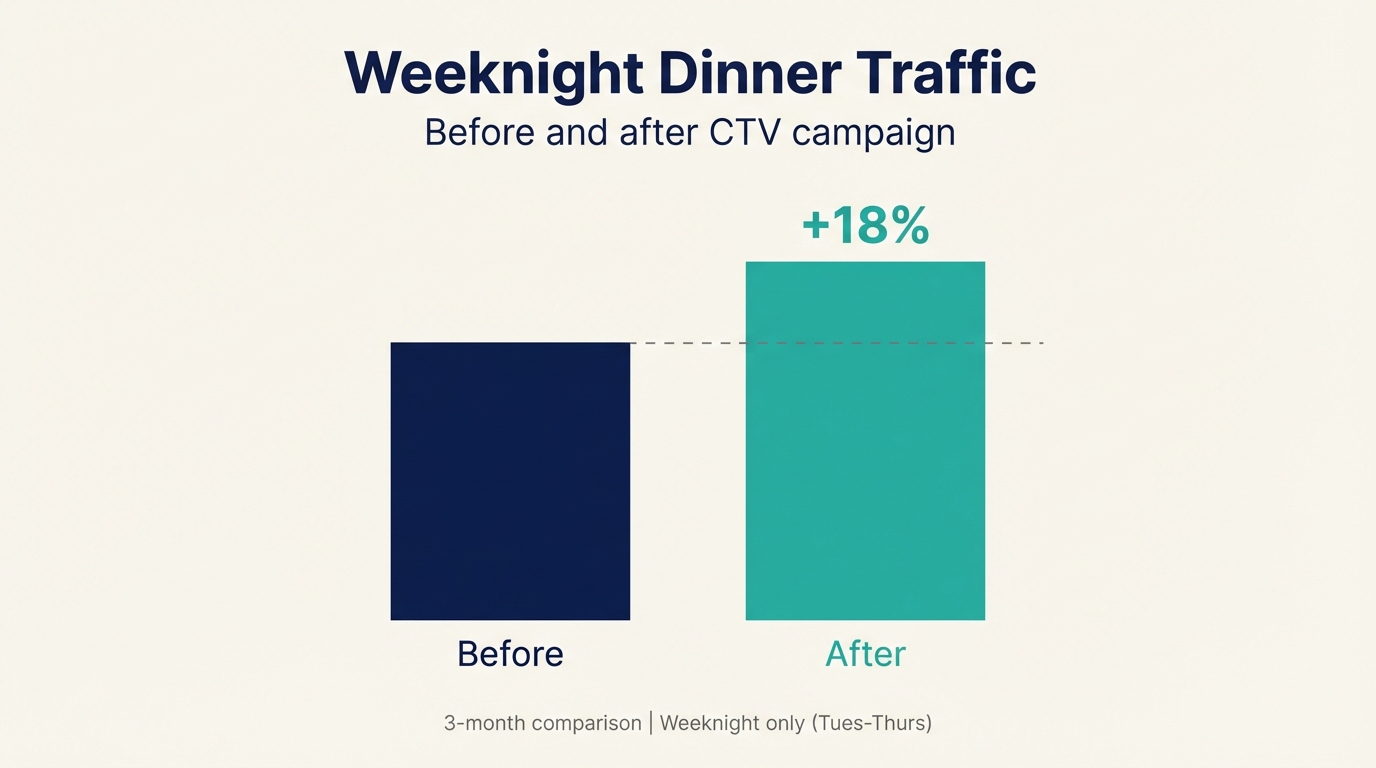
- 18% increase in weeknight dinner traffic (their weakest period before the campaign)
- New customer acquisition up meaningfully (based on new loyalty program signups)
- Average ticket size unchanged (people weren't coming for discounts, they were coming because they'd heard of the restaurant)
The honest caveat:
Can we attribute 100% of this growth to TV advertising? No. That's not how brand advertising works. But TV was the only new marketing channel during this period, and the timing of improvements aligned with the campaign.
"We can't prove every new customer came from TV," Sarah acknowledges. "But when multiple people a week mention seeing your ad, and your slow nights suddenly aren't so slow, something's working."
The Long Game: Why Awareness Matters
CTV advertising isn't about immediate clicks. It's about being remembered.
Think about how you choose restaurants. When someone suggests "let's get burgers," a handful of options come to mind immediately. Those are the restaurants that have built awareness. Everyone else is invisible.
Mountain Burger's goal was to get on that mental shortlist for families in their area. TV advertising helped because:
- Familiarity builds trust. People feel more comfortable trying a restaurant they've "seen" before.
- Repetition creates recall. Over three months, the average household in their target area saw the ad multiple times.
- TV conveys credibility. Fair or not, businesses on TV feel more established.
- Awareness compounds. Someone who sees your ad today might become a customer next month, or recommend you to a friend next year.
"We still get people who say they saw our ad months ago and finally decided to try us," Sarah notes. "The awareness doesn't disappear when the campaign ends."
Key Takeaways for Other Restaurants
Based on Mountain Burger's experience, here's practical advice for restaurants considering CTV advertising:
Set realistic expectations. CTV is an awareness channel, not a direct-response one. You're building brand recognition, not buying immediate customers. Give it at least three months to see meaningful results.
Start with a reasonable budget. Mountain Burger spent $500/month ($1,500 total). That's enough to build meaningful frequency in a local area without betting the business on an experiment.
Focus your targeting. The power of CTV is geographic precision. Don't try to reach everyone. Reach the people who could actually visit your restaurant, repeatedly.
Track what you can. Monitor branded search volume, new customer mentions, and traffic patterns. You won't have click-through attribution like digital ads, but you can see trends.
Give it time. Brand awareness builds gradually. The first month establishes recognition. The second month builds familiarity. The third month (and beyond) is when you see behavior change.
Check out more success stories from businesses using TV advertising to build their brand.
Advice from the Owner
We asked Sarah what surprised her most about the experience:
"Honestly? How many people actually watch streaming TV. I knew it was popular, but until you're running ads and hearing 'I saw you on Hulu last night,' you don't realize how much reach you can get locally."
Her advice for other restaurant owners:
"Don't expect it to work like Facebook ads. It's a different thing entirely. You're not going to see cost-per-click metrics or instant conversions. But if you want people to know you exist, to feel like you're a real, established restaurant and not just another place that popped up, TV does something social media can't."
Would she do it again?
"We're still running. We've actually increased our budget because the awareness keeps building. We're seeing customers who first came in a year ago as regulars now. That's the payoff."
Ready to Build Awareness for Your Restaurant?
Mountain Burger's story isn't about overnight success. It's about using TV advertising the way it's meant to be used: as a steady, consistent way to build brand awareness in your local market.
The math can work at almost any budget level. At $25 CPM, a $500 monthly investment gets your ad in front of local households approximately 20,000 times. Over three months, that's 60,000 impressions among people who could actually walk through your door.
Adwave makes it accessible to start. Create a professional TV commercial from your website or photos in minutes (no production costs), target households in your exact service area, and launch with a budget that makes sense for your business.
Your future regulars are streaming right now. Make sure they know you exist.
Version history
| Version | When | Summary |
|---|---|---|
| v1 | 6/20/2026, 3:11:54 AM | migration import |