Political Ad Rates 2026: What TV Time Actually Costs
slug: political-ad-rates-2026 · status: draft · score: 83% · 1 versions
View published version → · Contentful entry: nDymR1hXtmq2knUpJwXg0
Validation
| Rule | Detail | |
|---|---|---|
| pass | No banned competitors | No banned competitors |
| pass | No emdashes | No emdashes |
| warn | Avoid AI telltale words | AI telltale words found: leverage |
| pass | Primary keyword in title | No primary keyword to check |
| pass | Use contractions | Contractions used |
| fail | Minimum internal links | Internal links not in sitemap: /pricing, /industries/political/local-campaigns/tv-advertising-political-campaigns, /industries/political/local-campaigns/tv-advertising-political-campaigns, /industries/political/local-campaigns/tv-advertising-political-campaigns, /try-free |
| pass | FAQ section required | FAQ section present |
| fail | Author assigned | No author assigned (never use 'Adwave Team' for new content) |
| pass | Title length 50-60 | Title length 52 |
| pass | Minimum 4 images | 5 images |
| warn | SEO description under 160 | seoDescription 161 chars (keep under 160) |
| pass | Adwave mention cadence | 2 Adwave mentions |
| pass | Short description present | shortDescription 154 chars |
| pass | Word count by type | Word count 3085 within target |
| pass | Year-dated title for evergreen types | Title carries year 2026 |
| pass | No manual table of contents | No manual TOC |
Images (5)
Content
--- title: "Political Ad Rates 2026: What TV Time Actually Costs" slug: political-ad-rates-2026 shortDescription: Get the real numbers on political ad rates for 2026. Complete breakdown of TV, streaming, and digital ad costs by market size, daypart, and campaign type. seoDescription: Political ad rates for 2026 midterm elections. Actual TV ad costs by market, daypart, and platform. Learn what campaigns really pay from local to national races. resourceType: Guides resourceDate: 2026-01-17 ---
Political Ad Rates 2026: What TV Time Actually Costs
Campaign managers need real numbers, not vague ranges. This guide provides actual political ad rates for the 2026 midterm elections based on industry data and platform pricing.
The 2026 cycle will see record political ad spending of $10.8 billion according to AdImpact projections. That competition drives up rates across every platform. Understanding current pricing helps you budget accurately and negotiate effectively.
Whether you're running for Congress or city council, this breakdown covers every major channel with specific rate ranges so you can plan your media budget with confidence.
How political ad rates work
Before diving into numbers, understand the pricing models you'll encounter across different platforms.
Cost per thousand (CPM)
CPM measures cost per 1,000 impressions or viewers reached. Most digital, streaming, and cable advertising uses CPM pricing.
How to calculate ad cost from CPM: Cost = (Desired impressions / 1,000) × CPM rate
Example: To reach 100,000 viewers at $25 CPM: Cost = (100,000 / 1,000) × $25 = $2,500
CPM pricing makes comparing platforms straightforward. A $30 CPM on Hulu versus $15 CPM on Tubi tells you exactly what each impression costs.
Cost per point (CPP)
Broadcast TV often uses cost per rating point. One rating point equals 1% of the target demographic in a market.
How to calculate ad cost from CPP: Cost = Target GRPs × CPP rate
Example: To achieve 200 GRPs at $500 CPP: Cost = 200 × $500 = $100,000
GRP planning helps broadcast buyers think in terms of reach and frequency rather than raw impressions.
Spot rates
Traditional broadcast TV also sells individual spots at fixed rates based on program and daypart. These rates vary dramatically by market and demand. A Super Bowl spot costs millions; a Tuesday morning spot on local news costs hundreds.
Minimum commitments
Many platforms require minimum monthly or campaign spends:
- Broadcast TV: Often $5,000-50,000+ minimum
- Cable TV: $2,000-15,000+ minimum
- Premium CTV: $10,000-50,000 minimum
- Self-serve CTV: As low as $50-100
These minimums affect which platforms are accessible to different campaign sizes.
Broadcast TV political ad rates
Broadcast television (ABC, CBS, NBC, Fox affiliates) remains the most expensive but highest-reach option for political advertising.
Major market rates (Top 10 DMAs)
Major markets like New York, Los Angeles, Chicago, and Philadelphia command premium pricing due to high demand and large populations:
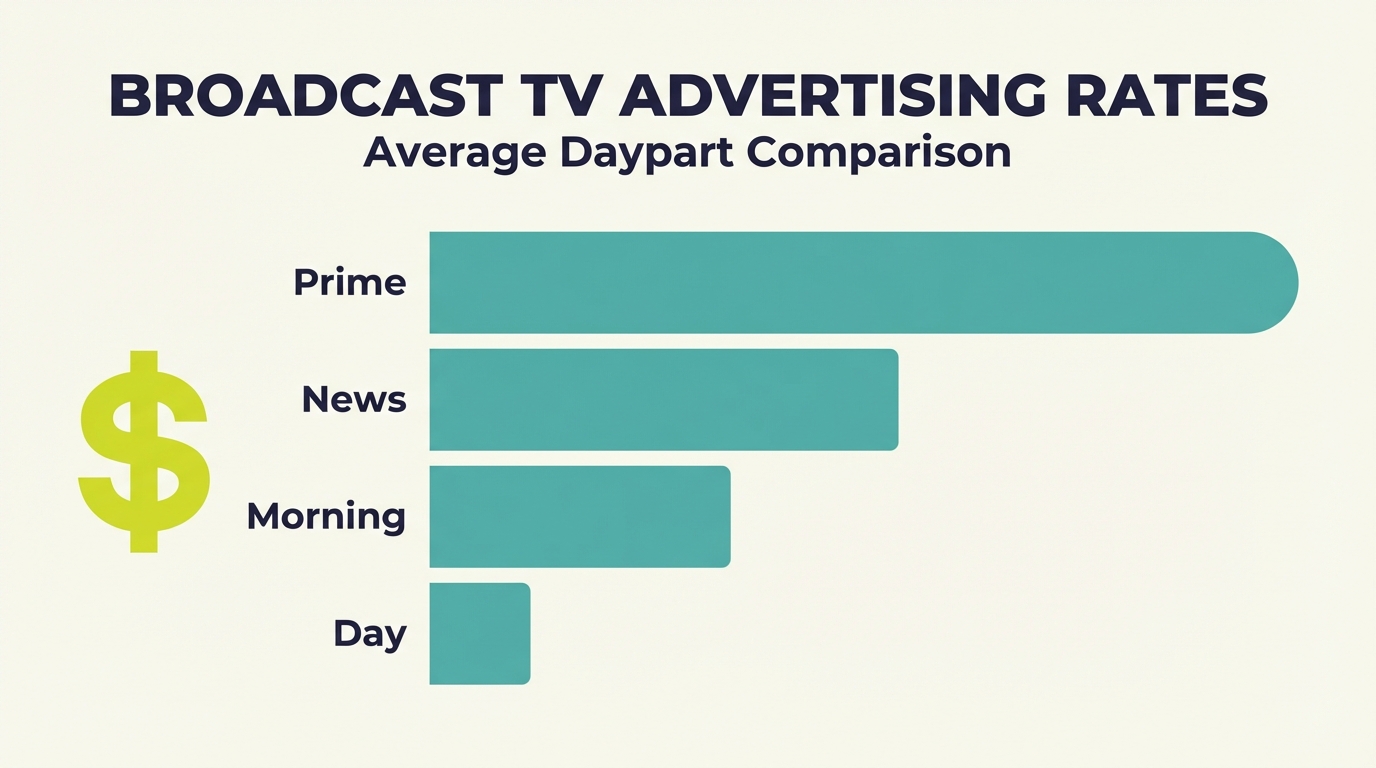
Prime time (8-11 PM):
- 30-second spot: $15,000-75,000
- During high-rated shows: $30,000-100,000+
- Live sports: $40,000-150,000+
Evening news (5-7 PM):
- 30-second spot: $3,000-20,000
- Anchor-adjacent: $5,000-25,000
- Political programming blocks: $8,000-30,000
Morning news/talk (6-10 AM):
- 30-second spot: $1,500-10,000
- Weather/traffic adjacency: $2,000-12,000
Daytime (10 AM-5 PM):
- 30-second spot: $500-3,000
- Talk shows: $800-5,000
Late night (11 PM-1 AM):
- 30-second spot: $1,000-8,000
- Late-night talk shows: $3,000-15,000
Mid-size market rates (DMAs 11-50)
Markets like Denver, San Diego, Portland, Charlotte, and Indianapolis offer more reasonable pricing while still delivering significant reach:
Prime time:
- 30-second spot: $2,000-10,000
- Sports programming: $4,000-20,000
Evening news:
- 30-second spot: $500-3,000
- Extended coverage: $800-4,000
Morning shows:
- 30-second spot: $300-1,500
Daytime:
- 30-second spot: $100-600
Late night:
- 30-second spot: $200-1,500
Small market rates (DMAs 51+)
Smaller markets and regional stations offer the most affordable broadcast rates:
Prime time:
- 30-second spot: $200-2,000
- Local sports: $500-3,000
Evening news:
- 30-second spot: $100-600
Morning shows:
- 30-second spot: $50-300
Daytime:
- 30-second spot: $25-150
Late night:
- 30-second spot: $50-400
These rates make broadcast TV accessible for state legislative and some local races in smaller markets.
Lowest unit rate protections
Federal candidates benefit from the FCC's lowest unit rate (LUR) during election windows:
- 45 days before primary elections
- 60 days before general elections
During these periods, stations must offer federal candidates the lowest rate charged to any advertiser for comparable time. This typically means 30-50% savings compared to standard political rates.
LUR requirements:
- Must be a federal candidate (Senate, House, President)
- Candidate must appear in or voice the ad
- "I approve this message" disclosure required
- Applies to broadcast and cable (not streaming)
Who doesn't get LUR:
- PACs and Super PACs
- State and local candidates
- Issue advocacy campaigns
- 527 organizations
PACs often pay 50-100% more than candidate rates for the same inventory, especially in competitive markets during peak election season.
Cable TV political ad rates
Cable networks offer targeting by content and zone at lower price points than broadcast.
National cable networks
News networks (CNN, Fox News, MSNBC):
- CPM: $20-40
- Per-spot range: $1,000-25,000 (varies by show)
- Prime time anchors: $5,000-40,000
- Minimum commitment: $25,000-100,000+
Sports networks (ESPN, regional sports):
- CPM: $25-50
- Per-spot during games: $3,000-50,000
- Regional sports networks: $500-10,000
- Minimum commitment: $10,000-50,000
Entertainment networks (USA, TNT, HGTV, Discovery):
- CPM: $10-25
- Per-spot range: $500-5,000
- Minimum commitment: $10,000-25,000
Local cable (system buys)
Local cable systems sell time within specific geographic areas:
Full system buy:
- CPM: $5-15
- Per-spot range: $25-200
- Minimum monthly spend: $5,000-20,000
Zone targeting:
- CPM: $8-20 (premium for targeting)
- Per-spot range: $35-250
- Minimum monthly spend: $3,000-15,000
Zone buying adds 10-25% to base rates but reduces waste for district-specific races.
Regional cable interconnects
Interconnects coordinate buys across multiple cable systems in a market:
Major market interconnects:
- CPM: $12-30
- Minimum monthly spend: $10,000-50,000
- Coverage: Multiple counties/systems
Mid-size market interconnects:
- CPM: $8-20
- Minimum monthly spend: $5,000-25,000
Interconnects simplify buying across fragmented cable systems but require larger commitments.
Connected TV (CTV) political ad rates
CTV and streaming platforms offer precision targeting with growing reach among cord-cutters. For many campaigns, CTV now offers the best balance of reach, targeting, and cost efficiency.
Premium streaming platforms
Hulu:
- CPM: $30-45
- Political inventory available with verification
- Disney Advertising Sales handles buying
- Minimum commitment: $20,000-50,000 (direct)
Peacock:
- CPM: $25-40
- NBC Universal content environment
- Strong news and sports inventory
- Minimum commitment: $15,000-40,000
Paramount+:
- CPM: $25-40
- CBS news content available
- Sports including NFL
- Minimum commitment: $15,000-35,000
Disney+ (ad-supported):
- CPM: $35-50
- Premium family and entertainment content
- Limited political ad acceptance
- Minimum commitment: $25,000+
Max (HBO):
- CPM: $30-50
- Premium content environment
- Highly limited political inventory
- Invitation-only political advertising
FAST channels (Free Ad-Supported)
FAST channels offer strong value with growing viewership:
Tubi:
- CPM: $12-22
- Large reach, Fox-owned
- Broad content library
- Lower minimum commitments
Pluto TV:
- CPM: $12-20
- Paramount-owned
- Diverse content including news
- Geographic targeting available
Roku Channel:
- CPM: $15-25
- Native Roku content
- Original programming
- Strong device reach
Samsung TV+:
- CPM: $12-22
- Built into Samsung smart TVs
- No app download required
- Good reach to streaming viewers
Amazon Freevee:
- CPM: $18-28
- Amazon Prime Video free tier
- Amazon DSP integration
- Growing original content
Self-serve CTV platforms
Platforms like Adwave offer direct access to political CTV advertising without agency relationships:
Self-serve CTV rates:
- CPM: $20-35
- Minimum spend: As low as $50
- No agency fees or markups
- Geographic targeting included
- AI creative tools available
At $25 CPM, a $1,000 CTV campaign delivers 40,000 impressions to targeted voters. For a city council district of 30,000 households, that's meaningful reach without broadcast TV's wasted impressions reaching voters outside your district.
Self-serve platforms have transformed political CTV advertising by eliminating traditional barriers to entry.
Digital political ad rates
Digital channels complement TV with additional touchpoints and targeting options.
Video advertising
YouTube:
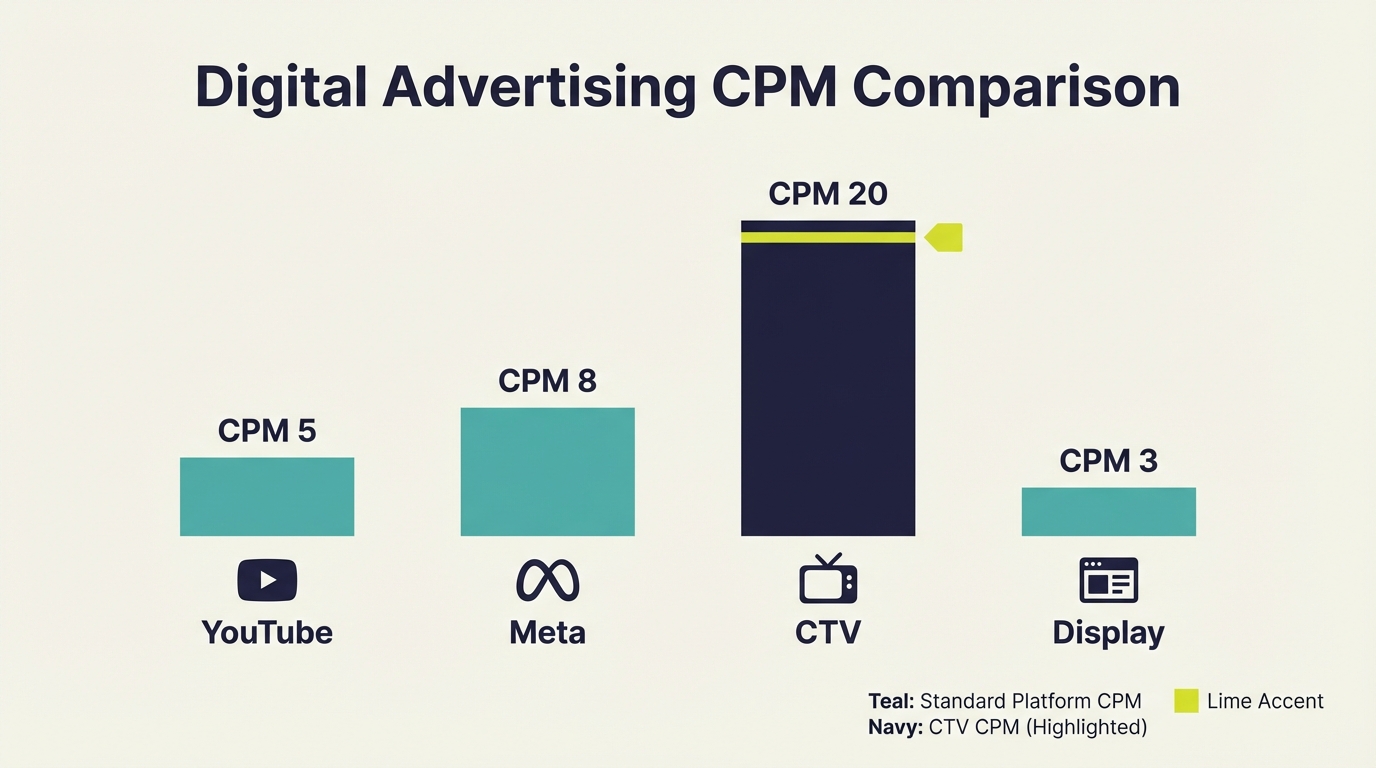
- Skippable video: $10-25 CPM
- Non-skippable (15 sec): $15-35 CPM
- Bumper ads (6 sec): $8-20 CPM
- Minimum daily spend: Flexible ($10+)
- Political verification required
Meta (Facebook/Instagram) video:
- In-feed video: $8-20 CPM
- Reels: $10-25 CPM
- Stories: $6-15 CPM
- Strict political ad verification and "Paid for by" disclosure required
Social media display advertising
Facebook/Instagram:
- Image ads: $5-15 CPM
- Carousel: $6-18 CPM
- Click cost: $0.50-3.00 CPC
- Extensive targeting options (with restrictions)
X (Twitter):
- Promoted posts: $8-20 CPM
- Engagement cost: $1-4 per engagement
- Amplify pre-roll: $12-25 CPM
LinkedIn:
- Display: $10-25 CPM
- Click cost: $5-12 CPC
- Message ads: $0.30-1.00 per send
- B2B and advocacy focused
TikTok:
- Video ads: $10-25 CPM
- Political ad policies vary by region
- Limited availability for explicit political content
Programmatic display
Standard display:
- CPM: $2-8
- Viewability varies widely
- Broad reach, lower engagement
Premium placements:
- CPM: $5-15
- Higher quality inventory
- Better viewability guarantees
Native advertising:
- CPM: $8-20
- Content-style placements
- Higher engagement rates
Search advertising
Google Ads:
- Candidate name terms: $2-10 CPC
- Issue-related terms: $1-5 CPC
- Generic political terms: $3-15 CPC
- Competition varies dramatically by race
Microsoft Ads (Bing):
- Generally 20-30% lower than Google
- Older demographic skew
- Lower volume but less competition
!Digital Platform Rate Comparison
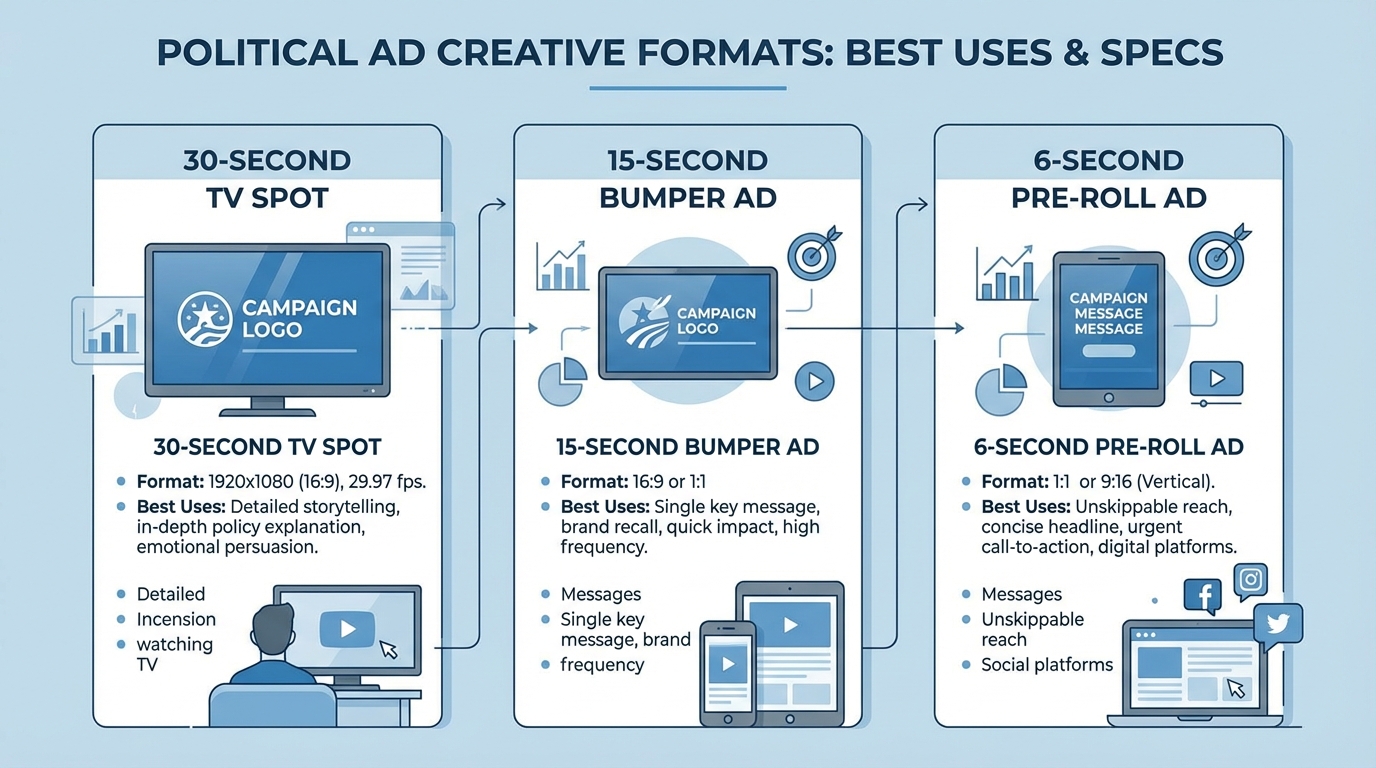
!Political Ad Creative Formats
Radio political ad rates
Radio remains relevant for reach and frequency, particularly for voter mobilization.
Major market radio rates
Drive time (6-10 AM, 3-7 PM):
- 30-second spot: $200-800
- Talk radio premiums: $300-1,200
- Sports radio: $250-900
Midday (10 AM-3 PM):
- 30-second spot: $75-300
Evenings/weekends:
- 30-second spot: $50-200
Small market radio rates
Drive time:
- 30-second spot: $25-150
Midday:
- 30-second spot: $15-75
Evenings/weekends:
- 30-second spot: $10-50
Radio excels at frequency due to lower unit costs. Campaigns often use radio to reinforce TV messages and drive turnout.
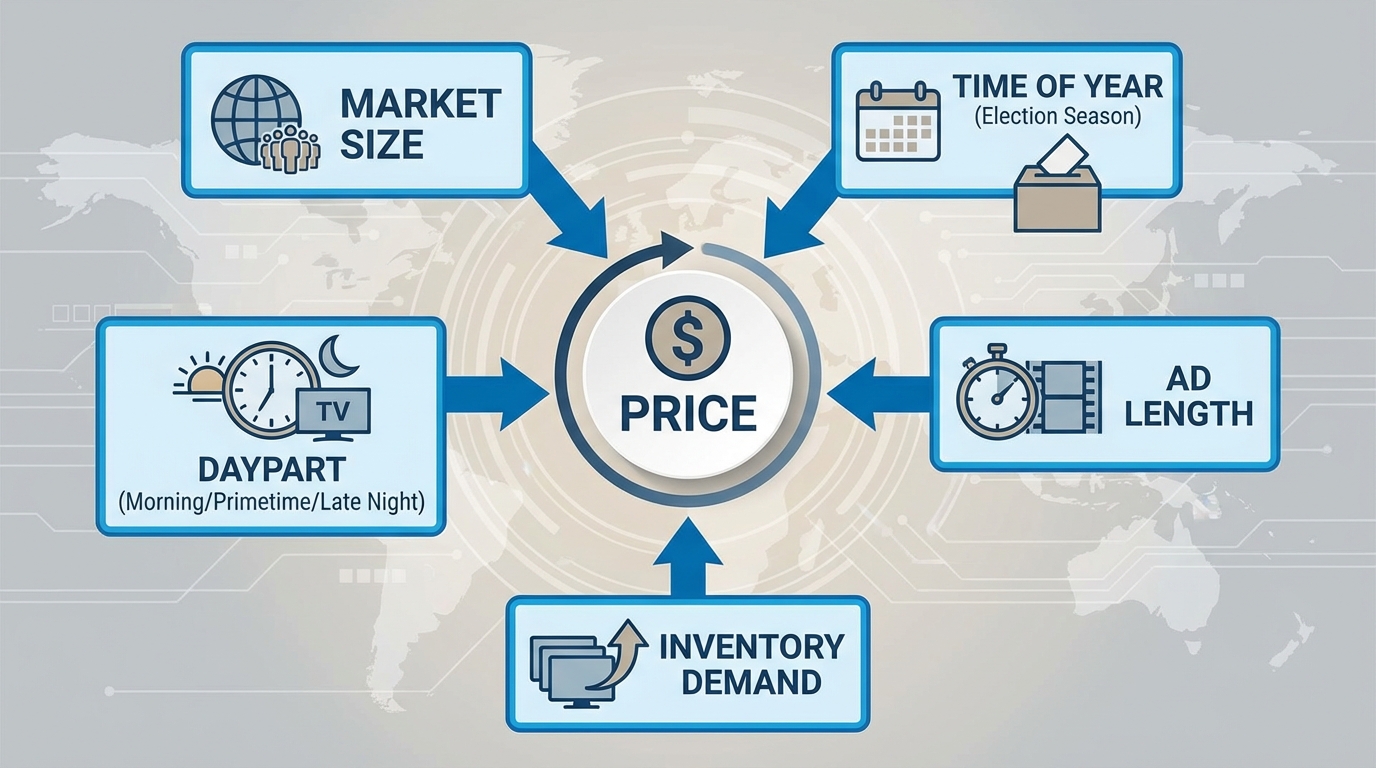
Rate factors and timing
Multiple factors affect the rates you'll actually pay.
Timing premiums
Political ad rates increase as Election Day approaches:
January-June: Baseline rates (lowest) July-August: 20-40% above baseline September: 50-80% above baseline October: 100-200% above baseline Final 2 weeks: 150-300% above baseline
Campaigns that start early pay significantly less for comparable reach. A $10,000 January buy might cost $25,000-30,000 in October.
Competitive market premiums
Battleground states see higher rates due to competitive demand:
High-premium states (2026):
- Georgia, Arizona, Nevada
- Pennsylvania, Michigan, Wisconsin
- Ohio, North Carolina, Florida
Expect 30-60% higher rates in these states compared to non-competitive markets during peak election season.
Daypart efficiency
Some dayparts deliver better value for political campaigns:
Best value dayparts:
- Evening news - engaged, politically interested viewers
- Prime time access (7-8 PM) - lower rates than prime, strong viewership
- Morning news - politically engaged audience, reasonable rates
- Weekend sports - captive audiences, good demographics
Lower value dayparts:
- Daytime - lowest engagement, cheapest rates
- Late fringe (after midnight) - very limited reach
- Weekend morning - often children's programming
Inventory type impact
Not all ad slots are equal:
Fixed position (guaranteed): 20-50% premium Run of schedule (ROS): Standard rates, station flexibility Preemptible: 10-30% discount (risk of being bumped by higher-paying advertisers)
Political campaigns often pay premiums for guaranteed positioning, especially in final weeks when inventory becomes scarce and preemption risk is highest.
Calculating your campaign costs
Use these benchmarks to estimate your advertising budget.
Federal race benchmarks
Competitive Senate race (statewide):
- Total media budget: $10-50 million
- TV/CTV allocation: $6-35 million
- Per-week spend (final month): $1-5 million
Competitive House race:
- Total media budget: $1-5 million
- TV/CTV allocation: $500K-3 million
- Per-week spend (final month): $100-500K
State race benchmarks
Governor/statewide office:
- Total media budget: $2-20 million
- TV/CTV allocation: $1-12 million
- Per-week spend (final month): $200K-2 million
State legislature:
- Total media budget: $50,000-500,000
- TV/CTV allocation: $25,000-300,000
- Per-week spend (final month): $10,000-50,000
Local race benchmarks
County-wide races:
- Total media budget: $25,000-200,000
- CTV/digital allocation: $15,000-120,000
- Per-week spend (final month): $5,000-25,000
City/municipal races:
- Total media budget: $5,000-75,000
- CTV/digital allocation: $3,000-50,000
- Per-week spend (final month): $1,000-15,000
School board/small local:
- Total media budget: $2,000-25,000
- CTV/digital allocation: $1,000-20,000
- Per-week spend (final month): $500-5,000
For local races, CTV advertising typically delivers better value than broadcast TV. The precision targeting eliminates waste from reaching voters outside your district.
Negotiating better rates
You can often improve on standard rate card pricing with the right approach.
Broadcast TV negotiation tactics
Request avails early: Earlier requests get better rates and more options. Stations reward proactive buyers.
Commit to volume: Larger buys earn discounts of 10-25% for major commitments. Bundle buys across flight dates.
Accept flexibility: Run-of-schedule or broad rotations cost less than fixed positions. If you can accept station flexibility, rates drop.
Bundle stations: Multi-station buys in a market can earn package discounts of 10-20%.
Negotiate make-goods: Get written commitments for replacement spots if you're preempted by a higher-paying advertiser.
Know LUR windows: For federal candidates, understand when lowest unit rate kicks in and maximize buys during those periods.
CTV and digital negotiation
Test first: Start with small tests ($500-2,000) to validate performance before major commitments.
Commit to longer flights: Monthly or quarterly commitments often earn 5-15% lower CPMs.
Use self-serve platforms: Eliminate agency markups (typically 10-20%) by buying directly.
Target efficiently: Tighter targeting reduces wasted impressions even at higher CPMs. $30 CPM reaching only your voters beats $15 CPM reaching half non-voters.
Agency vs. self-serve economics
Traditional agencies charge fees on top of media costs:
Typical agency fees:
- 10-15% of media spend
- $5,000-15,000 monthly minimums
- Additional creative production fees
- Research and planning fees
Self-serve platforms:
- No agency fees
- No minimums (or very low minimums)
- Often include creative tools
- Transparent pricing
For campaigns under $50,000 in media spend, self-serve platforms often deliver better net value. Larger campaigns may benefit from agency relationships for broadcast buying expertise and relationship-based rate negotiations.
Common questions
What is the average cost of a 30-second political TV ad in 2026?
Average costs vary dramatically by market. In major markets (New York, LA), expect $15,000-75,000 for prime time. Mid-size markets run $2,000-10,000. Small markets can be as low as $200-2,000. CTV/streaming offers a consistent $20-35 CPM regardless of market, making it more predictable and often more efficient for targeted campaigns.
How much does CTV political advertising cost compared to broadcast?
CTV political advertising typically costs $20-35 CPM, while broadcast TV effectively runs $30-100+ CPM when accounting for wasted reach outside your district. For targeted local campaigns, CTV delivers 2-3x more in-district impressions per dollar. Plus, CTV campaigns can start at $50 versus $5,000+ minimums for broadcast.
Do political ad rates go up before elections?
Yes, significantly. Rates can increase 100-300% in the final weeks before Election Day compared to earlier in the year. January-June offers the lowest rates. Starting earlier saves substantial money - a $10,000 January buy might cost $25,000-30,000 in October for equivalent reach and frequency.
What's the lowest unit rate and who gets it?
The lowest unit rate (LUR) requires broadcast stations to offer federal candidates the lowest rate charged to any advertiser during specific election windows (45 days before primaries, 60 days before general elections). Only federal candidates appearing in or voicing their ads qualify. PACs, state/local candidates, and issue campaigns pay full market rates - often 50-100% higher.
How much should a local campaign budget for TV advertising?
Local campaigns (city, county, school board) typically allocate $5,000-50,000 for TV/CTV advertising. At $25 CPM on CTV, a $5,000 campaign delivers 200,000 impressions - enough to reach voters in a small district multiple times. Skip broadcast TV for most local races due to wasted reach outside your district.
Are political ad rates negotiable?
Yes, especially for broadcast TV. Request rate cards early, commit to larger volumes for discounts, accept run-of-schedule flexibility, and negotiate make-goods for potential preemptions. CTV and digital rates are generally fixed but self-serve platforms eliminate agency fees (10-20% savings) and may offer volume-based pricing.
Rate comparison by campaign type
Different campaign types should prioritize different channels based on these rate realities.
Best value for federal campaigns
Federal candidates should leverage LUR for broadcast savings while using CTV for precision:
- Broadcast TV during LUR windows - 30-50% savings vs. standard rates
- CTV for targeted reach - Fill geographic and demographic gaps
- Cable news for engaged voters - Politically attentive audiences
- Digital video for frequency - Reinforce TV at lower CPMs
Best value for state campaigns
State races balance reach needs with budget constraints:
- CTV as primary channel - Best reach-to-targeting ratio
- Broadcast in small/mid markets - Affordable for statewide reach
- Cable zones for targeted areas - Geographic focus without waste
- Digital for voter mobilization - Drive turnout in final weeks
Best value for local campaigns
Local races should prioritize precision over reach:
- CTV via self-serve platforms - Start at $50, no waste
- Social media - Hyper-local targeting, low entry cost
- Radio for frequency - Low-cost message reinforcement
- Skip broadcast TV - Too much waste for most local races
The key insight: smaller campaigns should prioritize CPM efficiency and targeting precision over raw reach. A $5,000 CTV campaign reaching 200,000 targeted impressions beats a $5,000 broadcast buy reaching 500,000 impressions where 80% are outside your district.
Start planning your 2026 campaign
Understanding rates is the first step. The next step is getting your ads in front of the right voters at the right price.
For most 2026 campaigns, CTV offers the best combination of reach, targeting, and value. The rates are consistent ($20-35 CPM), minimums are low or nonexistent, and you reach voters where they're actually watching - streaming services.
Whether you're running for Senate or school board, the math works: targeted impressions at $25 CPM beat broadcast waste at any price. Platforms like Adwave make CTV advertising for political campaigns accessible to campaigns of all sizes.
Ready to see what your campaign can afford? Create your ad and get instant pricing based on your target audience and geography.
Version history
| Version | When | Summary |
|---|---|---|
| v1 | 6/20/2026, 3:11:54 AM | migration import |