Using Adwave for Seasonal Campaigns: A Step-by-Step Guide
slug: using-adwave-seasonal-campaigns-guide · status: draft · score: 86% · 1 versions
View published version → · Contentful entry: G9BM3qHly4X8RLFy7fP5W
Validation
| Rule | Detail | |
|---|---|---|
| pass | No banned competitors | No banned competitors |
| pass | No emdashes | No emdashes |
| warn | Avoid AI telltale words | AI telltale words found: leverage |
| pass | Primary keyword in title | No primary keyword to check |
| pass | Use contractions | Contractions used |
| warn | Minimum internal links | Only 1 internal links (minimum 3-5) |
| pass | FAQ section required | FAQ section present |
| fail | Author assigned | No author assigned (never use 'Adwave Team' for new content) |
| pass | Title length 50-60 | Title length 57 |
| pass | Minimum 4 images | 4 images |
| pass | SEO description under 160 | seoDescription 141 chars |
| warn | Adwave mention cadence | 11 Adwave mentions may feel salesy (aim 2-3) |
| pass | Short description present | shortDescription 180 chars |
| pass | Word count by type | Word count 2056 within target |
| pass | Year-dated title for evergreen types | Type not year-dated |
| pass | No manual table of contents | No manual TOC |
Images (4)
Content
Using Adwave for Seasonal Campaigns: A Step-by-Step Guide
Most small business owners are intuitive about their seasonal moments. The gym owner knows January is resolution season. The roofer knows late August through October is the peak window. The wedding venue knows February and March are when most couples start serious venue tours. What most owners don't yet know is how to translate that intuitive seasonal awareness into a TV ad campaign that captures the buying window without overrunning it.
This guide walks through how to use Adwave to build, launch, and manage seasonal campaigns. Whether you're running a 2-week holiday push or a 90-day spring campaign, the framework here will help you plan, generate creative, set targeting, and measure results.
What a seasonal campaign actually is
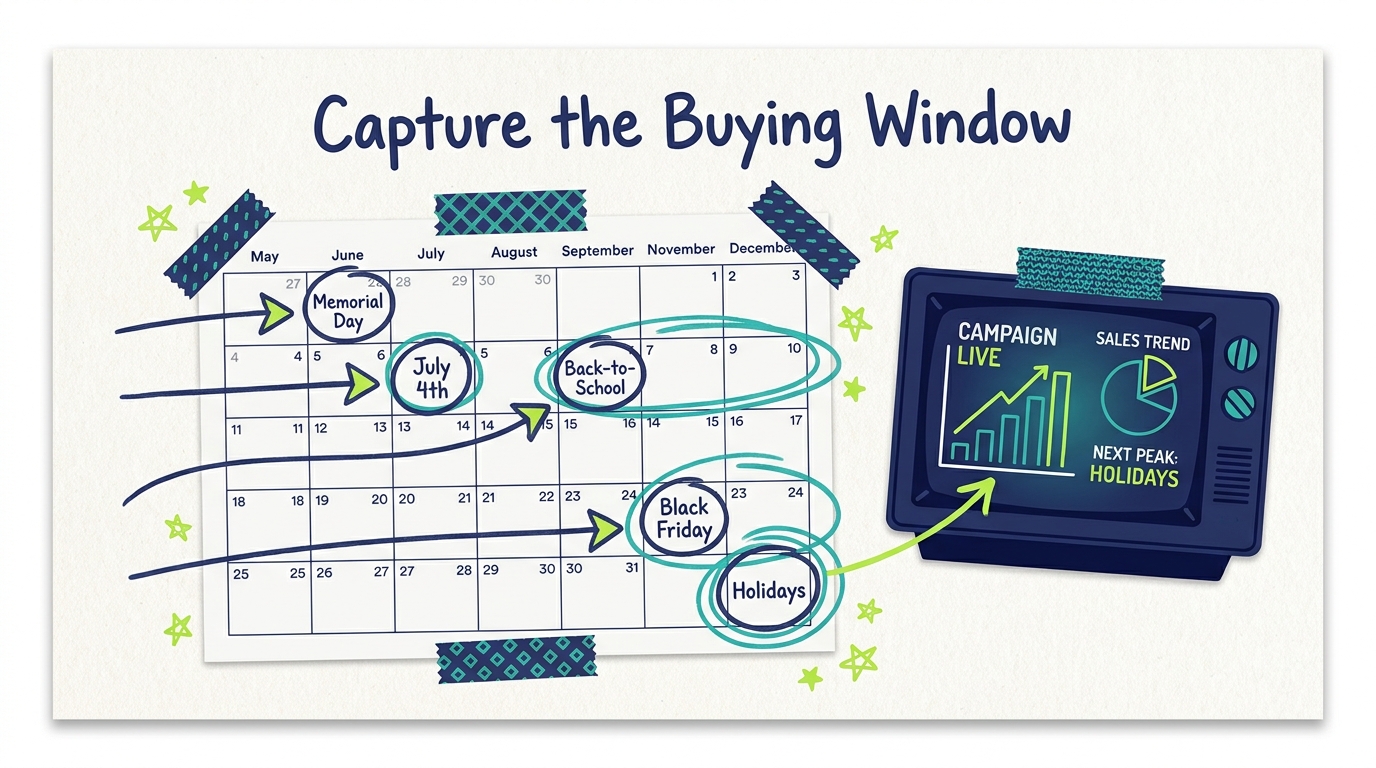
Before the steps, a brief definition. A "seasonal campaign" in TV advertising is a campaign timed to a specific demand window in your business calendar. The window can be a holiday (Memorial Day, Father's Day, Black Friday), a weather-driven season (spring lawn care, summer AC service), a category-specific peak (back-to-school, tax season, summer wedding planning), or a recurring local moment (your town's festival weekend, the start of the local school year).
Seasonal campaigns differ from year-round campaigns in three ways:
- Duration. Typically 2-12 weeks rather than ongoing
- Creative. Pegged to the specific moment rather than evergreen
- Budget pattern. Concentrated weight rather than steady delivery
Seasonal campaigns done well capture 2-4x the conversion lift of evergreen campaigns run during the same window because the creative and timing align with audience decision-making.
Step 1: Pick the right seasonal window
Not every business benefits from a seasonal campaign push. The right windows have three characteristics:
1. Concentrated demand. A clear period when prospects are making purchase decisions. Memorial Day weekend for retailers. Late spring for HVAC. September for fitness studios.
2. Recognizable trigger. A moment audiences are already thinking about. Holidays, weather changes, life-stage transitions, school calendars. The trigger does free awareness work that evergreen creative can't.
3. Sufficient business capacity. Your business needs to be able to absorb the volume the campaign will produce. If you're already at peak capacity during the window, the campaign creates frustrated would-be customers rather than revenue.
If you're new to seasonal campaigns, pick one window per quarter rather than trying to run continuous seasonal pushes. Build the muscle on a single campaign before expanding to a full seasonal calendar.
Step 2: Set your campaign timeline
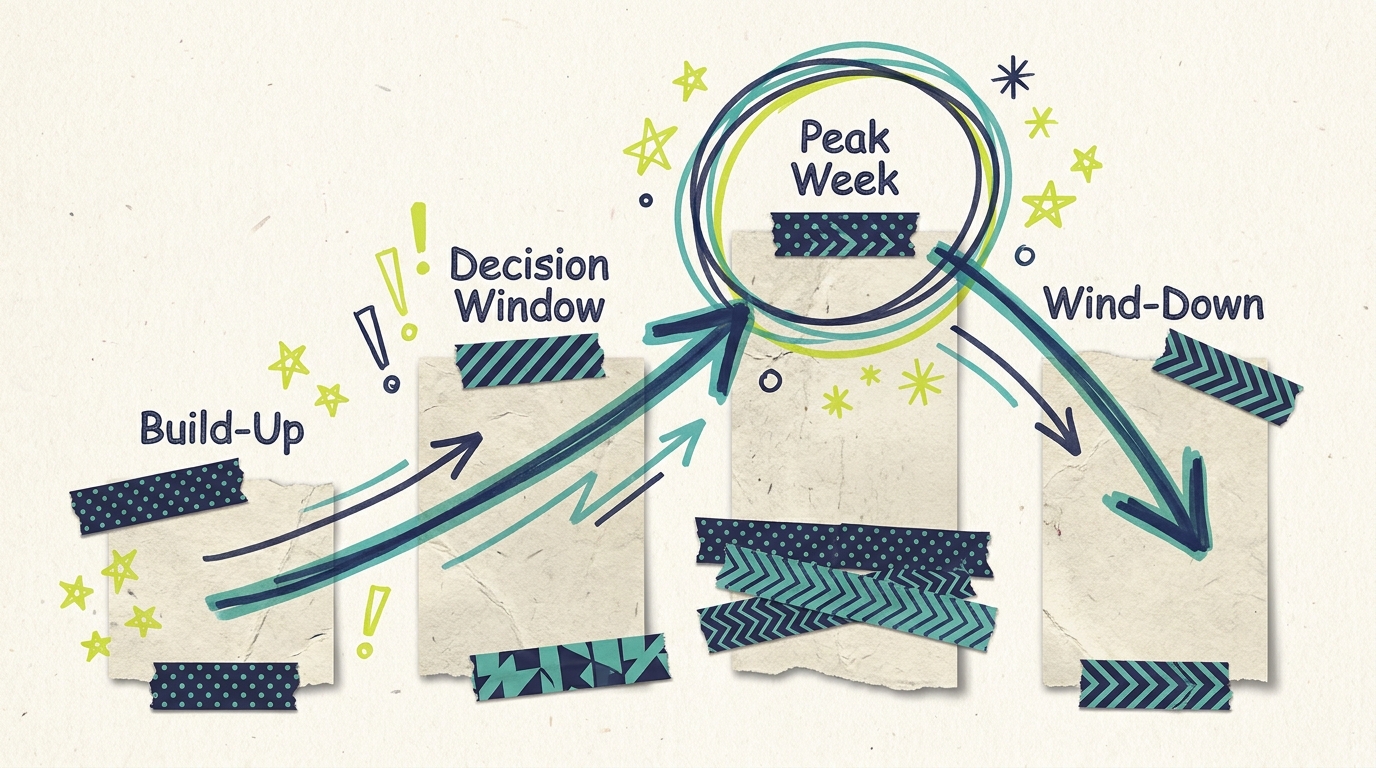
Most seasonal campaigns have four distinct phases, each requiring different creative and budget weight.
Phase 1: Build-up (3-4 weeks before the peak). Awareness creative introducing the seasonal moment. Modest daily cap. Goal: establish familiarity before active decision-making begins.
Phase 2: Decision window (1-2 weeks before the peak). Conversion creative with specific offers. Daily cap increased meaningfully. Goal: be top-of-mind when prospects are deciding.
Phase 3: Peak week (the window itself). Time-bound, urgent creative. Daily cap at its highest. Goal: maximize conversion during the demand peak.
Phase 4: Wind-down (3-7 days after the peak). Recency creative for prospects who acted on weekend or week-of decisions. Reduced daily cap. Goal: capture trailing demand.
For a Memorial Day campaign, the timing might look like:
- Build-up: early to mid-May
- Decision window: 5-9 days before Memorial Day
- Peak: Memorial Day weekend itself
- Wind-down: Tuesday and Wednesday after Memorial Day
For a fall HVAC campaign, the timing might look like:
- Build-up: late August through mid-September
- Decision window: mid-September through early October
- Peak: throughout October
- Wind-down: first 1-2 weeks of November
Step 3: Generate creative for each phase
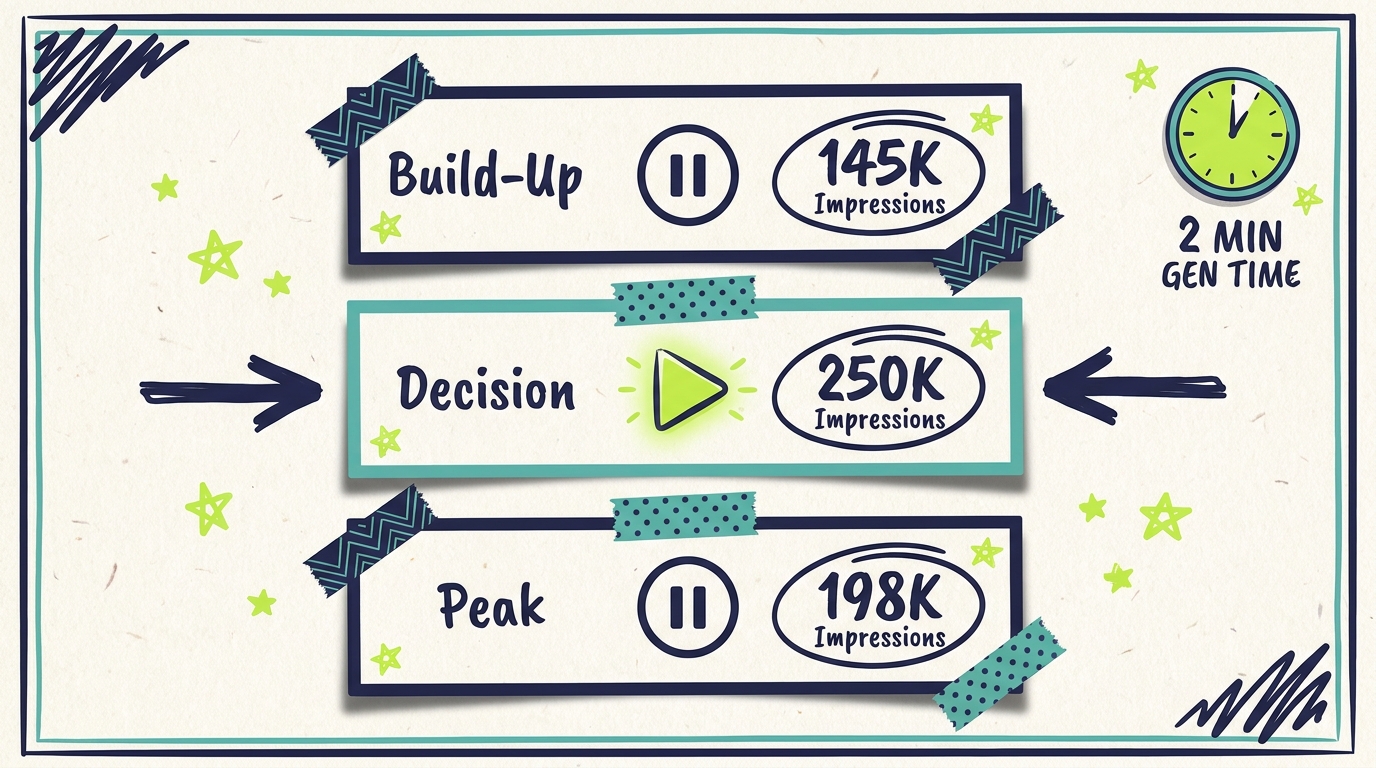
Adwave's AI creative tools can generate 30-second TV-ready creative from your website in about 2 minutes. For a seasonal campaign, you'll typically want 2-3 creative variations:
Variation 1: Build-up creative. Awareness-focused, introducing the seasonal moment. Soft CTA. Example for HVAC: "Summer's coming. Is your AC ready?"
Variation 2: Decision-window creative. Slightly harder positioning, specific offer or service emphasis. Example for HVAC: "Get your free pre-summer AC tune-up scheduled today."
Variation 3: Peak-week creative. Time-bound urgency. Specific call to action. Example for HVAC: "Last week to book pre-summer service. Don't wait for the first heat wave."
Each variation takes 2-5 minutes to generate through Adwave's tools. The platform handles the production grammar (pacing, voiceover, music, transitions) so you don't need a separate production agency or video team.
When generating each variation:
- Provide your website URL as the source. Adwave pulls business identity, branding, and offering from the site.
- Include the seasonal framing in your prompt or creative brief. The clearer the moment, the better the spot.
- Specify any specific offers or promotions you want included.
- Generate two takes of each variation. The first take is usually strong; the second often unlocks a different angle worth testing.
Step 4: Set up targeting
Seasonal campaigns benefit from the same targeting principles as year-round campaigns, with a few adjustments.
Geographic targeting. Same as your evergreen campaigns: tight to your real customer service area. Don't expand for the seasonal push. A 10-mile radius for a local retailer should stay at 10 miles.
Daypart consideration. For some seasonal campaigns, daypart matters more than usual. Memorial Day weekend planning happens Thursday-Saturday evening. Back-to-school decisions cluster Sunday evenings. Tax season decisions concentrate weekend mornings. Adwave's dashboard shows when your impressions land; for seasonal campaigns, you can adjust daily caps to weight toward decision-making windows.
Frequency target. Seasonal campaigns typically target slightly higher frequency than evergreen campaigns: 4-7 per household across the 4-6 week window rather than 3-5. The shorter window justifies more aggressive recall building.
Budget pacing. Most platforms let you set daily caps. For a seasonal campaign, set higher caps during the decision window and peak phase, lower caps in build-up and wind-down. A typical 6-week Memorial Day campaign might look like $80/day for two weeks, $130/day for two weeks, $130/day during peak week, then $60/day for wind-down.
Step 5: Launch and observe
Launch your campaign 3-4 weeks before the seasonal peak. The most common mistake is launching too late. By the time prospects are actively deciding, you should already have built familiarity through 2-3 weeks of build-up exposure.
During the first 7-10 days of the campaign:
- Don't optimize. The platform needs settling time to find inventory in your area.
- Watch geographic delivery. If meaningful impressions are leaking outside your service area, contact support to tighten.
- Watch creative-level data if multiple variations are running. Don't make pause/scale decisions until you have 10-14 days of signal.
Step 6: Adjust between phases
The right time to adjust creative is between phases, not mid-phase.
Build-up to decision window transition. Pause build-up creative (or reduce its rotation share). Launch decision-window creative. Raise daily cap.
Decision window to peak transition. Pause weaker decision creative. Launch peak creative with time-bound urgency. Daily cap stays elevated.
Peak to wind-down transition. Pause peak creative once the demand window closes. Launch wind-down creative for trailing demand. Reduce daily cap.
Each transition takes about 5-10 minutes in the Adwave dashboard: pausing the previous creative, launching the new creative, adjusting the daily cap.
Step 7: Measure the campaign's lift
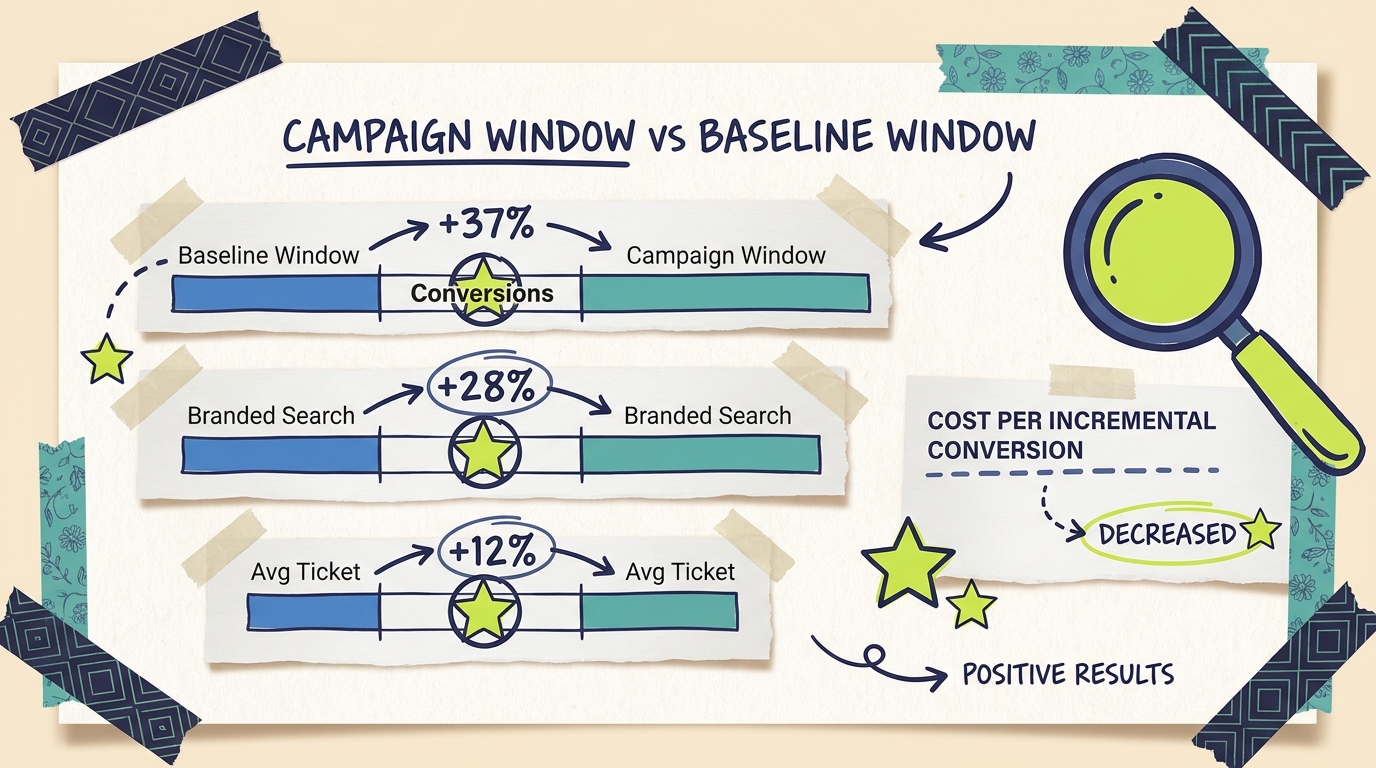
Seasonal campaign measurement uses the same framework as evergreen campaign measurement, with one adjustment: your baseline should be the same seasonal window from the prior year (or, if you have no prior year, the 4 weeks immediately before the campaign launched).
What to compare:
- Total conversions during the campaign window vs the baseline window
- Average ticket or transaction value during the campaign vs baseline
- Branded search lift during the campaign vs baseline
- Direct traffic lift during the campaign vs baseline
- Cost per incremental conversion (TV spend divided by conversions above baseline)
For most seasonal campaigns, a 20-50% conversion lift over baseline during the peak window is a strong result. Higher lifts indicate excellent campaign-to-business fit; lower lifts (under 10%) suggest geographic, creative, or timing issues to address in the next seasonal cycle.
Sample seasonal campaign: spring fitness studio
A worked example for a yoga and Pilates studio running a 5-week spring campaign in March-April:
Pre-launch (week -2 to 0):
- Capture 4-week baseline: weekly intro signups, weekly walk-ins, weekly branded search
- Generate two creatives: "Spring reset" awareness and "5-class intro for $39" conversion
- Set daily cap at $40 starting March 1
Build-up (weeks 1-2 of campaign):
- Run "Spring reset" creative
- Daily cap $40, geographic targeting to 8-mile radius
- Observe; don't optimize
Decision window (weeks 3-4):
- Pause "Spring reset"; launch "5-class intro" creative
- Daily cap $70
- Monitor intro signups
Peak week (week 5 of campaign):
- Maintain conversion creative
- Daily cap $90, push toward evening daypart concentration
- Layer in "Spring is here, last week for intro pricing" wind-down version Friday onward
Wind-down (3 days after campaign end):
- Reduce cap to $30 for trailing demand
- Conclude campaign
Measurement at end:
- Compare 5-week campaign intro signups to baseline + prior year same window
- Calculate cost per incremental signup
- Document for repeating the campaign next spring
Total campaign spend: roughly $2,000-$2,500 across the 5-week window.
Common questions answered
How early should I start a seasonal campaign?
For most categories, 3-4 weeks before the peak demand week is right. Earlier than 4 weeks often results in spend on prospects who aren't yet thinking about the seasonal moment; later than 2 weeks means missing the build-up phase where familiarity gets established.
Can I run a seasonal campaign on top of my year-round campaign?
Yes, and this is often the most effective approach. The year-round campaign maintains brand familiarity at modest spend; the seasonal campaign layers additional weight during peak demand. Adwave's dashboard lets you run multiple concurrent campaigns with different creative and targeting.
How many creative variations should I generate for a seasonal campaign?
Two minimum, three optimal. One per phase (build-up, decision-window, peak) is the typical structure. AI creative tools make production effectively free, so the only reason to run a single creative is that you didn't take the 10 minutes to generate the others.
What's the right total budget for a small business seasonal campaign?
Most small businesses running seasonal campaigns through Adwave land in the $1,500-$3,500 range for a 4-6 week window. The exact number depends on geographic size and competitive pressure. Smaller markets and tighter targeting allow smaller budgets to produce meaningful results.
Should my targeting change between phases?
Geographic targeting should stay consistent. Daypart emphasis can shift between phases (build-up evenly distributed; decision and peak weighted toward evening windows when households decide). Creative changes between phases; targeting mostly doesn't.
How do I know if my seasonal campaign worked?
Compare campaign-window performance against a clean baseline (the same window from the prior year, or the 4 weeks immediately before the campaign launched). A 20-50% lift over baseline during peak weeks is strong. Direct-attribution numbers (QR scans, vanity URL traffic) capture only part of the lift; baseline measurement captures the cross-channel effect too.
What's the most common mistake small businesses make with seasonal campaigns?
Launching too late. By the time the seasonal peak arrives, your competition has been building familiarity for weeks. Plan to launch your seasonal campaign 3-4 weeks before peak demand week, not 1 week before.
Make seasonal campaigns work for your business
Seasonal campaigns are one of the highest-leverage moves a small business can make in TV advertising. The combination of concentrated demand, recognizable triggers, and aligned creative produces conversion lifts that evergreen campaigns rarely match.
Adwave's AI creative tools, simple campaign setup, and dashboard reporting are built for the kind of multi-phase seasonal campaign described in this guide. The platform handles the production complexity so you can focus on the strategy: pick the right window, plan the phases, generate phase-appropriate creative, launch early, observe, adjust between phases, and measure the lift.
Ready to plan your next seasonal campaign? Create your first ad with Adwave in about two minutes, generate the first creative variation for your build-up phase, and start your pre-campaign baseline this week.
Version history
| Version | When | Summary |
|---|---|---|
| v1 | 6/20/2026, 3:11:54 AM | migration import |