Political Ad Targeting: Reaching the Right Voters on TV
slug: political-ad-targeting-voters-tv · status: draft · score: 78% · 1 versions
View published version → · Contentful entry: 3bL0LfIyi3rp9ECw3Bf6hM
Validation
| Rule | Detail | |
|---|---|---|
| pass | No banned competitors | No banned competitors |
| pass | No emdashes | No emdashes |
| warn | Avoid AI telltale words | AI telltale words found: landscape |
| pass | Primary keyword in title | No primary keyword to check |
| pass | Use contractions | Contractions used |
| fail | Minimum internal links | Internal links not in sitemap: /resources/ctv-political-advertising, /resources/what-is-geo-targeting, /resources/down-ballot-advertising-local-races, /resources/congressional-campaign-advertising-district-voters, /resources/political-media-buying-101, /resources/how-to-advertise-political-campaign-tv, /resources/tv-advertising-roi-calculation |
| pass | FAQ section required | FAQ section present |
| fail | Author assigned | No author assigned (never use 'Adwave Team' for new content) |
| pass | Title length 50-60 | Title length 55 |
| pass | Minimum 4 images | 4 images |
| warn | SEO description under 160 | seoDescription 164 chars (keep under 160) |
| pass | Adwave mention cadence | 1 Adwave mentions |
| pass | Short description present | shortDescription 176 chars |
| warn | Word count by type | Word count 2149 below target (2500-5000) |
| warn | Year-dated title for evergreen types | Year-dated type should include (2026) in the title |
| pass | No manual table of contents | No manual TOC |
Images (4)

Content
Political Ad Targeting: Reaching the Right Voters on TV
The 2024 election cycle shattered records. Campaigns spent $11.1 billion on political advertising, the most expensive election in U.S. history (AdImpact, 2024). And the 2026 midterms are projected to top $10.8 billion, over 20% higher than the 2022 cycle (AdImpact via OpenSecrets, 2026).
But here's the thing: the biggest shift isn't in how much campaigns are spending. It's in how they're targeting voters.
Streaming TV has transformed political advertising from a blunt instrument into a precision tool. Instead of buying airtime on a local broadcast station and hoping your voters are watching, you can now target specific districts, demographics, and even voter segments on connected TV. In 2024, campaigns spent $2.3 billion on CTV alone, making up 21% of all political ad spend (AdImpact via NBC News, 2024).
This guide breaks down how political ad targeting works on streaming TV, what targeting options are available, and how campaigns of every size can reach the right voters.
Why Targeting Matters More Than Ever in Political Advertising
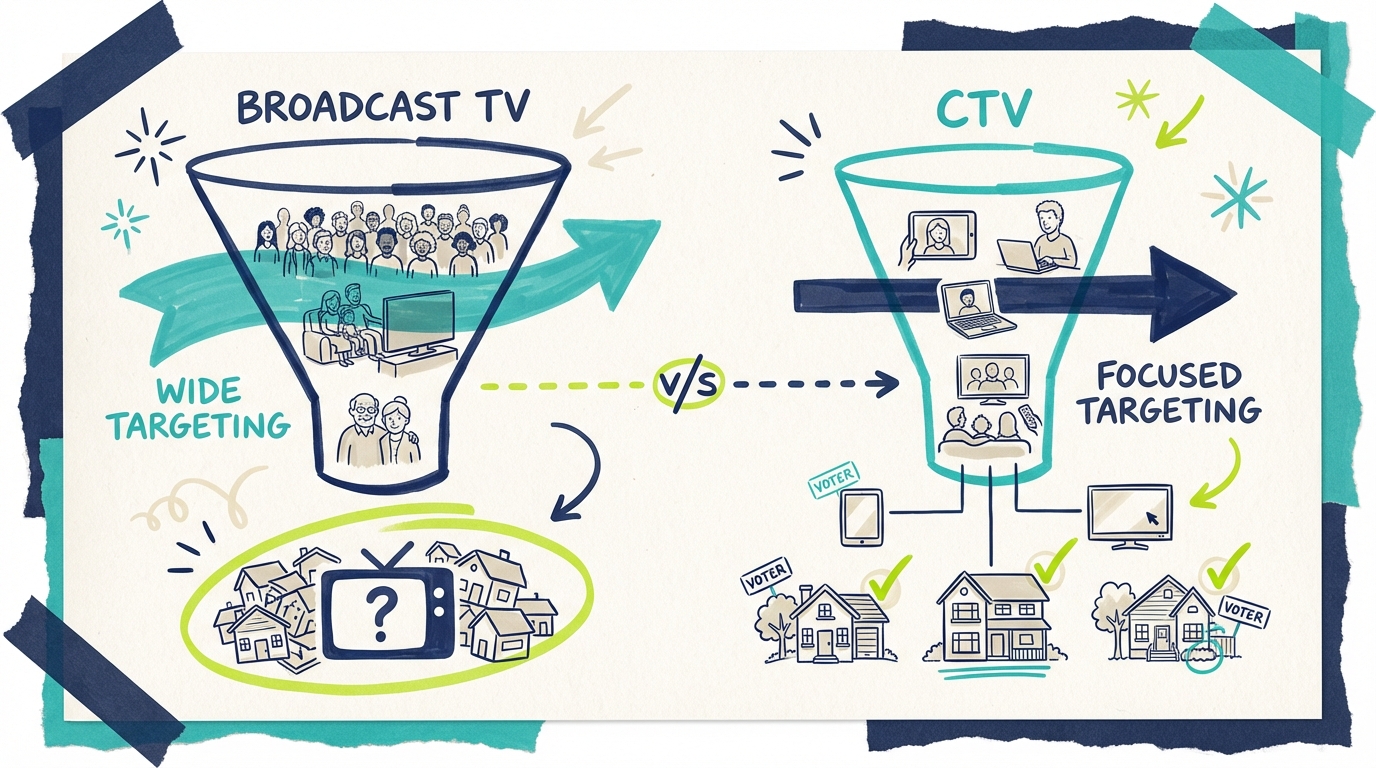
Traditional broadcast TV advertising works on a simple model: buy time on a local station and reach everyone watching in that market. The problem? TV markets (called DMAs, or Designated Market Areas) rarely match political districts. A congressional district might overlap three DMAs, or a single DMA might cover a dozen state legislative districts.
That means broadcast campaigns waste significant budget reaching people who can't even vote for you.
The Wasted Impression Problem
When a state senate candidate buys broadcast time in a major metro DMA, they're paying to reach millions of households outside their district. For down-ballot races, where districts are smaller, the waste can be enormous. You might pay for 500,000 impressions but only 50,000 are actually reaching your voters.
CTV changes this equation. With geographic targeting at the ZIP code level, campaigns can focus their budget on the households that actually matter.
Cord-Cutting Is Reshaping the Electorate
The voters who are hardest to reach on traditional TV are often the ones you need most. One in three potential voters who watch local news now watch through streaming only (Roku, 2024). And the shift crosses generations: 63% more baby boomers and 45% more Gen X viewers cut the cord in 2023 compared to 2022 (Experian, 2024).
If your campaign is only running broadcast TV, you're missing a growing share of the electorate entirely.
Political Ad Targeting Options on Streaming TV
CTV gives campaigns targeting options that traditional broadcast simply can't match. Here's what's available.
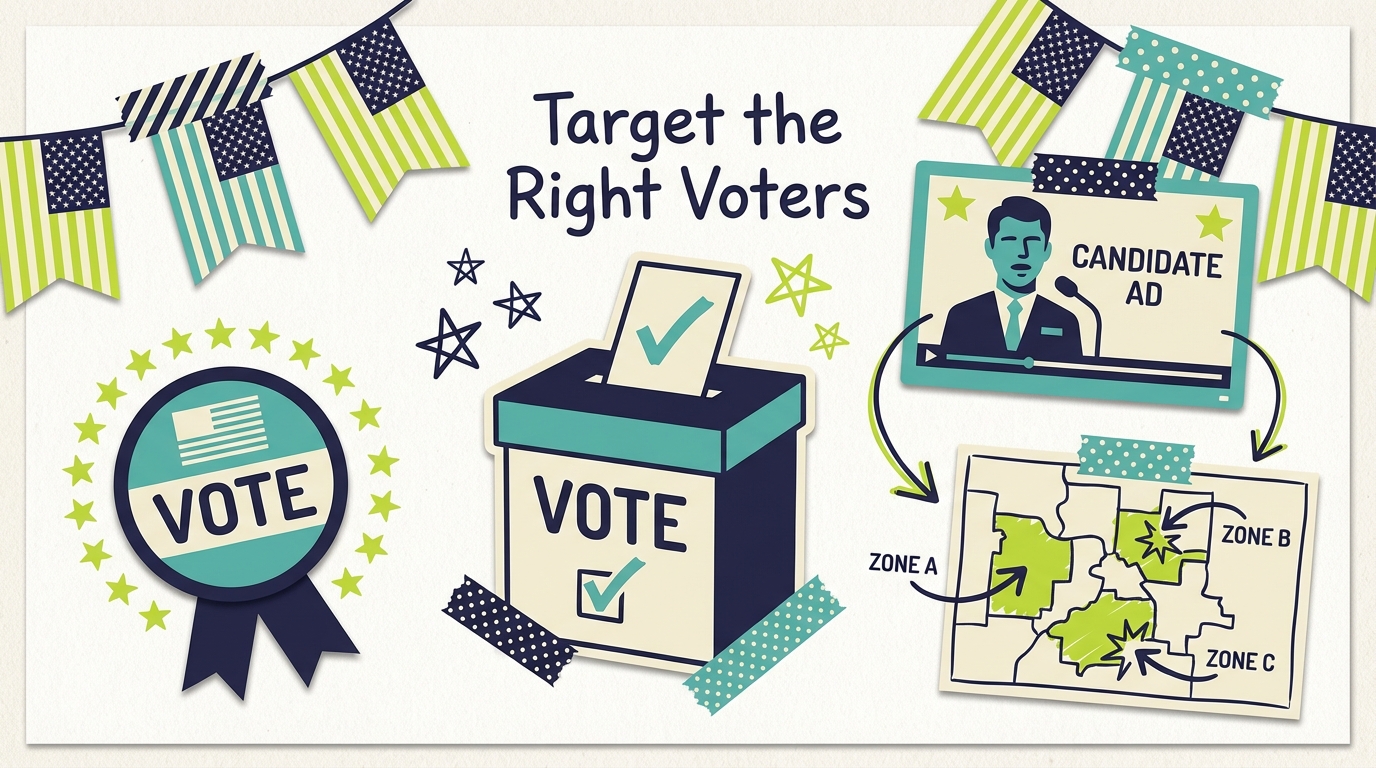
Geographic Targeting
This is the most important targeting tool for political campaigns. CTV platforms can serve ads to households based on:
- ZIP code: Target specific ZIP codes within your district boundaries
- Congressional district: Reach only households in your congressional district
- State legislative district: Focus on state house or state senate districts
- County or city: Target municipal voters for local races
For down-ballot campaigns, geographic targeting eliminates the biggest waste factor in political advertising. Every dollar goes toward reaching voters who can actually cast a ballot for you.
Demographic Targeting
Layer demographic filters on top of geography to reach the voter segments most likely to respond to your message:
- Age groups: Target younger voters who are harder to reach on traditional TV, or focus on older voters who turn out at higher rates
- Household income: Reach voters in specific income brackets
- Education level: Target college-educated or non-college households
- Household composition: Focus on families, retirees, or single-person households
Behavioral and Interest Targeting
CTV platforms can also target based on viewing behavior and interests:
- News viewers: Reach households that regularly watch news programming
- Politically engaged viewers: Target people who consume political content
- Issue-based targeting: Reach voters interested in specific topics (education, environment, local business)
Voter File Matching
The most powerful targeting option for political campaigns combines CTV data with voter registration files. This allows campaigns to:
- Target registered voters specifically
- Focus on likely voters based on voting history
- Reach persuadable voters identified through polling or modeling
- Suppress messaging to your strongest supporters and focus on swing voters
How CTV Political Ad Targeting Compares to Other Channels
The numbers tell the story. CTV ads achieve completion rates between 90% and 98%, meaning nearly every voter sees your full message (Madhive, 2024). Compare that to social media, where ads can be scrolled past in a fraction of a second.
Campaigns using CTV alongside traditional TV achieved a 32% increase in total reach compared to those using traditional TV alone (Jamloop, 2024). And 51% of frequent voter households reached by streaming were incremental, meaning they wouldn't have been reached by broadcast TV at all (Effectv/Comcast, 2022).
Building a Voter Targeting Strategy
The right targeting strategy depends on your race, your district, and your budget. Here's how to think about it.
For Local Races (City Council, School Board, Mayor)
Local races have the smallest districts and the tightest budgets. Targeting precision matters most here.
Recommended approach:
- Use strict ZIP code targeting to match your district boundaries
- Focus on likely voters (people who voted in the last 2-3 similar elections)
- Run ads during local news and prime-time programming
- Budget: $300-$1,000/month can create meaningful reach in a local district
For State Legislative Races
State house and senate districts are larger but still small enough that broadcast advertising wastes significant budget.
Recommended approach:
- Target by state legislative district or the ZIP codes that comprise it
- Layer demographic targeting to focus on persuadable voter segments
- Increase frequency in the final 4-6 weeks before the election
- Budget: $1,000-$5,000/month for competitive races
For Congressional Races
Congressional districts often cross DMA boundaries, making broadcast buying complicated and expensive.
Recommended approach:
- Use congressional district targeting to reach only your constituents
- Combine CTV with targeted broadcast buys in markets where your district dominates
- Use voter file matching for the most precise targeting
- Budget: $5,000-$25,000/month for competitive races
Timing Your Targeting
Political advertising isn't just about who you target. It's about when.
51% of total political ad spending in 2024 occurred in the final eight weeks before election day (AdImpact, 2024). The late surge is real, but campaigns that start building name recognition earlier have a significant advantage.
Making Your Political Ads More Effective
Reaching the right voters is only half the equation. Your ad has to land.
Keep It Authentic
Voters respond to authenticity. The most effective political ads feature the candidate speaking directly to camera, in a real location, with a clear message. Overproduced ads with dramatic music and attack graphics can feel like Washington politics, which is exactly what local voters don't want.
Lead With Local
Your biggest advantage over larger campaigns is that you're local. Reference specific neighborhoods, schools, and community landmarks. "I coach Little League at Jefferson Park" builds more trust than a polished policy speech.
One Message Per Ad
A 30-second spot has room for one clear message. Pick the issue or theme that resonates most with your target audience and build your ad around it. If you need to address multiple issues, create multiple ads and target each to the voter segment most likely to care about that issue.
Include a Clear Call to Action
Every political ad should tell voters what to do next: visit your website, come to a town hall, or vote on election day. Make the action specific and simple.
Compliance and Disclosure
Political advertising on CTV is subject to FCC and FEC regulations. Key requirements include:
- Paid-for disclaimers: All political ads must include a "Paid for by" disclosure
- Sponsor identification: The sponsoring organization or campaign must be clearly identified
- Record keeping: Platforms must maintain records of political ad purchases
- State-specific rules: Many states have additional disclosure requirements for state and local races
Work with your campaign compliance team or attorney to make sure your ads meet all applicable requirements before they go live.
Getting Started With Targeted Political Advertising
Platforms like Adwave make it possible for campaigns of any size to run targeted TV ads. You can create a professional ad in about two minutes, target specific districts and voter segments, and launch for as little as $50.
Here's a quick-start plan for your campaign:
- Map your district: Identify the ZIP codes that make up your district
- Define your audience: Decide which voter segments to prioritize
- Create your ad: Feature yourself, your local connection, and your core message
- Set a budget: Start with $300-$500/month to test messaging, then scale as the election approaches
- Track results: Monitor website traffic, branded searches, and volunteer sign-ups to measure impact
The campaigns that figure out CTV targeting in 2026, while their opponents are still overspending on broadcast, will have a real strategic advantage.
Common Questions Answered
How precise is CTV targeting for political campaigns? CTV targeting can reach voters at the ZIP code level, and when combined with voter file matching, can target specific registered voters by household. This is far more precise than broadcast TV, which targets entire metro areas (DMAs) that rarely match political district boundaries. For a state legislative race, CTV can reduce wasted impressions by 70-80% compared to broadcast.
How much should a political campaign spend on CTV advertising? It depends on the race. Local campaigns (city council, school board) can run meaningful CTV campaigns for $300 to $1,000 per month. State legislative races typically need $1,000 to $5,000 monthly for competitive districts. Congressional campaigns should plan for $5,000 to $25,000 per month. The 2026 midterms are projected to see $10.8 billion in total political ad spending, with CTV taking a growing share.
Can I target only voters in my specific district? Yes. CTV platforms allow targeting by congressional district, state legislative district, county, city, and ZIP code. You can also combine geographic targeting with voter file data to reach only registered voters, likely voters, or specific partisan segments within your district.
When should a political campaign start running TV ads? Most political ad spending is concentrated in the final 8 weeks before an election, but starting earlier gives you a real advantage. Begin with name recognition ads 6-12 months out, shift to issue messaging 3-6 months before the election, and increase frequency significantly in the final weeks. Early advertising builds the familiarity that late-stage ads can't create from scratch.
Is CTV political advertising subject to the same regulations as broadcast? Political advertising on CTV must include paid-for disclaimers and sponsor identification, similar to broadcast. However, CTV platforms are not subject to the same "lowest unit rate" rules that apply to broadcast stations during election windows. FEC and FCC rules apply, and many states have additional disclosure requirements. Always consult with your campaign attorney on compliance.
Sources
- AdImpact, "Political Ad Spend for the 2024 Election Cycle Hit a Record $11.1 Billion," 2024
- AdImpact via OpenSecrets, "Political Ad Spending Is Projected to Reach a New High in 2026 Midterms," 2026
- AdImpact via NBC News, "The Final Price Tag on 2024 Political Advertising: Almost $11 Billion," 2024
- Madhive, "Connected TV Stats for Political Advertising," 2024
- Jamloop, "CTV: The Political Campaign Battleground," 2024
- Effectv/Comcast Advertising, "Political Advertising Most Effective When Optimized Across Streaming and Linear TV," 2022
- Experian, "Connected TV Political Advertising in 2024," 2024
- Roku, "Voters Are Streaming: How 2024 Political Campaigns Are Adapting," 2024
- Basis, "2024 US Elections Digital Advertising Trends," 2024
Internal Links Used
- /resources/ctv-political-advertising
- /resources/what-is-geo-targeting
- /resources/down-ballot-advertising-local-races
- /resources/congressional-campaign-advertising-district-voters
- /resources/political-media-buying-101
- /resources/how-to-advertise-political-campaign-tv
- /resources/tv-advertising-roi-calculation
Version history
| Version | When | Summary |
|---|---|---|
| v1 | 6/20/2026, 3:11:54 AM | migration import |