Gym Advertising: 7 Channels to Increase Memberships
slug: gym-advertising-increasing-memberships · status: draft · score: 85% · 1 versions
View published version → · Contentful entry: 5wMYRLcmarAfJpmSZ5EoSW
Validation
| Rule | Detail | |
|---|---|---|
| pass | No banned competitors | No banned competitors |
| pass | No emdashes | No emdashes |
| pass | Avoid AI telltale words | No AI telltale words |
| pass | Primary keyword in title | No primary keyword to check |
| pass | Use contractions | Contractions used |
| fail | Minimum internal links | Internal links not in sitemap: /resources/how-to-optimize-your-google-business-profile-for-more-calls, /resources/why-customers-trust-tv-brands, /how-it-works, /industries/fitness-recreation/gyms-fitness-centers/tv-advertising-gyms-fitness, /resources/how-to-measure-advertising-effectiveness, /resources/ai-tv-commercials-small-business |
| pass | FAQ section required | FAQ section present |
| fail | Author assigned | No author assigned (never use 'Adwave Team' for new content) |
| pass | Title length 50-60 | Title length 51 |
| pass | Minimum 4 images | 4 images |
| pass | SEO description under 160 | seoDescription 153 chars |
| pass | Adwave mention cadence | 1 Adwave mentions |
| pass | Short description present | shortDescription 197 chars |
| pass | Word count by type | Word count 3701 within target |
| warn | Year-dated title for evergreen types | Year-dated type should include (2026) in the title |
| pass | No manual table of contents | No manual TOC |
Images (4)


Content
Gym Advertising: 7 Channels to Increase Memberships
The fitness industry is worth over $96 billion in the U.S., and it's growing every year. That's the good news. The bad news? You're not the only gym trying to capture new members.
Between boutique studios, big-box chains, home fitness apps, and the yoga studio that just opened two blocks away, the average person has more workout options than they know what to do with. A strong facility and great trainers aren't enough anymore. You need a marketing strategy that reaches potential members before they sign up somewhere else.
Here's the thing: most gym owners fall into one of two traps. Either they dump everything into Instagram and hope the algorithm cooperates, or they rely entirely on word of mouth and wonder why January is the only good month. Neither approach fills classes year-round.
This guide breaks down seven advertising channels that actually work for gyms and fitness centers, with real costs, honest pros and cons, and specific tactics you can put to work this week.
Channel 1: Google Ads (Search and Local)
When someone types "gyms near me" or "best CrossFit gym in [your city]," they're not casually browsing. They've already decided they want to work out. They're deciding where.
Google Ads puts you at the top of those search results, right when purchase intent is highest. According to Google Trends data, searches for "gyms near me" spike every January and stay elevated through spring. That's a massive window of high-intent traffic you can capture.
Tactics that work for gyms
Bid on high-intent keywords. Terms like "gym membership deals," "personal training near me," and "24 hour gym [your city]" signal someone who's ready to sign up. These cost more per click but convert at much higher rates than broad terms.
Use location targeting aggressively. Most gym members live within a 10-15 minute drive. Set your radius accordingly and don't pay for clicks from people who'll never show up. Research from IHRSA confirms that convenience is the top factor in gym selection.
Run call extensions. Fitness is a personal decision. Many prospects want to ask about pricing, class schedules, or trial offers before they visit. Make it easy for them to call directly from the ad.
Create separate campaigns for different services. Personal training, group classes, open gym, and kids programs all attract different people with different search terms. Don't lump them together.
Schedule your bids around motivation peaks. Early morning (5-7am) and evening (5-8pm) searches tend to convert better because people are thinking about their workout routine.
Costs and expectations
Expect to pay $2-6 per click for gym-related keywords, depending on your market. A monthly budget of $500-1,500 can generate 80-200+ leads in most areas. Track everything with unique phone numbers and landing pages so you know exactly which keywords bring members through the door.
Best for: Gyms with competitive pricing, strong trial offers, or unique specializations that differentiate them in search results.
Channel 2: Meta Ads (Facebook and Instagram)
Here's where most gym owners already spend money, but most of them do it wrong. They boost a post of their latest transformation photo and call it a marketing strategy. That's not advertising; that's hoping.
Meta's ad platform is powerful because it lets you target people based on fitness interests, life events, and behaviors. Someone who just moved to your area? That's a prospect. Someone who follows fitness influencers but hasn't joined a gym? Even better.
Tactics that work for gyms
Lead generation ads with trial offers. Facebook and Instagram lead form ads let people sign up for a free week or discounted first month without leaving the app. Lower friction means more leads. Meta's own case studies show fitness businesses averaging 30-40% lower cost per lead with lead forms compared to sending traffic to a website.
Video ads that showcase the experience. Short clips of energetic classes, friendly trainers, and real members create emotional connections that static images can't match. Keep videos under 15 seconds for Stories and Reels placements.
Retarget website visitors. Someone visited your pricing page but didn't sign up? Follow them with ads featuring a limited-time offer or member testimonial. Retargeting audiences typically convert at 3-5x the rate of cold audiences.
Use lookalike audiences. Upload your current member list, and Meta will find people who share similar demographics and interests. This is one of the most cost-effective targeting strategies available.
Seasonal campaign bursts. Run heavier budgets during New Year, spring break, and back-to-school season. Reduce spend during summer when sign-up rates naturally dip.
Costs and expectations
Plan for $5-15 per lead, with monthly budgets of $500-2,000 for consistent results. The key metric to watch isn't clicks or impressions but cost per trial sign-up and, ultimately, cost per paying member. A gym in Phoenix running Meta lead ads reported spending $8.50 per lead with a 25% conversion to paid membership, making each new member acquisition cost roughly $34.
Best for: Gyms with strong visual content, a compelling trial offer, and the follow-up systems to convert leads into members quickly.
Channel 3: Local SEO and Google Business Profile
This one is free, and most gyms don't give it the attention it deserves. When someone searches "gym near me," Google shows a map pack with three businesses before any paid or organic results. If you're not in that pack, you're invisible to a huge chunk of local searchers.
46% of all Google searches have local intent. And 76% of people who search for something nearby visit a business within 24 hours. That's not abstract data. That's foot traffic.
Tactics that work for gyms
Complete every field in your Google Business Profile. Hours, amenities (showers, parking, childcare), class types, equipment lists, accessibility features. Google matches search queries against these attributes. The more detail you provide, the more searches you'll appear in. For a deeper walkthrough, check out our guide to optimizing your Google Business Profile for more calls.
Post weekly updates. New class added? Holiday hours changing? Running a promotion? Post it to your profile. Activity signals relevance to Google's algorithm, and profiles that post regularly rank higher in local results.
Respond to every review within 24 hours. Positive reviews get a genuine thank-you. Negative reviews get a professional, solution-oriented response. BrightLocal research found that 88% of consumers are more likely to choose a business that responds to all reviews.
Build local citations. Get your gym listed on Yelp, ClassPass, Mindbody, the local Chamber of Commerce, and community directories. Consistent name, address, and phone number (NAP) across these sites builds trust with Google.
Encourage reviews systematically. Train front desk staff to mention reviews after a great class. Add QR codes to your check-in area. Send a post-class email asking for feedback. The gyms with 200+ reviews dominate local search.
Costs and expectations
Free to DIY, or $300-500/month if you hire a local SEO specialist. Results take 2-4 months to materialize, but once you rank in the map pack, every search is essentially a free lead. This is the single highest-ROI long-term investment most gyms can make.
Best for: Every gym. This isn't optional. Regardless of what other channels you run, local SEO should be your foundation.
Channel 4: Yelp and Directory Listings
Yelp might not be the first thing you think of for gym advertising, but fitness searchers on Yelp are closer to a buying decision than almost any other audience. These aren't people comparing workout philosophies on Reddit. They're reading reviews, checking photos, and making a shortlist.
Yelp reports that 83% of users have hired or purchased from a business they found on the platform. For gyms, that translates to trial visits and membership sign-ups.
Tactics that work for gyms
Invest in professional photos. Gyms with high-quality photos of their facilities, classes, and equipment get significantly more profile views than those with grainy phone shots. Update photos quarterly to show seasonal classes and new equipment.
Highlight what makes you different. Your Yelp profile should immediately answer: "Why this gym over the one down the street?" Specialized classes, unique equipment, community atmosphere, flexible membership options. Put it front and center.
Use Yelp's "Request a Quote" feature. Enable this for personal training, group booking, and corporate wellness inquiries. It gives prospects a low-pressure way to reach out.
Monitor and respond to competitors' reviews. You can't respond on their pages, but reading competitor reviews reveals what local gym-goers value most. Use those insights to improve your own service and highlight those strengths in your profile.
Consider Yelp Ads selectively. Yelp's paid advertising can be hit or miss. If your profile already has 4+ stars and 50+ reviews, paid placement can accelerate visibility. If you're below that, focus on earning better reviews first.
Costs and expectations
Free to maintain your profile. Yelp Ads typically run $300-1,000/month depending on your market and competition level. The real investment is time, consistently managing your profile, responding to reviews, and updating content. Plan for 1-2 hours per week of maintenance.
Best for: Gyms in competitive markets where prospects actively compare options before visiting.
Channel 5: Direct Mail and Local Print
Yes, direct mail still works. In fact, it might work better now than it did five years ago precisely because fewer businesses are using it. Your mailbox isn't nearly as crowded as your inbox.
The Data & Marketing Association reports that direct mail has a 4.4% response rate for prospect lists, compared to 0.12% for email. And in fitness, there's a geographic angle that makes mail especially effective: you can target specific neighborhoods within your drive-time radius.
Tactics that work for gyms
New mover campaigns. People who just moved to your area don't have a gym yet. Services like Our Town America and Valpak let you reach new residents with a welcome offer. This is one of the highest-converting direct mail strategies for gyms because you're reaching people during an active decision window.
Seasonal postcards. Mail oversized postcards (6x11 works well) in late December, early March, and late August, right before the three biggest membership peaks. Include a specific, time-limited offer like "Your first month for $1" or "Free 7-day pass."
Neighborhood saturation drops. If your gym draws from a 3-5 mile radius, you can use USPS Every Door Direct Mail (EDDM) to hit every household in specific carrier routes for as little as $0.20 per piece. No mailing list needed.
Include a trackable offer. Use a unique promo code, QR code, or dedicated landing page so you can measure exactly how many members came from the mailer. Without tracking, you're guessing.
Pair with digital. Run Meta retargeting ads to the same zip codes you're mailing. People who see your brand across multiple channels are more likely to take action.
Costs and expectations
Budget $0.50-1.50 per piece all-in (design, printing, postage) for quality postcards. A targeted campaign of 5,000 pieces runs $2,500-7,500. Expect 1-3% response rate for well-designed pieces with a strong offer, which means 50-150 responses per campaign. Not the cheapest channel, but the tangible nature of mail creates a different kind of engagement.
Best for: Gyms opening new locations, entering new markets, or targeting specific neighborhoods. Particularly effective when combined with digital campaigns.
Channel 6: TV and CTV (Connected TV) Advertising
Most gym owners dismiss TV advertising as something only Planet Fitness and Equinox can afford. That used to be true. It's not anymore.
Connected TV (CTV) lets you run professional 30-second spots on streaming platforms like Hulu, Peacock, Tubi, and ESPN, targeted by zip code, interests, and demographics. You're not buying a Super Bowl ad. You're reaching fitness-minded viewers in your specific area while they're watching their favorite shows.
Why does this matter for gyms? Consumers trust TV advertising more than any other channel. That trust translates into brand credibility that search ads and social posts simply don't build. When someone sees your gym on TV, it signals legitimacy. You're not just another Instagram ad in their feed. You're a real business on a real screen.
And the cost barrier has essentially disappeared. Platforms like Adwave let you create professional TV commercials using AI and launch campaigns starting at just $50. You can generate a broadcast-quality ad in about two minutes using your website or social media profiles as the creative source.
For a deep dive into TV advertising specifically for fitness businesses, see our complete TV advertising for gyms and fitness centers guide. It covers creative strategy, seasonal timing, and targeting tactics designed for the fitness industry.
Costs and expectations
CTV campaigns start at $50, with CPMs (cost per thousand impressions) averaging $15-35. A local gym running $500-1,000/month in CTV can generate thousands of impressions among targeted viewers in their area. The primary benefit isn't direct response but brand awareness and credibility that lifts performance across every other channel.
Best for: Gyms looking to build brand awareness and credibility in competitive markets. Especially effective during January, spring, and back-to-school seasons when fitness intent peaks.
Channel 7: Email and Retention Marketing
Here's a stat most gym owners overlook: acquiring a new member costs 5-25x more than retaining an existing one. And the average gym loses 50% of new members within the first six months. That means half your marketing budget is being wasted if you're not investing in keeping the people you already have.
Email isn't just for newsletters. It's your most powerful retention and reactivation tool.
Tactics that work for gyms
Onboarding sequences. New members should receive a structured email series during their first 30 days: welcome message, tips for getting started, introduction to classes, trainer spotlight, and a check-in asking how things are going. Members who feel supported early are far more likely to stick around.
Class and event promotions. Weekly emails highlighting upcoming classes, workshops, and community events keep your gym top of mind. Include a clear CTA to book or RSVP.
Win-back campaigns for lapsed members. Someone who hasn't visited in 30+ days gets a "We miss you" email with a reason to come back: a new class, a buddy pass, or a limited-time personal training session. This is some of the highest-ROI marketing you can do because these people already know and (hopefully) like your gym.
Referral program promotion. Your happiest members are your best salespeople. Use email to promote a referral program that rewards both the referrer and the new member. "Bring a friend this month and you both get a free personal training session" costs you one PT hour and could net a member worth hundreds per year.
Milestone celebrations. Celebrate member anniversaries, visit milestones (100th check-in!), and personal records. These small touches build emotional connection and reduce churn.
Costs and expectations
Email platforms like Mailchimp or ActiveCampaign cost $20-100/month for most gym-sized lists. The ROI is exceptional: email marketing generates $36 for every $1 spent on average across industries. Even conservative estimates put gym email ROI at 10-15x when factoring in reduced churn and reactivated memberships.
Best for: Every gym with more than 100 members. Like local SEO, this isn't optional. It's foundational.
Channel Comparison: How They Stack Up
Here's how all seven channels compare across the factors that matter most:
No single channel does everything. The gyms that grow consistently are the ones running a mix of channels that cover both acquisition and retention.
Recommended Budget Allocation
Budget allocation depends on your gym's size, maturity, and goals. Here are two scenarios:
New or Growing Gym (Under 500 Members)
If you're still building your membership base, prioritize acquisition channels:
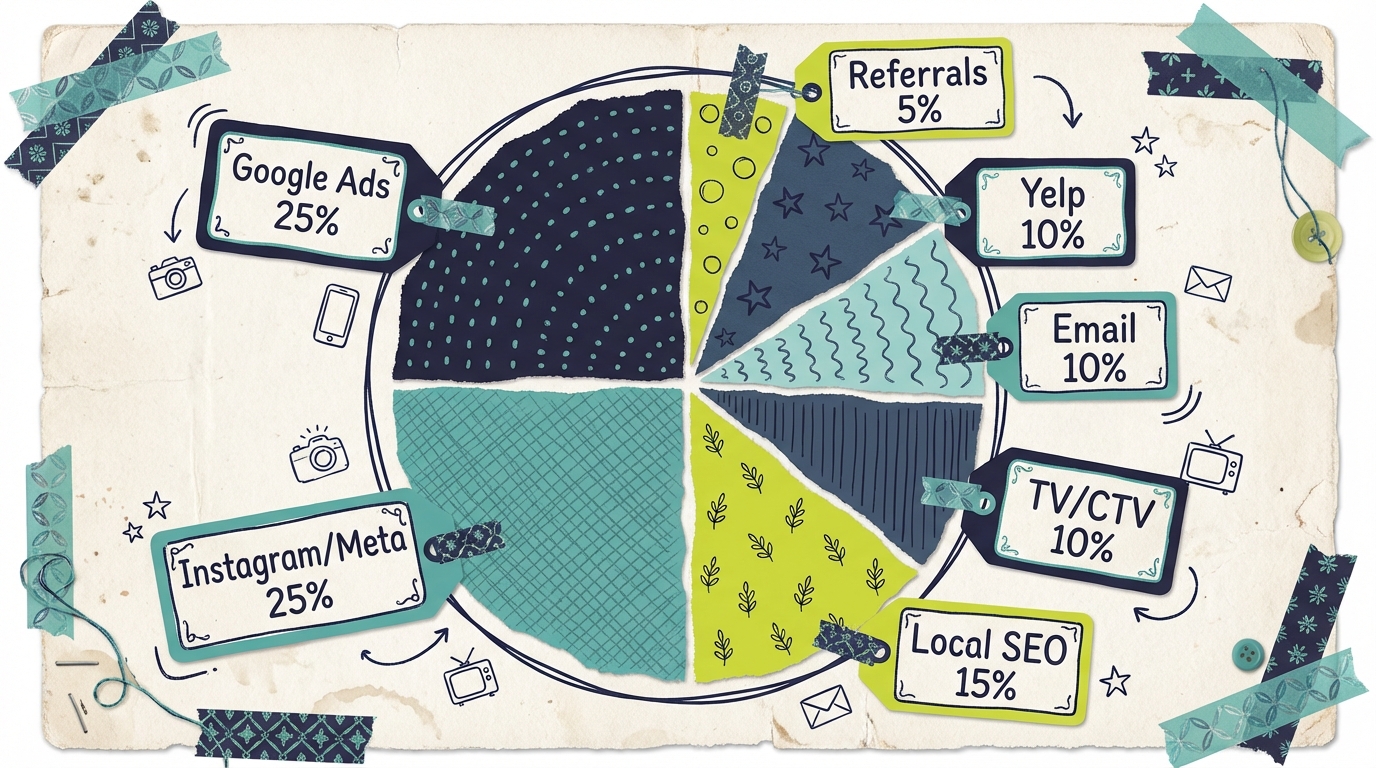
- Google Ads: 25% (capture active searchers)
- Meta Ads: 25% (generate trial leads)
- Local SEO: 15% (build long-term foundation, mostly time investment)
- TV/CTV: 15% (build brand credibility)
- Direct Mail: 10% (targeted neighborhood campaigns)
- Email/Retention: 5% (onboarding and early retention)
- Yelp/Directories: 5% (profile optimization, selective ads)
Example on a $2,000/month budget: $500 Google Ads, $500 Meta, $300 Local SEO, $300 TV/CTV, $200 direct mail, $100 email tools, $100 Yelp.
Established Gym (500+ Members)
Once your base is solid, shift more toward retention and brand building:
- Email/Retention: 20% (protect your existing revenue)
- Google Ads: 20% (maintain search presence)
- TV/CTV: 20% (build brand awareness)
- Meta Ads: 15% (targeted campaigns for specific programs)
- Local SEO: 10% (maintain and optimize)
- Direct Mail: 10% (seasonal campaigns)
- Yelp/Directories: 5% (profile maintenance)
Example on a $3,000/month budget: $600 email/retention, $600 Google Ads, $600 TV/CTV, $450 Meta, $300 Local SEO, $300 direct mail, $150 Yelp.
How to Measure What's Working
Tracking results across seven channels sounds complicated, but it doesn't have to be. Focus on these metrics:
Cost per lead (CPL). How much does it cost to get someone to inquire, book a tour, or sign up for a trial? Track this for each channel separately.
Cost per member (CPM). Not to be confused with advertising CPM. This is how much you spend in advertising to acquire one paying member. It accounts for conversion rate from lead to member.
Member lifetime value (LTV). If your average member stays 14 months at $50/month, their LTV is $700. Any channel that acquires members for less than 10-15% of LTV ($70-105) is working well.
Channel attribution. Ask every new member how they heard about you. It's simple but surprisingly few gyms do it consistently. Combine "how did you hear about us" surveys with digital tracking (UTMs, unique phone numbers, promo codes) for a fuller picture. Our guide on how to measure advertising effectiveness walks through these tracking methods in detail.
Common Questions Answered
How much should a gym spend on advertising per month? Most successful independent gyms spend 5-10% of gross revenue on marketing. For a gym generating $30,000/month in membership revenue, that's $1,500-3,000 per month across all channels. Start at the lower end and increase as you identify which channels deliver the best return for your specific market and offer.
What's the fastest way to get new gym members? Google Ads and Meta lead generation ads deliver the quickest results because they reach people who are already interested in fitness. A well-structured Google Ads campaign can produce inquiries within days of launch. Pair that with a strong trial offer (free week or discounted first month) and solid follow-up, and you can convert leads into paying members within two to three weeks.
Do gyms still need to advertise during the summer slump? Yes, but shift your strategy. Summer typically sees lower sign-up volume, so reduce acquisition spend and increase retention efforts. Focus on keeping existing members engaged with summer challenges, outdoor classes, and referral promotions. Use the lower advertising costs during summer to test new channels or creative approaches so you're ready to scale when September and January demand returns.
Is TV advertising realistic for a single-location gym? Absolutely. CTV advertising has removed the budget barriers that used to make TV exclusive to large chains. With AI-powered ad creation tools, a single-location gym can create a professional commercial and run it on streaming platforms in their local area for as little as $50. The targeting is precise enough to reach viewers within a specific zip code radius, so you're not wasting impressions on people who would never visit your location.
How do I compete with big chain gyms that have massive advertising budgets? Focus on what chains can't replicate: community, personality, and local relevance. Big chains run generic national campaigns. You can create hyperlocal content that speaks directly to your neighborhood. Highlight your unique trainers, specialized classes, and community events. On channels like local SEO and Google Ads, a well-optimized single-location gym can absolutely outperform a chain location because your content and offers are more specific and relevant to local searchers.
What's the most important advertising channel for a new gym? Start with Google Ads and local SEO simultaneously. Google Ads generates immediate leads while local SEO builds your long-term foundation. Add Meta ads in month two once you have a compelling trial offer dialed in. Layer in additional channels as you build confidence in your tracking and follow-up systems. Trying to run all seven channels from day one usually means doing none of them well.
The Bottom Line
Growing gym memberships isn't about finding one magic advertising channel. It's about building a system where multiple channels work together. Google Ads and Meta capture people who are actively looking. Local SEO and Yelp build long-term visibility and trust. Direct mail and TV/CTV reach prospects before they start searching. And email keeps the members you've worked so hard to win.
Start with two or three channels. Measure results. Double down on what works and cut what doesn't. The gyms that grow year-round aren't spending the most. They're spending the smartest.
---
Sources
- IHRSA, "Grow Your Membership," https://www.ihrsa.org/improve-your-club/grow-your-membership/
- IHRSA, "Retain Members," https://www.ihrsa.org/improve-your-club/retain-members/
- Google Trends, "Gyms near me" search interest, https://trends.google.com/trends/explore?q=gyms+near+me&geo=US
- LocaliQ, "Google My Business Benefits," https://localiq.com/blog/google-my-business-benefits/
- Think with Google, "Local Search to Store Visit," https://www.thinkwithgoogle.com/consumer-insights/consumer-trends/local-search-to-store-visit/
- BrightLocal, "Local Consumer Review Survey," https://www.brightlocal.com/research/local-consumer-review-survey/
- Yelp, "Advertise on Yelp," https://www.yelp.com/advertise
- Data & Marketing Association / ANA, "Response Rate Report," https://www.ana.net/content/show/id/dma-response-rate-report
- Litmus, "Email Marketing ROI," https://www.litmus.com/resources/email-marketing-roi/
- Harvard Business Review, "The Value of Keeping the Right Customers," https://hbr.org/2014/10/the-value-of-keeping-the-right-customers
- Meta for Business, "Success Stories," https://www.facebook.com/business/success
- Social Media Examiner, "Facebook Ads for Fitness Businesses," https://www.socialmediaexaminer.com/facebook-ads-for-fitness-businesses/
Internal Links Used
- /resources/how-to-optimize-your-google-business-profile-for-more-calls
- /resources/why-customers-trust-tv-brands
- /how-it-works
- /resources/ai-tv-commercials-small-business
- /resources/how-to-measure-advertising-effectiveness
- /industries/fitness-recreation/gyms-fitness-centers/tv-advertising-gyms-fitness
Version history
| Version | When | Summary |
|---|---|---|
| v1 | 6/20/2026, 3:11:54 AM | migration import |