Radio vs. TV Advertising for Local Business: An Honest Comparison
slug: radio-vs-tv-advertising-local-business · status: draft · score: 83% · 1 versions
View published version → · Contentful entry: 4Ng0Zj6PK2lDvKGJE7gxsb
Validation
| Rule | Detail | |
|---|---|---|
| pass | No banned competitors | No banned competitors |
| pass | No emdashes | No emdashes |
| pass | Avoid AI telltale words | No AI telltale words |
| pass | Primary keyword in title | No primary keyword to check |
| pass | Use contractions | Contractions used |
| fail | Minimum internal links | Internal links not in sitemap: /resources/what-is-connected-tv-advertising, /how-it-works, /resources/tv-advertising-cpm-by-platform, /resources/geotargeting-marketing-local-business, /resources/consumer-trust-tv-vs-digital-ads, /resources/tv-advertising-attribution-small-business, /resources/sales-funnel-small-business-guide, /resources/what-is-connected-tv-advertising, /how-it-works, /resources/tv-advertising-cpm-by-platform, /resources/geotargeting-marketing-local-business, /resources/consumer-trust-tv-vs-digital-ads, /resources/tv-advertising-attribution-small-business, /resources/sales-funnel-small-business-guide |
| pass | FAQ section required | FAQ section present |
| fail | Author assigned | No author assigned (never use 'Adwave Team' for new content) |
| pass | Title length 50-60 | Title length 65 |
| pass | Minimum 4 images | 4 images |
| pass | SEO description under 160 | seoDescription 156 chars |
| pass | Adwave mention cadence | 7 Adwave mentions |
| pass | Short description present | shortDescription 190 chars |
| warn | Word count by type | Word count 2497 below target (2500-5000) |
| warn | Year-dated title for evergreen types | Year-dated type should include (2026) in the title |
| pass | No manual table of contents | No manual TOC |
Images (4)
Content
Radio vs. TV Advertising for Local Business: An Honest Comparison
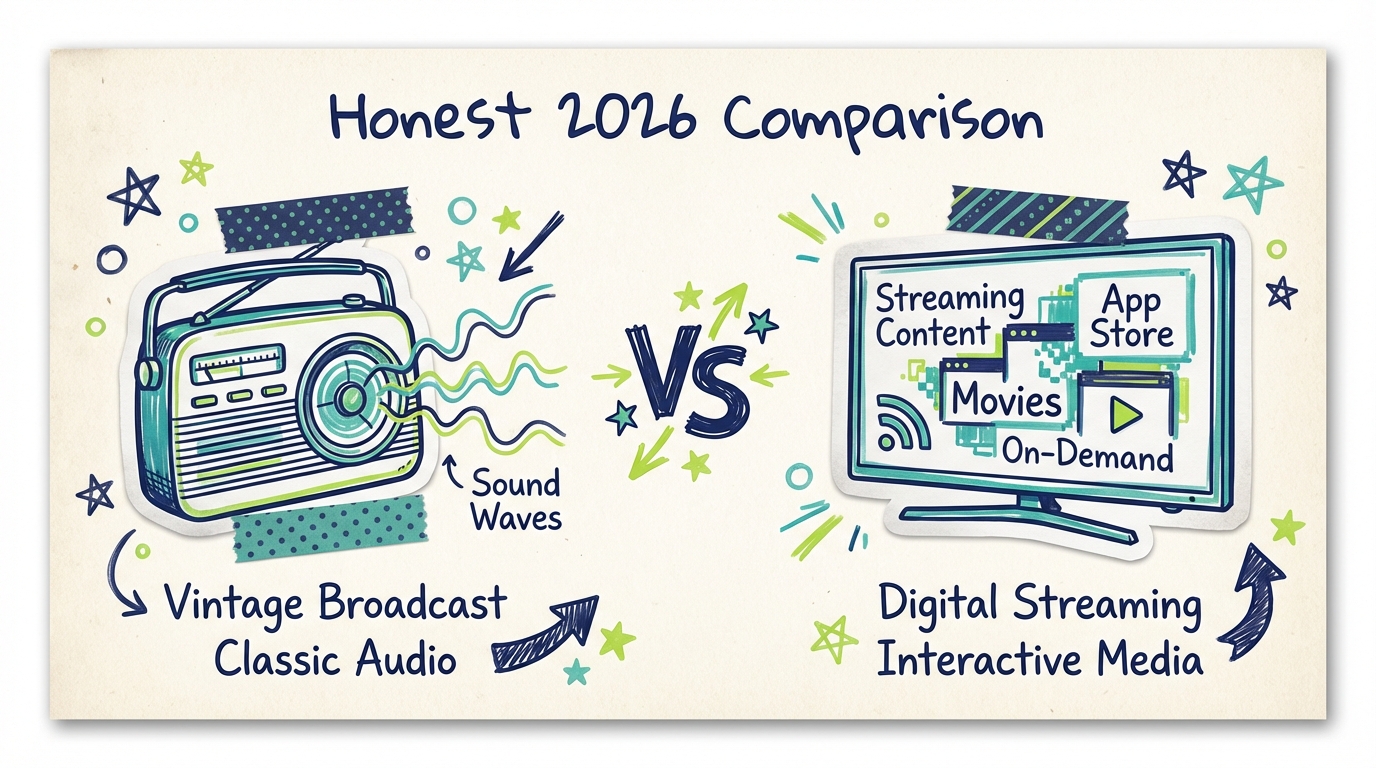
Radio and TV are the two oldest broadcast advertising channels, and both are still used by local businesses every day. But they've changed dramatically in the last few years. Radio has shifted toward streaming audio and podcasts. TV has shifted toward streaming and CTV. The question of which one to use looks different than it did even five years ago.
This guide compares radio and TV advertising for local businesses across cost, reach, targeting, creative impact, and measurability, so you can decide where your money works hardest.
How radio advertising works today
Local radio advertising comes in two main forms:
Traditional radio (AM/FM). You buy 30 or 60-second spots on local stations during specific dayparts (morning drive, midday, afternoon drive, evening). Pricing is based on station ratings and time slots. Your ad reaches whoever happens to be listening at that time.
Streaming audio (Spotify, Pandora, iHeart). Digital audio ads play between songs or podcast segments on streaming platforms. These can be targeted by demographics, interests, and geography, similar to digital ads.
Most local radio campaigns still focus on traditional AM/FM, though streaming audio is growing.
How TV advertising works today
TV advertising also comes in two forms:
Traditional TV (linear). You buy 30-second spots on broadcast or cable networks at scheduled times. Pricing varies enormously by market, network, and time slot. In a mid-size market, a single 30-second spot can cost $500 to $5,000+.
CTV/Streaming TV. You run ads on streaming platforms like Hulu, Peacock, Tubi, and 100+ other channels through platforms like Adwave. CTV offers demographic and geographic targeting, real-time analytics, and campaigns that start at just $50.
For most local businesses, CTV is the relevant comparison to radio because traditional TV pricing puts it out of reach.
Cost comparison
Radio costs
Traditional radio:
- A 30-second spot in a small market costs $25 to $100
- In a medium market, expect $100 to $500 per spot
- Most stations require minimum buys of 12 to 20 spots per week
- A typical local radio campaign costs $1,000 to $5,000 per month
- Production costs range from free (the station reads your script) to $500 to $2,000 for a professionally produced spot
Streaming audio:
- CPMs (cost per thousand impressions) range from $10 to $25
- Lower production requirements since spots can be simpler
- More flexible minimum budgets than traditional radio
TV costs
Traditional TV:
- Prohibitively expensive for most local businesses
- A single 30-second spot in a medium market costs $500 to $5,000
- Production costs for a professional commercial: $2,000 to $20,000+
- Monthly campaigns typically start at $5,000 to $10,000+
CTV/Streaming TV:
- CPMs range from $15 to $35
- Adwave campaigns start at $50, with most local businesses investing $500 to $2,500/month
- Ad creation is free and takes about 2 minutes with Adwave's AI
- No production costs, agency fees, or media buyer required
Bottom line: Traditional radio is cheaper per spot than traditional TV, but CTV has closed the gap dramatically. A $1,500/month CTV campaign delivers reach and impact that would require $3,000 to $5,000 in radio to approximate, and with better targeting.
Reach and audience
Radio reach
According to Nielsen, AM/FM radio reaches about 82% of U.S. adults weekly. That's broad reach, but there are caveats:
- Fragmented audience. A single station might reach 3 to 8% of the local market. To reach a broad audience, you need to buy spots across multiple stations, which multiplies costs.
- Passive listening. Most radio listening happens during commutes. Listeners are driving, which means divided attention and no way to act on your ad immediately.
- Declining younger demographics. Adults under 35 are spending more time on streaming audio and podcasts than traditional radio, according to Edison Research.
- No visual component. Radio is audio-only. For businesses where the visual matters (restaurants showing food, med spas showing results, retailers showing products), this is a significant limitation.
TV reach
CTV reaches about 87% of U.S. households, according to Leichtman Research. The viewing environment is fundamentally different:
- Big screen, lean-back attention. TV ads play on the largest screen in the home while viewers are actively engaged with content. This is a higher-attention environment than the car radio.
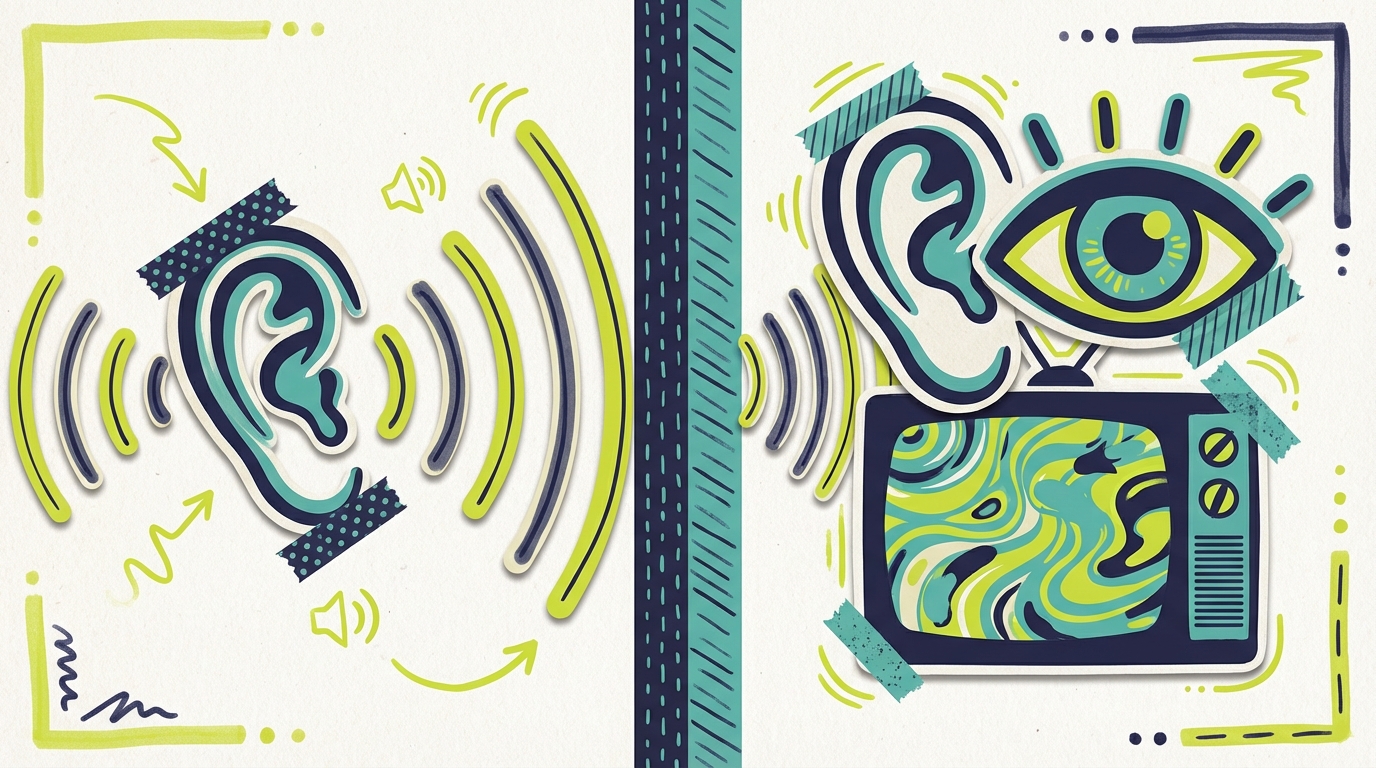
- Full sight, sound, and motion. A 30-second TV ad can show your business, your team, your products, and your results in a way that radio simply can't. For visually driven businesses, this advantage is decisive.
- Non-skippable. CTV ads have completion rates above 90%. Every impression is a full 30-second view. Radio listeners frequently change stations during commercial breaks.
- Growing audience. Streaming TV viewership is increasing every year as more households cut cable. Radio listening is flat or declining in most demographics.
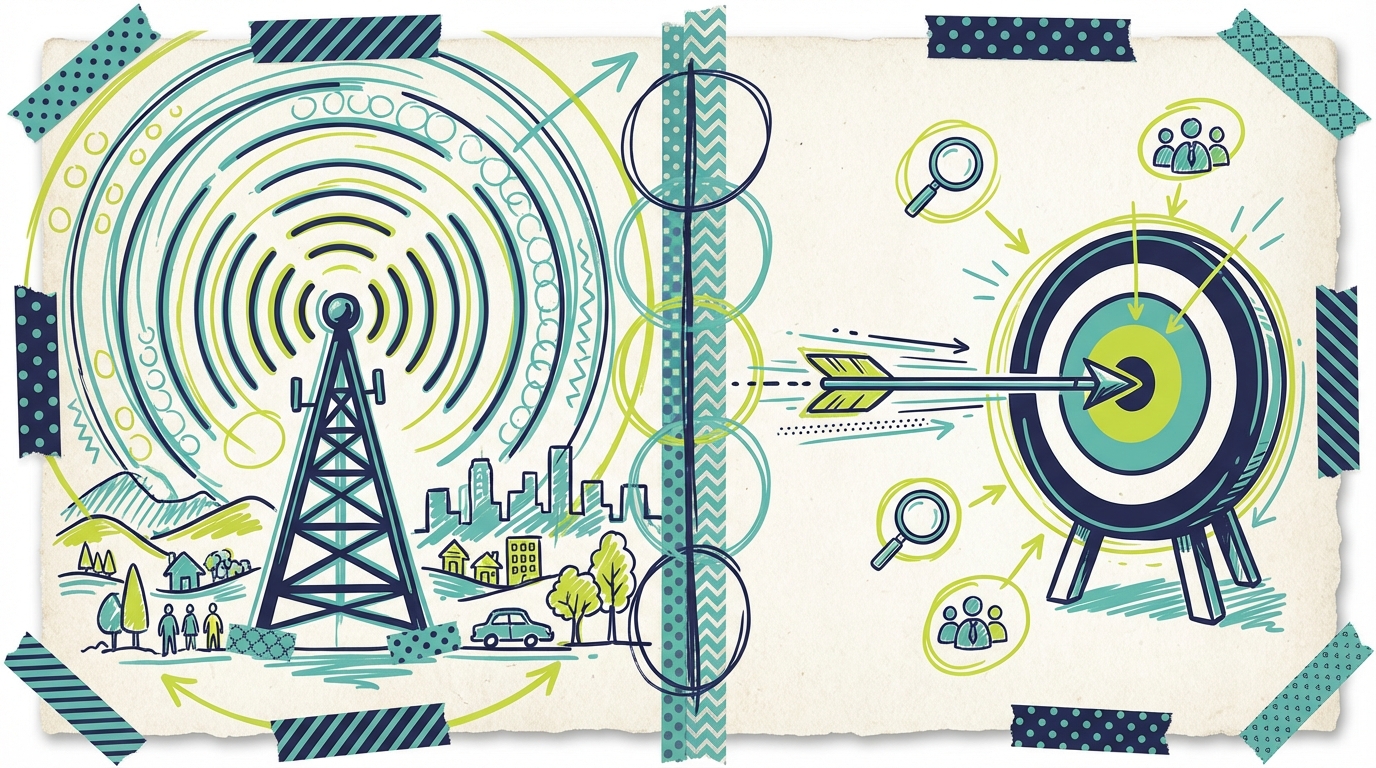
Bottom line: Radio has broad reach but fragmented attention. TV has focused reach with deeper engagement. For local businesses, CTV's targeted reach to the right households in your market is more valuable than radio's broader but thinner coverage.
Targeting capabilities
Radio targeting
Traditional radio targeting is blunt:
- Station format. You choose stations based on format (country, top 40, talk, classic rock) as a proxy for demographics
- Daypart. Morning drive reaches commuters, midday reaches at-home listeners, etc.
- Geography. Limited to the station's broadcast area, which often extends well beyond your business's service area
Streaming audio offers better targeting (demographics, interests, geography), but the audience is smaller than traditional radio.
TV targeting
CTV targeting is precise:
- Geographic targeting down to zip codes and DMAs
- Demographics including age, gender, household income
- Interests and behaviors based on viewing habits and third-party data
- Household-level targeting ensures your ad reaches homes that match your ideal customer profile
Bottom line: CTV offers dramatically better targeting than radio. You're paying to reach only the households likely to become customers, rather than broadcasting to everyone within a station's signal range.
Creative impact and memorability
This is where the comparison really favors TV.
Radio is audio-only. Your ad competes with road noise, conversations, and the listener's own thoughts. The average person remembers about 10% of what they hear after three days, according to research from the University of Iowa. Radio ads need high frequency (hearing the same ad many times) to build recall.
TV is sight, sound, and motion. Research consistently shows that video ads create stronger memory formation than audio alone. The Video Advertising Bureau found that TV advertising generates significantly higher unaided brand recall than radio. When you can show your restaurant's food, your auto shop's facility, or your med spa's results, the visual element does persuasion work that words alone can't match.
Trust factor. Being "seen on TV" carries more credibility weight than being "heard on the radio." For businesses where trust matters (healthcare, home services, professional services), TV's credibility advantage translates directly into customer confidence.
Storytelling capacity. A 30-second TV ad with visuals can tell a more complete story than a 30-second radio spot. You can show before-and-after transformations, happy customers, your team at work, and your facility in a way that builds an emotional connection.
Measurability
Radio measurement
Traditional radio measurement is notoriously imprecise:
- Nielsen Audio ratings estimate listener counts, but they're based on sample panels, not actual listening data
- "How did you hear about us?" is often the primary attribution method
- Promo codes and vanity URLs can track some response, but most listeners don't remember them
- No real-time data. You typically wait weeks for ratings reports
TV measurement
CTV measurement is more sophisticated:
- Impression-level data. You know exactly how many households saw your ad, how often, and whether they watched the complete spot
- Branded search lift tracking shows when viewers search for your business after seeing your ad
- Website traffic correlation. Increases in direct and organic traffic during campaign periods indicate TV is working
- Real-time dashboards. Platforms like Adwave provide real-time campaign analytics so you can see performance as it happens
Bottom line: CTV is significantly more measurable than radio. You'll have a clearer picture of whether your investment is working and can adjust campaigns based on actual data.
When radio makes more sense
Radio isn't dead, and for some situations it's still a reasonable choice:
You have a very small budget. If you can only spend $500/month on broadcast advertising, local radio spots may be your only option. Though at that budget, CTV with Adwave ($50 minimum) is worth testing.
Your business relies on drive-time traffic. If you're a restaurant, gas station, or retail store near a major highway, reaching commuters during drive time can be valuable because they're physically nearby when they hear your ad.
You're advertising events or time-sensitive promotions. Radio's immediacy (people hear it right now) can work well for weekend sales, grand openings, or events happening in the next few days.
Your target audience is 55+. Older demographics still listen to AM/FM radio at high rates. If your business primarily serves this audience, radio remains an efficient way to reach them.
When TV makes more sense
For most local businesses, CTV is the stronger choice:
Your business is visual. Restaurants, retailers, med spas, auto dealerships, home services, fitness studios, and any business where seeing is believing will benefit more from TV's visual format.
You need to build trust. Healthcare providers, professional services, home services companies, and any business where the customer is making a high-stakes decision benefits from TV's credibility advantage.
You want to reach younger demographics. Adults under 45 are watching more streaming TV and less radio. CTV reaches them where they actually spend time.
You need precise targeting. If you only want to reach households within specific zip codes, income brackets, or demographic profiles, CTV's targeting is far superior to radio's format-based approach.
You want measurable results. If you need data to justify your advertising spend, CTV provides the tracking and analytics that radio lacks.
Using both together
Some local businesses find value in running both radio and TV as complementary channels:
Radio for frequency, TV for impact. Radio's lower per-spot cost lets you build high frequency (listeners hearing your ad many times). TV's visual impact creates deeper brand impressions. Together, the audience hears your name on the radio and then sees your business on their TV, reinforcing the message across two formats.
Radio for immediate promotions, TV for brand building. Use radio to promote this weekend's sale or next week's event while CTV builds long-term brand awareness and trust in your market.
Shared creative themes. When your radio and TV ads share the same tagline, offer, and tone, the cross-channel repetition builds stronger recall than either channel alone.
For most local businesses with limited budgets, however, prioritizing CTV over radio will deliver more impact per dollar. The visual element, better targeting, higher attention quality, and stronger measurability make TV the more efficient investment for building a full marketing funnel.
Industry-specific recommendations
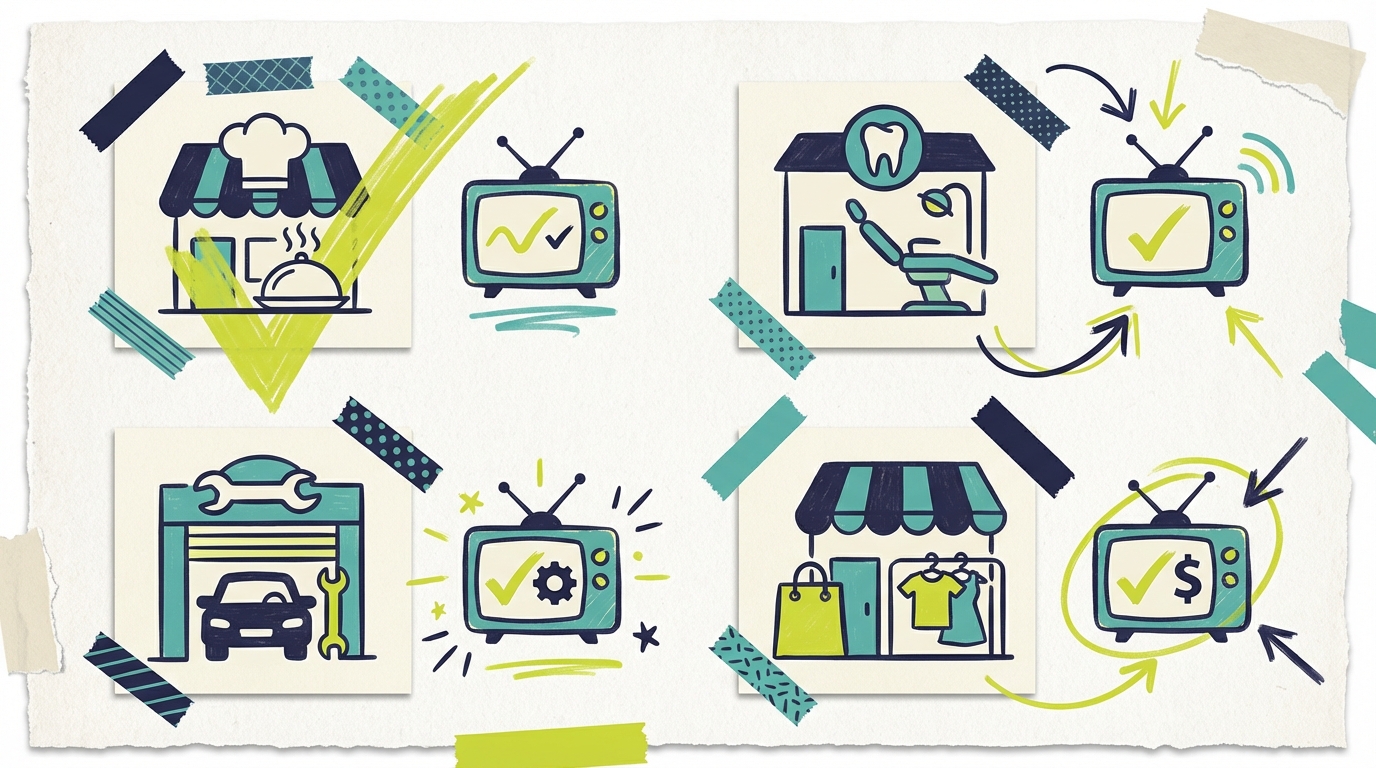
Restaurants and food service. TV wins decisively. Showing food, ambiance, and happy diners does persuasion work that audio descriptions can't match. A 30-second CTV spot showcasing your menu items generates cravings that radio mentions just don't create.
Home services (HVAC, plumbing, electrical). TV is the better choice for building the trust homeowners need before letting someone into their home. Showing your uniformed team, clean trucks, and professional process builds confidence. Radio can supplement with drive-time frequency for emergency services.
Healthcare (dentists, chiropractors, med spas). TV's trust and credibility advantage is critical in healthcare. Patients want to see the facility and the provider before booking. CTV's ability to show your office, team, and patient experience builds the comfort that drives bookings.
Retail stores. Visual product showcase on TV drives foot traffic better than radio descriptions. CTV targeting by zip code ensures you're reaching households within driving distance of your store.
Professional services (lawyers, accountants). Trust is the deciding factor for professional services, and TV builds it more effectively than radio. A 30-second spot showing your office, team, and credentials creates a professional impression that radio voice-overs struggle to achieve.
Auto dealerships and repair shops. TV lets you show your inventory, facility, and team. For dealerships especially, the visual element of showing actual vehicles and a clean showroom outperforms radio descriptions of "great deals" that every other dealer is also claiming.
Common questions answered
Is radio advertising cheaper than TV advertising? Traditional radio is cheaper per spot than traditional TV, but CTV has changed the equation. A CTV campaign through Adwave starts at $50, and most local businesses invest $500 to $2,500/month. That's comparable to or less than a typical radio campaign, but with better targeting, visual impact, and measurability. Dollar for dollar, CTV typically delivers more impact than radio for local businesses.
Can radio advertising build the same brand awareness as TV? Radio can build awareness through repetition, but it takes more frequency and time than TV because it's audio-only. Research consistently shows that video creates stronger memory formation than audio alone. For businesses where the visual matters (showing your facility, products, or results), TV builds awareness that radio fundamentally cannot.
Should I stop radio advertising if I start CTV? Not necessarily, but if budget is limited, CTV should take priority. If you have the budget for both, they can work well together with radio handling frequency and immediate promotions while CTV handles brand building and trust. If you have to choose one, CTV typically delivers better results for local businesses.
How do I measure whether radio or TV is working better? For radio, your best options are "how did you hear about us" surveys and tracking any promo codes or vanity URLs you mention in ads. For CTV, track branded search lift, website traffic changes, and use the real-time analytics dashboard. CTV's measurement advantage is significant and gives you much clearer insight into what's working.
What about podcast advertising as an alternative to radio? Podcast advertising offers some advantages over traditional radio (engaged audiences, host-read endorsements, niche targeting) but operates differently from both radio and TV. It's worth considering as a supplement, but it lacks the visual component and broad reach that CTV provides. For most local businesses, CTV is a more effective awareness channel than podcasts.
Sources
- Nielsen, "Audio Today 2025: How America Listens"
- Edison Research, "Share of Ear" report, 2025
- Leichtman Research Group, "Streaming and Connected TV" study, 2025
- Video Advertising Bureau, "Brand Recall by Media Channel" study, 2025
- University of Iowa, "Auditory vs. Visual Memory Formation" research
Internal Links Used
- What Is CTV Advertising? - anchor: "streaming and CTV"
- How It Works - anchor: "Adwave"
- TV Advertising CPM - anchor: "$15 to $35"
- Geotargeting - anchor: "Geographic targeting"
- Consumer Trust - anchor: "seen on TV"
- TV Attribution - anchor: "Branded search lift"
- Sales Funnel Guide - anchor: "building a full marketing funnel"
Version history
| Version | When | Summary |
|---|---|---|
| v1 | 6/20/2026, 3:11:54 AM | migration import |