google-ads-vs-facebook-ads-vs-tv
slug: google-ads-vs-facebook-ads-vs-tv · status: draft · score: 74% · 1 versions
View published version → · Contentful entry: 6fRQhPWNdtzaw45dNPhgwW
Validation
| Rule | Detail | |
|---|---|---|
| pass | No banned competitors | No banned competitors |
| pass | No emdashes | No emdashes |
| warn | Avoid AI telltale words | AI telltale words found: comprehensive |
| pass | Primary keyword in title | No primary keyword to check |
| pass | Use contractions | Contractions used |
| fail | Minimum internal links | Internal links not in sitemap: /resources/advertise-local-business-budget, /resources/facebook-ads-not-working-alternatives, /resources/ctv-advertising-statistics-2025, /resources/ai-tv-commercials-small-business, /how-it-works, /resources/ctv-measurement-attribution-guide, /pricing, /try-free |
| fail | FAQ section required | Missing FAQ / 'Common questions answered' section |
| fail | Author assigned | No author assigned (never use 'Adwave Team' for new content) |
| pass | Title length 50-60 | Title length 32 |
| pass | Minimum 4 images | 4 images |
| pass | SEO description under 160 | seoDescription 137 chars |
| pass | Adwave mention cadence | 2 Adwave mentions |
| pass | Short description present | shortDescription 165 chars |
| warn | Word count by type | Word count 1971 below target (2500-5000) |
| warn | Year-dated title for evergreen types | Year-dated type should include (2026) in the title |
| pass | No manual table of contents | No manual TOC |
Images (4)
Content
If you're running a small business, you've probably asked this question: should I put my advertising budget into Google Ads or Facebook Ads?
It's the classic debate. But here's the thing: comparing Google Ads vs Facebook Ads misses a third option that most small businesses don't even consider. TV advertising, specifically streaming TV (CTV), has become accessible at budgets that used to only work for Google and Facebook.
So let's have an honest conversation about all three, because each channel serves a fundamentally different purpose in growing your business.
Understanding What Each Channel Does Best
Before diving into costs and tactics, you need to understand the core difference between these channels. They're not interchangeable.
Google Ads: Capturing Intent
Google Ads works because people are actively searching for something. "Plumber near me." "Best running shoes." "Dentist open Saturday." These are people ready to buy or hire. Google captures existing demand.
Facebook/Meta Ads: Creating Demand
Facebook (and Instagram) ads interrupt people while they're scrolling. You're not capturing intent; you're creating interest. Someone sees your product and thinks, "Oh, that looks nice." It's demand generation, not demand capture.
TV Ads: Building Awareness and Trust
TV advertising does something neither Google nor Facebook does well: it builds brand awareness at scale. When viewers see your business on NBC, Hulu, or ESPN, you become a "real" brand in their minds. The next time they need what you sell, you're already familiar.
Google Ads: The Deep Dive
Let's start with what most small businesses try first.
Best for: Service businesses, urgent needs, high-intent purchases
The Good:
- High intent. People searching are actively looking to solve a problem or make a purchase
- Immediate and measurable. You can see exactly which keywords drove which conversions
- Geographic targeting. Perfect for local service businesses
- Proven track record. Two decades of data on what works
The Challenges:
- Expensive keywords. "Personal injury lawyer" can cost $100+ per click. Even local service keywords often run $15-50
- Competition pressure. Your competitors are bidding on the same terms, constantly driving costs up
- Limited awareness building. You only reach people actively searching; you miss everyone who doesn't know they need you yet
- Click fraud. A percentage of your budget goes to bots and competitors
Typical Costs:
- Average CPC (cost per click): $2-15 for most small businesses, $20-100+ for competitive industries
- Monthly management: Often 15-20% of ad spend if using an agency
When Google Ads Makes Sense:
- You sell services people search for in emergencies (plumbers, locksmiths, HVAC)
- Your average customer value justifies higher acquisition costs
- You have landing pages optimized for conversion
- You need leads immediately
Facebook/Meta Ads: The Deep Dive
The platform that democratized digital advertising for small businesses.
Best for: Visual products, lifestyle brands, e-commerce, impulse purchases
The Good:
- Detailed targeting. Interests, behaviors, demographics, lookalike audiences
- Visual formats. Carousel, video, Stories, Reels work great for products
- Lower barrier to entry. You can start with $5/day
- Social proof. Likes, comments, and shares build credibility
- Retargeting power. Reach people who visited your website
The Challenges:
- iOS 14 changes. Apple's privacy updates significantly impacted tracking and targeting
- Rising costs. CPMs have increased significantly as more advertisers compete
- Ad fatigue. Users see so many ads they've learned to scroll past them
- Declining organic reach. You increasingly must pay to reach even your own followers
- Algorithm dependence. One update can tank your campaign performance
Typical Costs:
- Average CPM: $10-30 (varies significantly by industry and targeting)
- CPC: $0.50-2.00 for most campaigns
- Agency management: Often 10-15% of spend
When Facebook Ads Make Sense:
- You have visually appealing products
- Your target customers are definable by interests/behaviors
- You can create engaging creative content regularly
- You understand it's demand generation, not demand capture
TV/Streaming Ads: The Deep Dive
The channel most small businesses assume they can't afford. That's changed.
Best for: Local brand building, trust establishment, awareness at scale
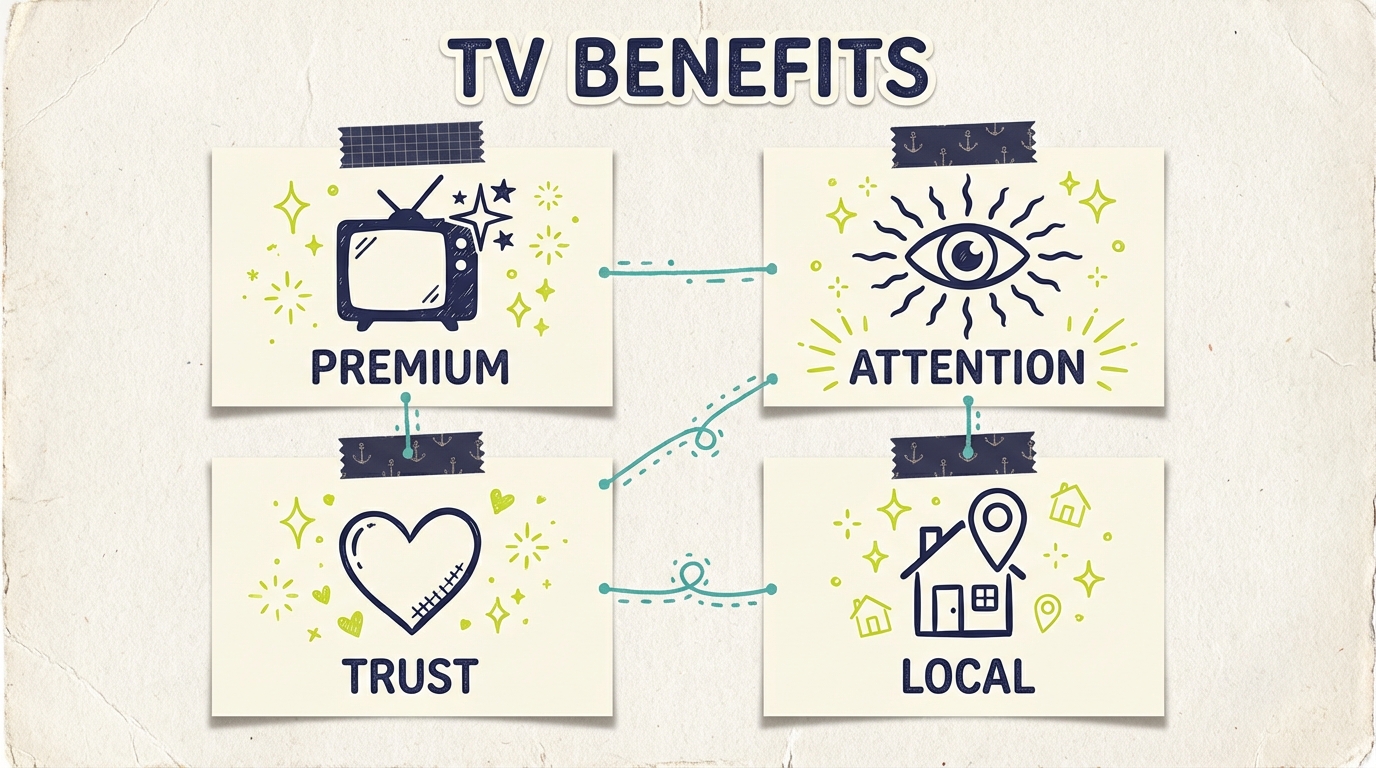
The Good:
- Premium placement. Your ad runs alongside major brands on networks like NBC, Hulu, ESPN, and Peacock
- High attention. 95%+ completion rates because viewers can't skip streaming ads
- Trust building. "As seen on TV" still carries weight with consumers
- Local targeting. Target specific zip codes, cities, or regions
- Amplifies other channels. People who've seen your TV ads convert better on Google and Facebook
- Unskippable. Unlike YouTube pre-roll, most CTV ads play to completion
The Challenges:
- Less direct response. TV builds awareness; conversions often happen later through other channels
- Longer attribution. Harder to trace "this TV ad caused this purchase"
- Creative requirements. You need video (though AI tools now create this automatically)
- Perception barrier. Many business owners still think TV is only for big brands
Typical Costs:
- CPM: $15-35 for most small business campaigns (average $25)
- Minimum spend: As low as $50 on platforms like Adwave
- No production costs: AI-generated commercials from your existing assets
When TV Ads Make Sense:
- You want to build local brand recognition
- Your business benefits from trust and credibility
- You're running Google/Facebook and want to amplify their effectiveness
- You want to reach customers before they start searching
The Comparison Table
Here's how the three channels stack up across key factors:
Which Should You Choose?
The right answer depends on your specific situation. Here's a simple decision framework:
If you need leads immediately: Start with Google Ads. You'll capture people actively searching for what you sell. Pair with a solid landing page and track conversions carefully.
If you have visual products: Facebook and TV both work well. Facebook for demand generation and retargeting, TV for broader awareness and credibility.
If you need local awareness: TV advertising is your best bet for reaching people in a specific geographic area who don't know you exist yet. Pair with Google Local Services ads to capture the searches TV generates.
If you want to build a lasting brand: TV is the answer. There's a reason major brands have used television for decades. The "I've seen them on TV" factor builds trust that compounds over time.
The smart answer: Diversify. Each channel has different strengths. Relying on just one leaves gaps in your marketing.
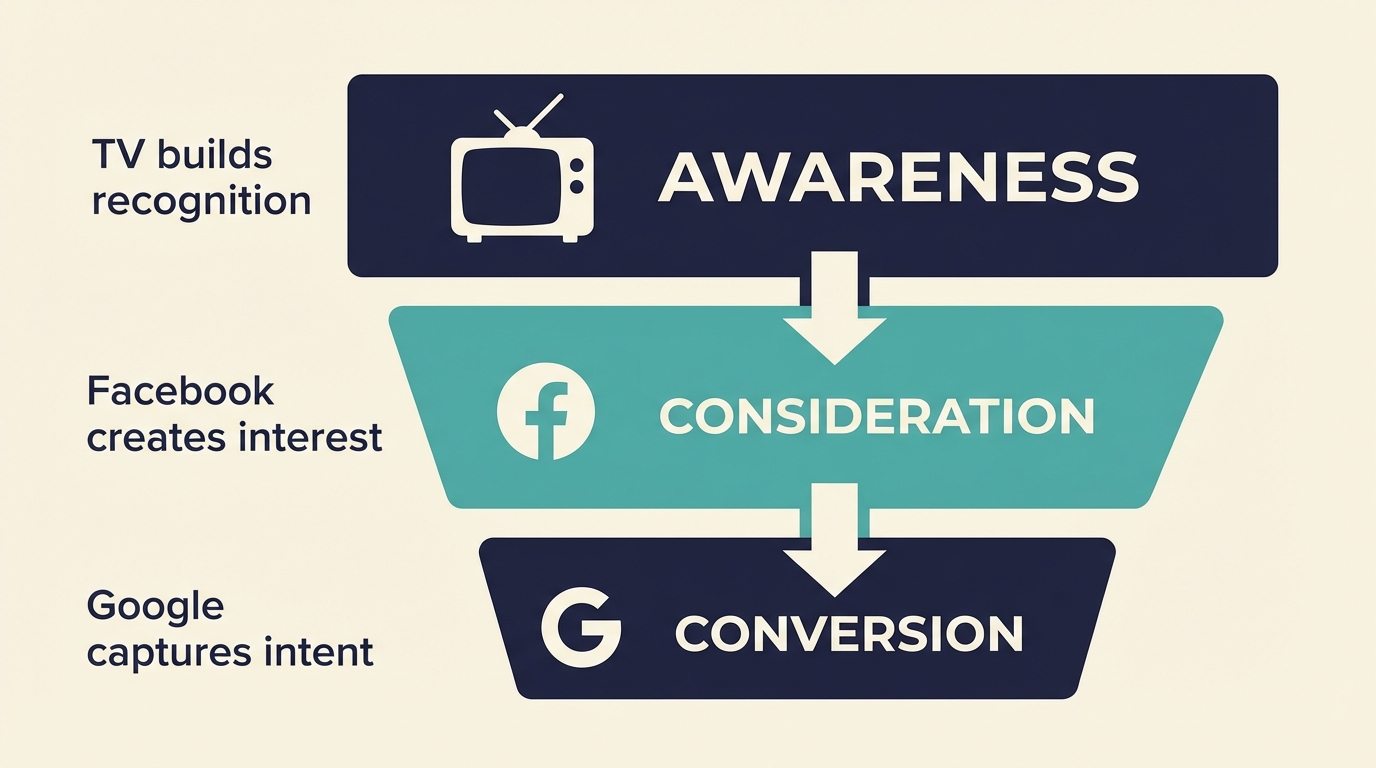
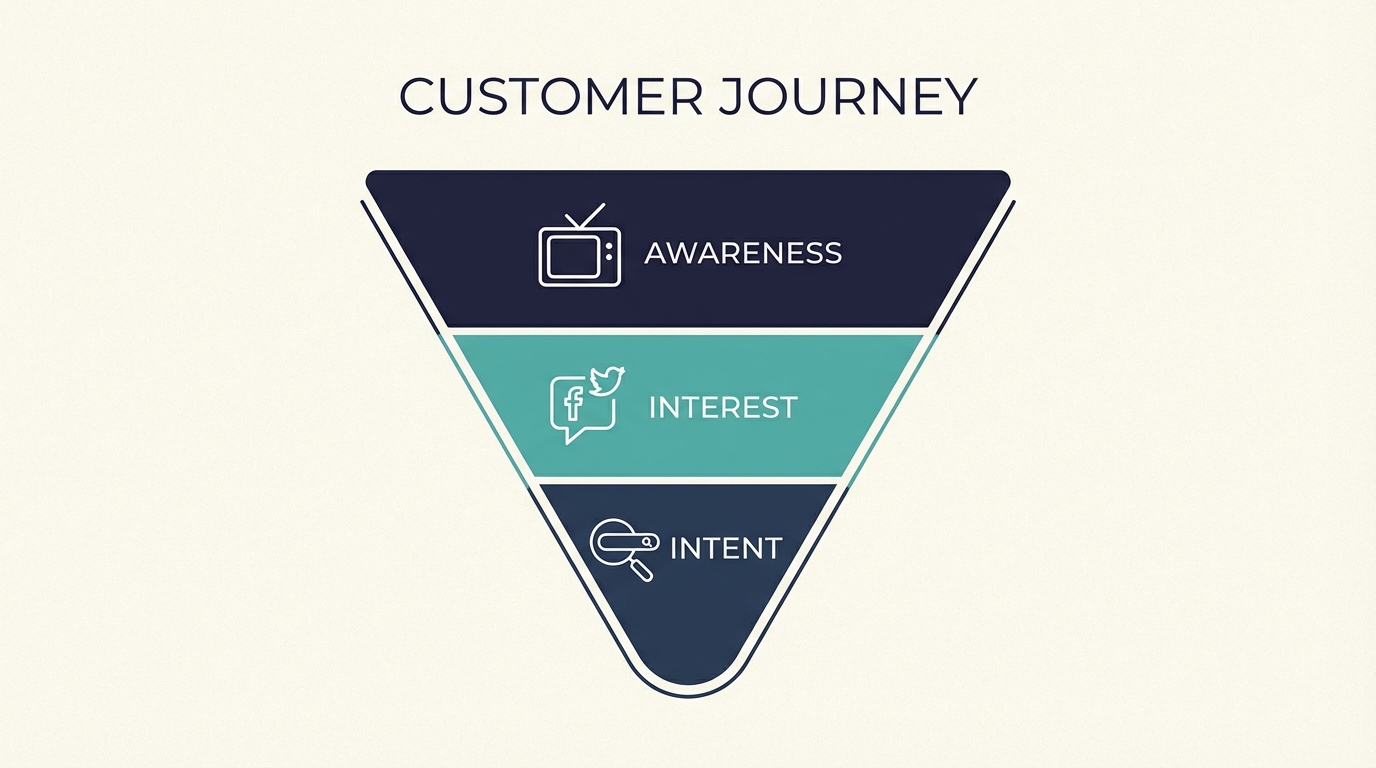
The Full-Funnel Approach
Here's how sophisticated small businesses combine all three channels:
Top of funnel (Awareness): TV Advertising
Run streaming TV ads to introduce your brand to potential customers. They may not need you today, but when they do, they'll remember seeing you. This creates the warm audience that converts better everywhere else.
Middle of funnel (Consideration): Facebook/Instagram
Retarget people who visited your website or engaged with your brand. Serve ads that build on the awareness TV created, showcasing products, testimonials, and offers.
Bottom of funnel (Conversion): Google Ads
Capture the searches that your awareness efforts generate. When someone who's seen your TV ad Googles your category, you're there to convert them.
Why this works:
The research is clear: TV exposure increases the effectiveness of digital advertising. People who've seen a brand on TV are more likely to click ads, more likely to trust the business, and more likely to convert. Your TV advertising ROI shows up partly in your Google and Facebook results.
Budget Allocation Examples
Here's how different budget levels might be allocated across channels:
$500/month Budget:
- Google Ads: $300 (60%) - Focus on high-intent keywords
- TV Ads: $100 (20%) - 2-week awareness burst in local area
- Facebook: $100 (20%) - Retargeting only
At this level, concentrate on one or two channels. Use TV for a short awareness burst, then capture intent with Google.
$1,000/month Budget:
- Google Ads: $400 (40%) - Capture intent
- TV Ads: $300 (30%) - Consistent local awareness
- Facebook: $300 (30%) - Prospecting + retargeting
With $1,000, you can maintain presence across all three channels consistently.
$2,500/month Budget:
- TV Ads: $750 (30%) - Broad local awareness
- Google Ads: $1,000 (40%) - Comprehensive keyword coverage
- Facebook: $750 (30%) - Full prospecting and retargeting
At this level, you can run full campaigns on each platform with proper testing and optimization.
These aren't rigid rules. Your specific business, industry, and goals should guide allocation. The key is recognizing that diversification reduces risk and captures customers at every stage.
The Bottom Line
Comparing Google Ads vs Facebook Ads is the wrong frame. Each advertising channel serves a different purpose:
- Google captures people ready to buy
- Facebook creates interest in people who might buy
- TV builds awareness and trust that makes everything else work better
Most small businesses start with Google or Facebook because that's what they know. But adding TV advertising to the mix, especially now that you can start with just $50, creates a more complete marketing strategy.
The businesses that grow fastest aren't the ones that master one channel. They're the ones that build presence across the entire customer journey.
Ready to Add TV to Your Marketing Mix?
You can test TV advertising for the same cost as a few clicks on Google Ads. Adwave creates professional commercials from your website and existing assets, then runs them on 100+ premium channels in your target area.
Create your first TV ad and see what your brand looks like on the big screen. The $50 minimum means you can test TV without committing to a major budget shift.
Version history
| Version | When | Summary |
|---|---|---|
| v1 | 6/20/2026, 3:11:54 AM | migration import |